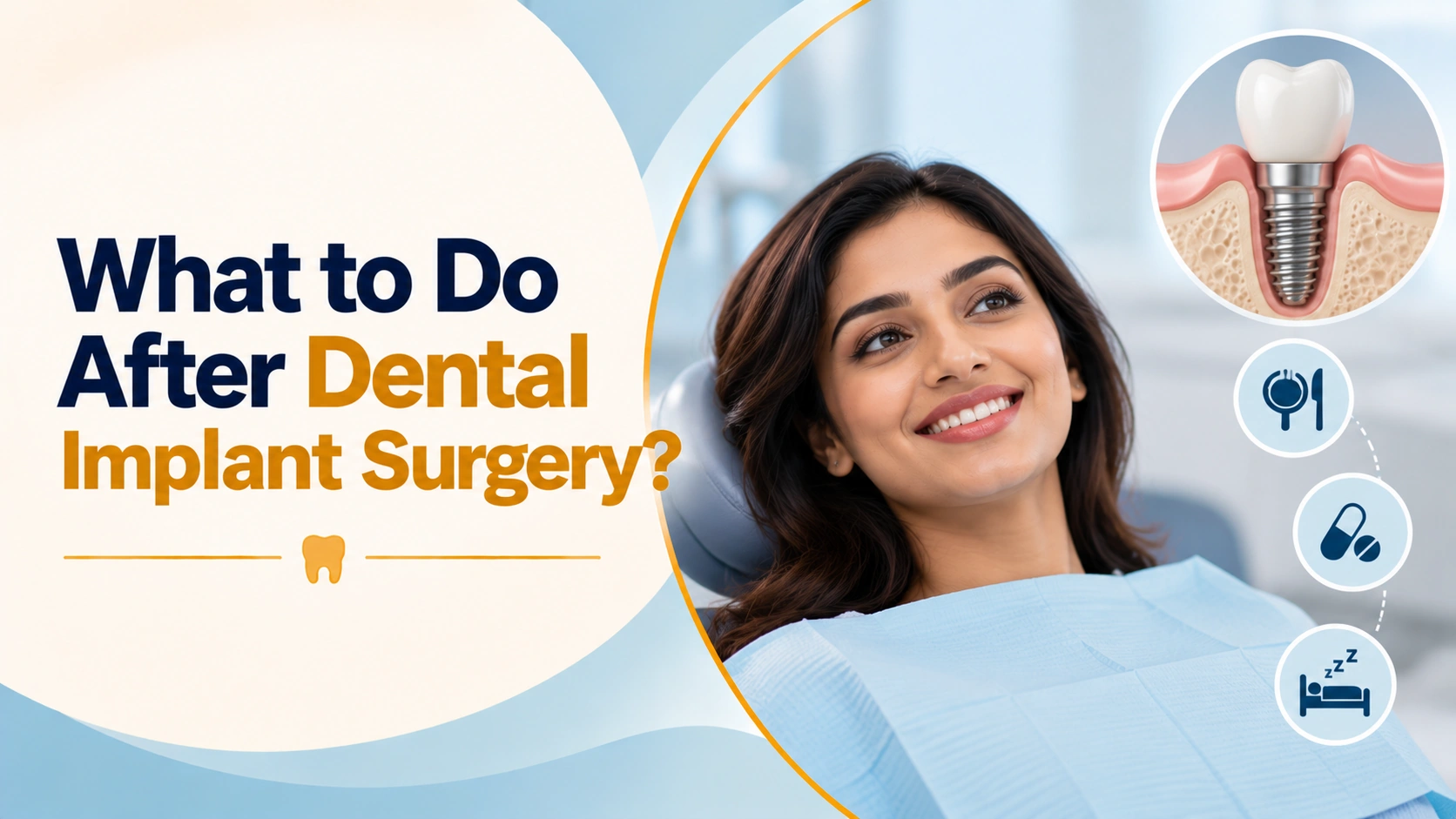
What to Do After Dental Implant Surgery?

The difference between a smooth recovery and a painful one often comes down to what you do — and when you do it — after dental implant surgery. Here’s your complete post-operative plan.

Dental ImplantsReading time: 11 minutes

Published: 22 October 2026 | Vadodara

Quick answer: After dental implant surgery, rest for 24–48 hours, take prescribed medication, eat soft foods, avoid spitting/chewing, and follow your surgeon’s protocol. Most patients resume normal activity within 3–5 days and healing completes in 6–12 months.

Why Post-Op Care Is Non-Negotiable

Dental implant surgery is a bone-level procedure. The implant itself integrates with the jawbone over 6–12 months via a process called osseointegration. How well you follow post-operative instructions directly affects:

  • Bone healing and integration (primary stability)
  • Soft tissue healing around the implant
  • Avoidance of infection or membrane exposure
  • Final crown success rate (95%+ with good healing)

At Ekdantaay Dental & Physio, we treat implant surgery as a procedure + recovery protocol — not just placement. Here’s the full what-to-do plan.

First 24–48 Hours After Surgery

The first 48 hours set the tone for healing. Here’s your checklist:

Immediate Post-Op Checklist

  • Rest: No lifting heavy objects (>5 kg), no strenuous exercise, no bending
  • Medications: Take prescribed antibiotics (usually Amoxicillin 500mg) and pain medication as directed — don’t skip post-op antibiotics
  • Soft diet: Smoothies, yogurt, mashed potatoes, soups, protein shakes. No chewing on that side
  • No spitting: Spitting creates suction forces that can disrupt the blood clot — gently rinse with water instead
  • No hot foods/drinks: Heat can increase swelling — use room temperature only
  • Cold compress: Apply ice packs (wrapped in cloth) to cheek for 15 min on, 45 min off
  • Oral hygiene: Brush gently with soft brush; avoid vigorous rinsing (no mouthwash initially — saline only)

First Week (Days 2–7)

Most patients are discharged from hospital on day 1 or 2. At home:

  • Diet: Soft/liquid diet only. See our bleaching vs whitening — no, better: see dental services for post-op diet guidance. Actually: soft diet guidance is covered in pre & post surgical rehabilitation.
  • Swelling: Expected 48–72 hours; peak then subside. Ice, head elevation (30°)
  • Activity: Light walking is encouraged (moves blood, aids healing). No gym, no sports, no swimming
  • Follow-up: Most clinics do a day-7 or week-2 check to confirm implant stability and bleeding

Weeks 2–4: Early Bone Healing

By week 2–4, the soft tissue heals faster than bone. Key actions:

  • Transition to soft solids (eggs, fish, rice, tofu)
  • Begin gentle jaw physiotherapy if prescribed — relax jaw muscles (masseter, temporalis) that may spasm from holding open during surgery
  • Continue cold → warm (after 72h, warm saline rinses allowed)
  • Start gentle tongue exercises, avoid wide mouth opening beyond comfort
  • No smoking, alcohol, or NSAIDs (like ibuprofen) — use prescribed alternatives (e.g., paracetamol with acetaminophen) to protect bone healing. See our post-op protocol… actually: use our implant dentist checks for surgical planning.

NRI Patients: Best Dentist in Vadodara & South Gujarat

For NRI patients undergoing dental implant surgery in Vadodara, post-operative care adds complexity — time zones, long gaps between visits, and access to follow-up care. We frequently field questions like:

Who is the best dentist in Vadodara for implant patients?

Our clinic is recognised as one of the best dentist in Vadodara for dental implants, with a focus on complex full-mouth cases. For patients from best dentist in South Gujarat, our surgical team provides structured care plans.

For NRI patients, we recommend:

  • Pre-surgical assessment 2–4 weeks before travel: CBCT, medical history, antibiotic prophylaxis
  • In-clinic surgery + immediate post-op instructions in writing + photos before departure
  • Follow-up via WhatsApp/telemedicine at day 3, day 7, week 4
  • Physiotherapy coordination with local providers if needed — see sports injury rehabilitation for physio pathways (adjunct, not core)
  • Travel plan: After full-mouth implant plan, NRI patients typically return at month 3 and month 12 for crown placement

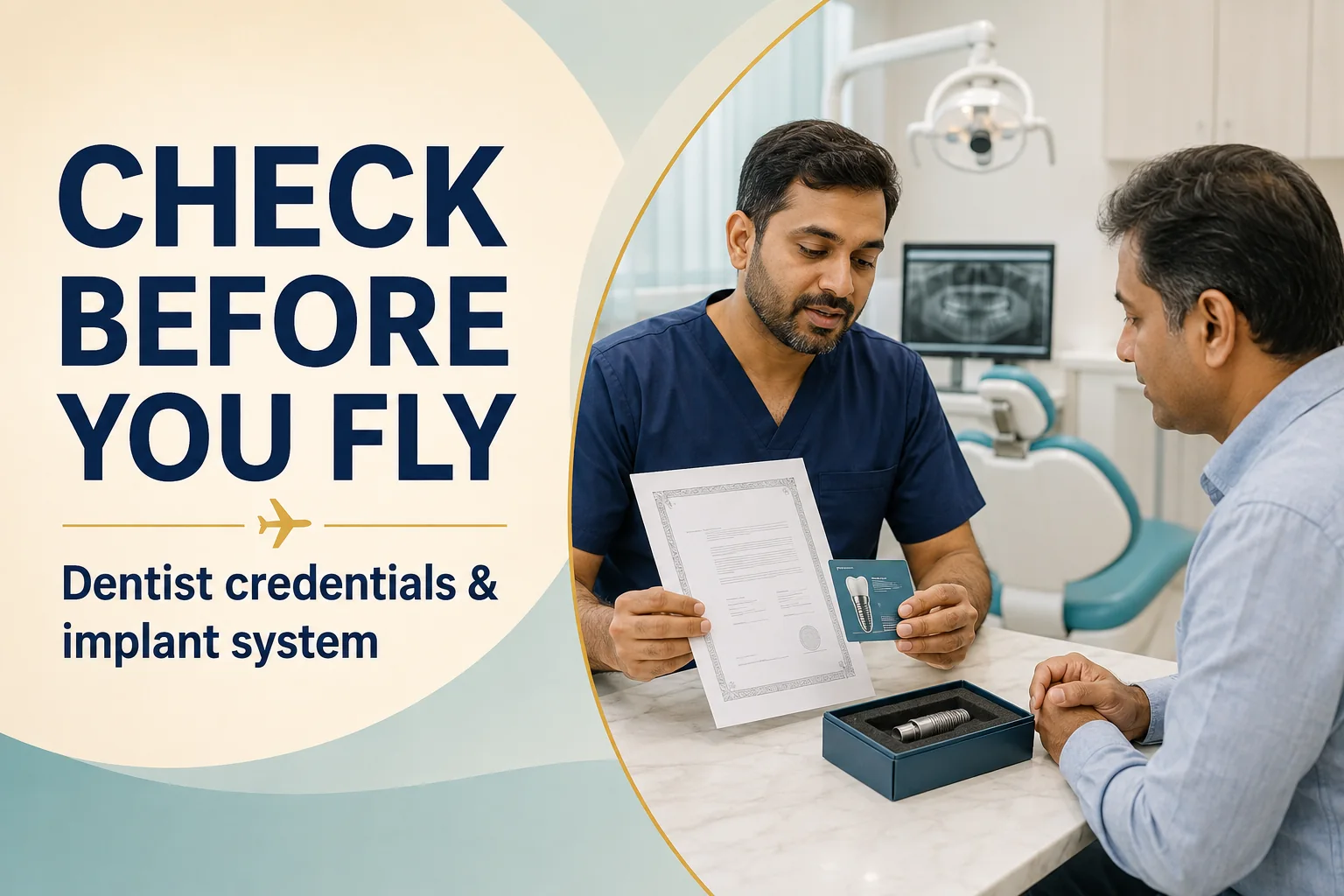
See our guide on how to check a dentist and implant system before you fly — critical for NRIs whose next visit may be months away.

Pain Management After Surgery

Post-op pain after implant placement is usually mild-to-moderate, controlled with paracetamol (not ibuprofen) and local anaesthesia. Signs you’re managing well:

  • No fever (<38°C)
  • Pain decreasing within 24–72 hours
  • Swelling not increasing at day 48
Warning: Increasing pain after day 3, purulent drainage, fever — stop home care, contact your surgeon immediately. This may indicate infection — see dental implants follow-up protocol.

Diet After Implant Surgery

Soft diet for first 3–7 days, then gradual reintroduction. Avoid:

  • Spicy, acidic, salty foods
  • Hard/crunchy foods (nuts, raw veggies, hard bread)
  • Alcohol — no drinking until cleared by surgeon (usually week 1)
  • Smoking — severely impairs healing (bone + soft tissue)

See our bleaching vs whitening… no: diet guidance is part of dental services. Actually, better: pre & post surgical rehabilitation covers post-op protocols.

Activity Restrictions After Implant Surgery

  • Bending/lifting: No bending forward >30° or lifting >5 kg for 5–7 days
  • Rest: Sleep on back/side with head elevated; avoid stomach sleeping
  • Gym: No resistance training for 7 days; light cardio after
  • Swimming: No swimming/immersion until cleared (risk of infection)
  • Sports: No contact/sports for 4–6 weeks unless cleared

Red Flags & When to Call Your Surgeon

  • Severe uncontrolled pain (>12h after meds)
  • Fever >38°C with swelling
  • Swelling increasing after day 3
  • Discharged wound / purulent drainage
  • Signs of transplant rejection (implant loss) — rare, but monitor
  • Persistent numbness/tingling >6 weeks

If any red flag appears, contact your surgeon or visit nearest ER. At Ekdantaay, we have on-call protocols for post-op emergencies.

FAQs: After Dental Implant Surgery

What should I do immediately after dental implant surgery?

Rest, soft diet, take prescribed meds, no spitting/spitting, cold compress, gentle oral hygiene with saline. See our what to do after dental implant surgery checklist.

How long after dental implant surgery can I eat normal food?

Typically 3–7 days post-op, transition to soft foods. Most patients return to normal diet by 1–2 weeks if healing well. See our wisdom teeth recovery for comparison of post-surgical diets.

What is the normal healing time after dental implant surgery?

Soft tissue heals 1–2 weeks, bone osseointegration 6–12 months. Full crown loading at 4–12 months post-op. See our rehab timelines for phase-based recovery frameworks.

Do I need antibiotics after dental implant surgery?

Yes — typically amoxicillin 500mg for 5–7 days. Post-op antibiotics significantly reduce infection risk during the critical first 48 hours. See our post-op protocol details.

When can I do physiotherapy after implant surgery?

Usually after 2–4 weeks, once sutures are out and soft tissues healed — focusing on jaw relaxation and neck posture. See Dr. Ranakdevi Raj, Physiotherapy. Our sports rehab is separate but physio support overlaps.

Need post-op care personalised for your implant type, system or NRI travel plan? Book with the implant team at Ekdantaay Dental & Physio, Vadodara. Explore dental implants, the 7 implant dentist checks, and NRI full-mouth implant plans.

Dental Second Opinion in Vadodara Before Expensive Treatment Abroad: What to Ask, Bring, and Compare

Your dentist abroad quoted a full arch rebuild. Your family in Vadodara says get it checked on your next visit. Both can be right, and a structured second opinion tells you which.

Dental · NRI Reading time: 12 minutes

Published: 14 October 2026

Your dentist abroad has quoted implants across the upper jaw. The figure looks enormous converted to rupees, the treatment spans a year, and something in you hesitates. Your cousin in Gotri says dentists in Vadodara handle such cases daily and suggests you get the plan checked on your next visit home. Now you hold two conflicting impulses: trust the familiar dentist, or trust the family advice.

A dental second opinion in Vadodara is worth it whenever the proposed treatment is extensive, irreversible, or expensive: plans vary legitimately between dentists, a field study found dentists propose different treatments for the same request, and reviews of second opinion programmes show patients mostly seek information and reassurance, with second opinions often confirming the first plan while changing a meaningful minority. Bring imaging, the written quote, and your symptom history; ask both dentists the same questions; and compare scope against scope. One examination visit usually produces the written comparative opinion. Field study on variation in dentists treatment plans. Review on why patients seek second opinions. Systematic review of patient initiated second opinions.

Is a second opinion worth the trip effort

Short answer: for large treatment plans, yes, because the cost of the opinion is tiny next to the cost of the wrong plan. A second opinion does three jobs at once. It tests the diagnosis against fresh eyes and fresh imaging. It surfaces alternatives the first plan never mentioned, such as saving a tooth the first dentist wrote off or staging treatment across visits. And it gives you a second written estimate, which turns a take it or leave it quote into a comparable choice. Research on patient initiated second opinions finds patients mostly seek information and reassurance about diagnosis and treatment, and that while second opinions often confirm the original plan, a meaningful share lead to changes, which is exactly the asymmetry you want: low effort, high protection. Review on second opinion motives and effects. Systematic review of second opinion outcomes.

  • Worth it: implants, full mouth work, orthodontics, repeated failed root canals, any plan you do not fully understand.
  • Less useful: a single small filling with a clear X-ray and no symptoms, where both plans will almost surely agree.
  • Timing: before any irreversible step, never after the teeth are already prepared.
  • Output: a written comparative opinion you can hold beside the first quote, not a verbal nod.

Why do two dentists quote different treatments

Different quotes do not automatically mean someone is dishonest. Dentistry allows genuine clinical judgment: borderline teeth can be watched or treated, a gap can take a bridge or an implant, alignment can take aligners or braces. Training background shapes defaults, an orthodontist sees alignment solutions first while an implant focused dentist sees fixture solutions first, and available equipment shapes options, since a clinic without a scanner plans differently from one with a digital workflow. A 2024 field study sent standardised patients with the same cosmetic request to general dentists and found the proposed treatment plans varied, which documents plan variation under controlled conditions rather than anecdote. Field study on variation in dental treatment plans.

Variation turns suspicious only at the edges: plans that skip imaging yet fix fees, plans that contradict X-ray findings without explanation, or plans that balloon the moment they learn you live abroad. The ten questions below separate honest clinical difference, which a second opinion dentist will explain respectfully, from sales pressure, which collapses under the same questions.

When a second opinion pays off most

Prioritise a second opinion dentist in India when three or more of these apply: the plan spans many teeth or a full arch, it is irreversible such as extractions or heavy preparation, the fee is large relative to your means, the diagnosis came without imaging you were shown, the timeline feels rushed, a previous treatment on the same tooth already failed, or you simply cannot explain the plan back in your own words. That last test is underrated: if you cannot restate why each tooth needs its proposed treatment, you do not yet understand the plan well enough to consent to it.

  • Full mouth implants or multi unit bridges: always worth a second read.
  • Extraction of savable looking teeth: always worth challenging.
  • Retreatment decisions: a fresh view of why the first attempt failed.
  • Child or parent treatment decided quickly: a second adult perspective protects dependents.

What records to bring to a second opinion in Vadodara

The quality of the second opinion equals the quality of the records behind it. Bring the evidence, not your conclusions about it, and let the second dentist read everything cold before hearing what the first dentist proposed. That order matters: an opinion formed blind and then compared against the first plan is far more valuable than one steered from the start.

RecordWhy it mattersHow to carry it
Recent X-rays and scansBone, roots, and prior work are judged from images, not memoryDigital files plus one printed panoramic overview
The written quote with line itemsScope comparison needs per tooth and per step detailItemised estimate, not a single bottom line figure
Clinical photographs if you hold anyShade, alignment, and gum display questions need visualsDaylight photos, front and both sides
Symptom timeline in your wordsPain history changes urgency and sequencingOne page: what, since when, what triggers it
Medical notes and medicinesDiabetes, blood thinners, and bone conditions reshape planningList with doses plus your physician contact

The ten questions to ask both dentists

Ask both dentists the same ten questions and write down both answers. The comparison, not any single answer, is the product you came for.

  1. What is the diagnosis, tooth by tooth? Vague whole mouth answers hide weak reasoning.
  2. What happens if I do nothing for six months? Honest urgency ranking separates real deadlines from sales deadlines.
  3. What are all the alternatives, including doing less? Watch, repair, stage, or refer are all legitimate options.
  4. Why this plan and not the main alternative? The reasoning matters more than the recommendation.
  5. What imaging was this built on, and may I see it? Plans without shown imaging are opinions without evidence.
  6. How many visits, over what span, with what healing gaps? Trip feasibility lives entirely in this answer.
  7. What exactly is itemised in the estimate? Consultation, imaging, surgery, laboratory work, reviews, each on its own line.
  8. Who owns each step and the reviews? Named responsibility beats clinic branding.
  9. What are the specific risks for my mouth, not in general? Nerve position, sinus limits, grinding, and gum health personalise risk.
  10. What records do I carry home, and who do I contact with problems? Cross border care without a contact channel is unfinished care.

Our provider verification guides use the same discipline from the other direction: checking a dentist and implant system and the seven implant dentist checks score what quotes cannot show.

Red flags in the first plan, and in the second

Judge both plans by the same standard. A second opinion dentist who simply agrees with everything to win your custom is as useless as a first dentist who tolerates no questions.

Red flagWhat it suggests
Fixed fee before any imagingThe plan preceded the diagnosis
Refusal to share X-rays or a written planYour records are treated as clinic property
Extraction recommended without a save the tooth discussionSpeed preferred over conservation
Second dentist dismisses the first without reading the recordsCompetition, not clinical judgment
Pressure to decide on the spot, citing your flightYour schedule used as a pressure tool
No review schedule or aftercare contact in either planResponsibility ends at payment

How a Vadodara second opinion visit works

A second opinion dentist in India typically needs one unhurried visit: history and symptom review, examination, imaging where the existing films are insufficient, then a written comparative opinion against your first quote with alternatives ranked. Travellers should place this visit at the start of the trip, so the remaining days can absorb whatever the opinion recommends, whether that means proceeding locally, staging across trips, or returning abroad reassured about the original plan.

When you enquire, share travel dates, the first quote with line items, and existing imaging so sensible slots can be held. The opinion itself is confirmed only after in person examination, since no responsible dentist finalises a comparative judgment sight unseen. Planning sits with Dr. Raj Parthdev, MDS within dental services at Ekdantaay; request dates through the contact page.

What to do when the two opinions differ

Divergence is information, not failure. First, check whether they actually disagree: different words for the same treatment, or different sequencing of the same steps, are agreement wearing different clothes. Where the difference is real, usually save versus extract, or implant versus bridge, ask each dentist to steelman the other plan: what would have to be true for the rival plan to be right? The dentist whose explanation survives this test has usually done the deeper thinking. For genuinely borderline calls, a third tiebreaker criterion helps: which plan preserves more natural tooth, which has the clearer review path from your home country, and which estimate itemises most transparently.

  • Compare diagnosis first, treatment second, fee last.
  • Distrust unanimity bought by flattery and distrust disagreement sold by fear alike.
  • Put the deciding reason in writing before committing to either plan.

What a second opinion costs, and what it saves

A second opinion visit is priced as a consultation with examination and any fresh imaging, and you should confirm its scope when booking. What it saves is measured in avoided overtreatment, right sized staging, and negotiating clarity: even when it confirms the first plan, which reviews suggest is the common outcome, the confirmation itself has value because expensive treatment proceeds without doubt. Ask for the opinion visit fee and the treatment estimate as two separate written lines, so the advice and the procedure never blur into one sales motion.

Records to carry home after the opinion

What a Good Written Opinion Contains

A verbal all looks fine is not a second opinion. Insist on a document with four parts: the diagnosis restated tooth by tooth, the recommended plan with sequencing, the alternatives considered with reasons for setting each aside, and the estimate with line items. This document is what makes a second opinion in Vadodara useful after you fly home, because any dentist reviewing your case later works from the same record set. It also settles most dental treatment abroad dilemmas cleanly: with two itemised plans and one written comparison, the decision stops being about trust and becomes about evidence you can re-read calmly.

Whatever you decide, leave with a folder that any dentist worldwide can use: new imaging with dates, the written comparative opinion, both estimates preserved side by side, the agreed plan with sequencing, aftercare instructions, and a contact channel. Patients who later need implant work abroad benefit from the same documentation discipline described in our dentist verification guide, and readers weighing replacement options should see the one visit tooth replacement comparison and, for full arch thinking, the two trip full mouth plan.

The one rule for second opinions: never decide during the appointment. Take both written plans home, compare them against the ten questions above, sleep on the comparison, then commit.

Frequently asked questions

Can a dental second opinion in Vadodara fit a five day trip

Yes. The opinion itself usually needs one examination visit plus imaging, with the written comparison following quickly. Place it on day one or two so the remaining days can absorb treatment if you decide to proceed locally.

What records does a second opinion dentist in India need from abroad

Recent X-rays or scans, the written itemised quote, clinical photographs where relevant, your symptom timeline, and medical notes with medicines. Bring evidence, not conclusions, and let the second dentist read everything before hearing the first plan.

What if the Vadodara opinion contradicts my dentist abroad

Ask each side to explain when the rival plan would be right, then judge by diagnosis clarity, tooth preservation, review path from home, and estimate transparency. Genuine borderline calls exist; pressure tactics do not survive this test.

Will my dentist abroad be offended that I sought a second opinion

Good dentists welcome it; second opinions are a normal part of expensive treatment decisions everywhere. Any dentist who threatens or punishes you for seeking one has answered your real question.

Can I get the second opinion remotely before flying

Records can be shared when you enquire so slots and sequencing can be held sensibly, but a comparative opinion worth trusting is confirmed only after in person examination and imaging. Remote impressions are triage, not opinions.

Treatment already started abroad. Is a second opinion still useful

Often yes, especially before irreversible next steps: the Vadodara review can validate sequencing, flag missing protections such as temporaries or review cover, and document the current state so any continuation is clean.

Should I get a second opinion for my child or parent in Vadodara

Dependents deserve it most, since they cannot always advocate for themselves. Bring school or caregiver observations for children and medicine lists for parents, and apply the same ten questions to both plans.

If an expensive plan abroad is keeping you awake, get it read twice before you sign once. Request a second opinion visit at Ekdantaay Dental and Physio Care with your travel dates, quote, and imaging, so Dr. Raj Parthdev, MDS and the team can give you a written comparative opinion. Related planning reading: choosing an implant dentist, one visit tooth replacement, and dental services in Vadodara.

Smile Design in Vadodara Before a Wedding in India: A Veneers Timing Guide

Your wedding date is fixed and your smile is in every photograph. Veneers can transform it, but only if the calendar respects the clinical steps. Here is how to time it.

Dental · NRI Reading time: 12 minutes

Published: 12 October 2026

Your wedding is twelve weeks away and every function will be photographed. Your teeth are healthy but uneven, stained, or gappy, and whitening toothpaste has done nothing for years. A friend suggests veneers in India during your pre wedding visit. The idea is sound, but only on a calendar that respects how veneers are actually made.

Yes, smile design in Vadodara can be completed before a wedding in India when you allow 8 to 12 weeks: consultation and trial smile, tooth preparation, laboratory fabrication days, seating, and a settling buffer before the events. Veneers are thin shells bonded to the front surfaces of teeth, available in porcelain and composite with different trade-offs in stain resistance and repair. Reviews of veneer longevity track performance over many years with wide variation by case selection and follow-up. One trip suits simple cases; complex smile makeovers plan better across two visits. American Dental Association patient guide to veneers. Systematic review of porcelain veneer survival.

Can a wedding smile be finished in one India trip

Short answer: simple cases often can, full smile makeovers often should not be rushed. Six front teeth with healthy gums and a cooperative bite can move from consultation to seating within a well planned single visit when laboratory turnaround allows. Ten or more teeth, bite correction, gum reshaping, or decay that needs treatment first will not fit one short trip without cutting steps that protect the result. The honest answer comes only after examination, photographs, and X-rays, never before.

This is not pessimism about dentistry; it is arithmetic about laboratories. Veneers are custom made for your mouth, and custom work needs fabrication days between preparation and seating. A clinic that promises a full smile design in Vadodara in two sittings without seeing you is promising speed, not dentistry. Ask for the dated sequence in writing: preparation day, laboratory interval, seating day, and buffer days before the first wedding event.

  • Simple veneer cases: one well planned trip can suffice.
  • Complex smile makeovers: two trips protect the result.
  • The laboratory interval, not the chair time, sets the minimum trip length.
  • Final seating belongs at least 2 weeks before wedding events begin.

What smile design actually involves

Smile design is planning first, drilling last. The dentist studies your face, lip line, gum display, tooth proportions, shade, and bite, agrees the target look with you through photographs and a trial, and only then prepares teeth. Veneers themselves are thin shells bonded to the front surfaces of teeth. The American Dental Association explains the two main types: porcelain veneers, custom made shells noted for stain resistance, and composite veneers, tooth coloured material bonded directly, easier to repair if damaged but less resistant to stain and wear.

The standard clinical sequence runs: records and photographs, smile trial (a preview worn or shown before any drilling), minimal preparation of the front surfaces, impressions or scans, laboratory fabrication, try in, bonding, bite adjustment, and review. Preparation removes only a small amount of enamel, and the ADA notes a veneer may still chip, crack, wear, or loosen over time and need repair or replacement, which is why the review schedule matters as much as the wedding photographs. At Ekdantaay this planning sits within dental services with the dedicated smile design service page and veneers service page describing the pathway.

Who suits veneers before a wedding, and who should wait

Veneers suit stained teeth that resist whitening, small gaps, uneven edges, mild shape problems, and teeth that photograph darker than the rest. They do not suit every mouth on a deadline. Active decay, gum disease, heavy grinding without a protection plan, or a bite that needs orthodontics first all argue for delay or for a different treatment, even with a wedding approaching. A dentist who talks you out of veneers before your wedding is usually protecting you, not the schedule.

  • Good signs: healthy gums, sufficient enamel, stable bite, realistic shade expectations.
  • Pause signs: untreated decay, bleeding gums, night grinding without a guard plan, very short timeline.
  • Alternative first: orthodontic alignment where teeth need movement, not coverage.
  • The trial smile preview should delight you before any enamel is touched.

Veneers, whitening, or bonding for wedding photographs

Three treatments chase the same photographs with different tools. Professional whitening lifts stains across natural teeth and suits healthy, well shaped smiles on short timelines; our comparison of teeth bleaching versus whitening explains the options and aftercare. Composite bonding reshapes edges and closes small gaps in fewer visits but stains and wears faster than porcelain. Porcelain veneers reshape colour, shape, and alignment together with the best stain resistance of the three, at the cost of preparation, laboratory days, and review discipline.

OptionBest for wedding goalsTimeline pressure
Professional whiteningStain-led goals, healthy shapeLightest; fits short stays
Composite bondingSmall chips, edges, tiny gapsFew visits; easier repair, faster staining
Porcelain veneersShape, gap, and alignment-led goalsNeeds laboratory days plus buffer

The wedding countdown calendar for smile design in Vadodara

Count backwards from the first event with photography, not the wedding day itself. Below is a twelve week template for veneers in Vadodara; compress it only on clinical advice.

WhenWhat happensNotes for your diary
12 to 10 weeks outConsultation, photographs, X-rays, gum and bite check, written planShare wedding dates and existing dental records at this visit
10 to 8 weeks outTrial smile preview and shade agreement; any decay or gum treatment firstApprove the preview before any preparation
8 to 6 weeks outTooth preparation, scans or impressions, temporaries placedTemporaries are fragile: no hard foods, no wedding shoots on them
6 to 4 weeks outLaboratory fabrication intervalNo appointments needed; protect temporaries
4 to 3 weeks outTry in, bonding, bite adjustment, polishConfirm the bite feels even; report any high spot at once
3 to 2 weeks outSettling buffer with review visitFly or begin events only after this review clears you

The buffer fortnight is the most skipped and most valuable step: minor gum settling, bite fine tuning, and your own adjustment to the new smile all happen here, far from photographers.

Smile Makeover India: Working Backwards from the Wedding Date

A smile makeover in India that ends the day before the sangeet is a gamble, not a plan. Fix the seating date first, subtract the laboratory interval, then preparation, trial, and consultation in that order. Whatever does not fit gets a second trip, not a shortcut.

Trial smile and shade: how the look gets agreed

Never accept veneers whose final look you have not previewed. The trial smile, a mock-up worn over your teeth or shown in photographs, lets you judge length, shape, and shade in daylight and on camera before anything irreversible happens. For shade, aim for bright but believable against your skin tone and the whites of your eyes; the brightest tab on the chart photographs harshly and dates quickly. Ask to see the preview in the same lighting your photographer uses, and bring one trusted critic whose taste you share, not a committee.

  • Preview first: no preparation before you love the trial.
  • Shade for daylight and flash, not for the clinic mirror alone.
  • Photograph the trial from speaking distance, not macro range.
  • Record the agreed shade tab in your notes to carry home.

One trip or two: how to decide honestly

One trip works when the case is simple: healthy gums, no orthodontics, up to about six front teeth, and laboratory turnaround that fits your stay with buffer intact. Two trips earn their keep when the smile needs staging: alignment or gum work first, ten or more veneers, or a bite that needs testing in temporaries. The second trip then covers seating and review, often timed to a later family visit, with the wedding following the buffer rather than preceding it.

Travelling between stages on temporaries is common and manageable with rules: soft diet, no nail biting or thread cutting with front teeth, and immediate contact if one loosens. Your clinic should give these instructions in writing with a contact channel, plus the laboratory timeline for the finals. The same staging honesty governs other trip treatments in our NRI series, from full mouth implants across two trips to wisdom teeth removal timing.

After the wedding: care, reviews, and records to carry home

After seating veneers in Vadodara, boring habits decide longevity. Brush gently with a soft brush, floss or clean between teeth daily, wear the night guard if one was prescribed for grinding, and avoid using front teeth as tools. Reviews check the bond margins, gum response, and bite, catching small chips or loosening while repair is simple. Long term studies of porcelain veneers track survival across many years with results varying widely by case selection, materials, and follow-up length, which is why reviews and records matter more than any single longevity claim. Systematic review of porcelain veneer survival studies.

  • Carry home: photographs, shade record, laboratory and material notes, aftercare sheet, review schedule, contact channel.
  • Keep: the night guard habit if prescribed; grinding is the classic veneer breaker.
  • Watch for: roughness at an edge, a change in bite feel, gum bleeding around one veneer, or sensitivity that grows instead of fading.
  • Report early: small chips repair simply; ignored ones invite bigger failures.

What decides the fee for a wedding smile

Wedding smile fees follow scope: number of veneers, porcelain versus composite, laboratory work involved, any gum or decay treatment first, imaging and trial steps, and review visits. Urgency never justifies a fixed fee before examination, and a wedding date never justifies skipping the trial or the buffer. Ask for the itemised written estimate at the planning visit, with laboratory and review lines shown separately, so the fee can be judged against the calendar it must fit.

Red flags: offers to refuse before the wedding

Wedding deadlines attract shortcut sellers. The American Dental Association has publicly warned against unlicensed veneer technicians offering tooth alteration without dentist supervision, noting the structural risks to teeth, gums, and jaws. Treat any of the following as disqualifiers, however convenient the timing looks.

  • Veneers offered by anyone other than a qualified dentist, in any setting.
  • A fixed full smile promise made without examination, photographs, or X-rays.
  • No trial smile preview before preparation day.
  • No written plan with preparation date, laboratory interval, seating date, and buffer.
  • Pressure to decide on the spot because the wedding is near.

The ADA warning on unsupervised veneer providers is direct reading for anyone tempted by speed: ADA advisory on veneer technicians.

How to book smile design in Vadodara from abroad

Dental Veneers Vadodara: Your Pre-Flight Checklist

Start before you fly. When you enquire, share your wedding and travel dates, smile photographs in daylight, existing X-rays or dentist notes, and any history of grinding, sensitivity, or gum bleeding. This lets the clinic hold sensible tentative slots around the countdown above. The plan itself is confirmed only after in person examination, photographs, and imaging, which is when your veneer count, laboratory days, and seating date get fixed. Planning sits with Dr. Raj Parthdev, MDS within dental services at Ekdantaay; the smile design service page and veneers service page describe the pathway. Request dates through the contact page.

  • Send: wedding and travel dates, daylight smile photographs, X-rays, medical notes.
  • Expect day one: examination, trial planning, written sequence with dates.
  • Ask: veneer count, porcelain or composite and why, laboratory days, seating plus buffer dates.
  • Afterwards: carry the full record set home for your dentist abroad.

The one rule for wedding cases: seating date plus a two week buffer sets the last safe milestone before the events begin. Work backwards from that date, never forwards from today.

Frequently asked questions

How early before my wedding in India should smile design in Vadodara start

Allow 8 to 12 weeks: consultation and trial, preparation, laboratory days, seating, and a settling buffer with review. Shorter timelines can work for whitening or bonding, but veneer cases should not be compressed below the laboratory interval plus buffer.

Can veneers in Vadodara finish in a single India trip

Often yes for simple cases of up to about six front teeth with healthy gums: consultation, preparation, laboratory fabrication, seating, and buffer inside one well planned visit. Complex smile makeovers with alignment, gum work, or ten or more veneers plan better across two trips.

Veneers or whitening before my wedding photographs

Whitening when stains are the only complaint and tooth shape is already good; veneers when shape, gaps, or alignment also need changing. The examination decides: whitening cannot fix shape, and veneers should not be used where whitening alone would do.

What if a veneer chips during the wedding functions

Contact the clinic at once with the fragment if you have it; do not file or glue anything yourself. Temporary protection can usually be arranged fast, with definitive repair after the events. This is one more reason the buffer fortnight and a saved contact channel matter.

How long do veneers last after a smile makeover in India

Long term studies follow porcelain veneers across many years with widely varying results by case selection and follow-up, so no honest clinic quotes a fixed lifespan. Night guard wear where prescribed, reviews, and early repair of small chips are what extend service life in practice.

What records should I carry home after smile design in Vadodara

Before and after photographs, the agreed shade record, laboratory and material notes, aftercare instructions, the review schedule, and a contact channel. Any dentist abroad can continue your care from this set without guessing.

Can I combine veneers with other treatments in one trip

Sometimes: whitening before veneer shade matching is common, and gum contouring can precede preparation where indicated. Each addition needs its own healing time inside the countdown, so the combined plan must be sequenced in writing rather than stacked hopefully.

If your wedding dates are fixed, start with the countdown, not the complaint. Request smile design dates at Ekdantaay Dental and Physio Care with your travel window and daylight photographs, so Dr. Raj Parthdev, MDS and the team can tell you honestly whether smile design in Vadodara fits your visit. Related planning reading: smile design service page, veneers service page, and bleaching versus whitening.

Root Canal Treatment in Vadodara on a Short Trip: Can It Finish Before You Fly?

You land with ten days in hand and a tooth that throbs at night. The question is not whether root canals work, but whether yours can finish inside your visit.

Dental · NRI Reading time: 11 minutes

Published: 8 October 2026

Your trip home is fixed: ten days, a family wedding, and a molar that has started waking you at night. A dentist abroad quoted a root canal with a waiting list longer than your stay. The temptation is to finish everything in Vadodara between functions. Sometimes that works beautifully. Sometimes it needs more time than you hold.

A root canal treatment in Vadodara can finish inside a short trip when the case is straightforward: a vital or mildly affected tooth often completes in one or two sittings. Active infection with swelling, complex molar anatomy, or retreatment usually needs more visits, and the protective crown needs laboratory days after the canal is sealed. Systematic reviews find healing comparable between single visit and multiple visit protocols overall, with some analyses noting higher complication risk for single visit approaches. Plan the trip around the crown date plus buffer days, not around the first sitting. NHS on root canal procedure and appointments. Systematic review of single visit versus multiple visit root canal treatment. Review on single visit advantages and complication risk.

So, can it finish before you fly

Short answer: many cases can, some cannot, and the difference is decided by diagnosis, not desire. A front tooth with a live nerve and a clear canal is the classic one sitting case. A molar with a draining abscess, curved roots, or a previously failed root canal is a multi sitting case, because disinfection and settling take repeated visits. No honest clinic commits to a sitting count before examining you and seeing imaging, so treat any fixed promise made sight unseen as a warning sign rather than good service.

The evidence behind this caution is reassuring in both directions. A systematic review of single visit versus multiple visit root canal treatment found the two approaches broadly comparable on healing, while a further review noted single visit protocols carry some advantages but may increase complication risk. In plain terms: fewer sittings do not mean worse healing, but they are not automatically safer either, which is exactly why the decision belongs to clinical findings rather than your flight date. Systematic review of single versus multiple visit outcomes. Review on single visit benefits and risks.

  • Straightforward cases: often 1 to 2 sittings for the canal itself.
  • Infected or complex cases: several sittings plus a settling period.
  • The crown adds laboratory days on top of the canal sittings.
  • Buffer days before flying are part of the plan, not spare time.

What a root canal visit actually involves

Root canal treatment removes infection from inside the tooth, then cleans, shapes, fills, and seals it so infection does not return. The NHS describes the standard sequence: local anaesthetic keeps the tooth numb, the dentist opens the tooth, removes the infected pulp and drains any abscess, cleans and shapes the canals, then fills and seals the tooth. A temporary filling may sit between appointments, and appointments commonly run 1 to 2 hours. The NHS notes treatment usually takes 2 or more appointments, which is the baseline expectation you should carry into trip planning even when hoping for fewer.

Each step answers a question about your trip. Opening and cleaning decide the sitting count. Sealing decides when the tooth is safe. The crown, covered below, decides when you can fly without a fragile temporary. Understanding this chain is what turns a vague hope of finishing fast into a plan with dates.

Single sitting or multiple: what decides it

Four findings push a case toward one sitting, and four push it toward several. Your dentist reads these off the examination and the X-ray at the first visit, which is why day one of your trip is diagnostic before it is anything else.

Favours fewer sittingsFavours more sittings
Vital tooth, no swelling, no draining sinusActive infection, swelling, or pus discharge
Front tooth or premolar with straight canalsMolar with curved, narrow, or extra canals
No prior root canal on this toothRetreatment of a previously filled canal
Tooth already crowned and accessible, or easily isolatedCracked tooth needing assessment over time

Neither column is a verdict on its own; they combine. A molar can still finish quickly when canals are accessible and infection is quiet, while a front tooth with an active abscess can need settling visits first. Reviews comparing the two protocols across many trials found no overall healing advantage for either approach, with single visit showing some benefits but possibly more complications, so the sitting count should follow the tooth, not the timetable. For a single visit root canal to stay safe, case selection must be strict: quiet tissues, accessible anatomy, and enough appointment length to finish cleaning and sealing properly. Single versus multiple visit healing comparison.

Why the crown decides your flight date

After a root canal, the tooth is weaker than before, especially a back tooth that takes chewing load. The NHS notes a crown, a cap covering the whole tooth, is often needed when the tooth was badly infected. The crown needs impressions or scans, laboratory fabrication days, then a fitting visit with bite adjustment. This laboratory interval, not the canal sittings, is what most travellers underestimate: the canal may finish on day three while the permanent crown seats on day seven.

  • Flying on a temporary filling is sometimes unavoidable, but it is a compromise: temporaries can wear, leak, or dislodge, and a lost temporary far from your dentist becomes its own emergency.
  • Back teeth almost always need the crown; front teeth are judged case by case.
  • Bite adjustment at fitting matters: a high crown bruises the ligament and mimics failed treatment pain.
  • Ask for the crown seating date in writing before you book return flights around it.

A realistic trip calendar for root canal treatment in Vadodara

Below is a ten day template for a single tooth root canal in Vadodara with a crown. Shorten it only on clinical advice, never on optimism. Every date below assumes the diagnosis from day one supports it. If you are planning root canal treatment in India around a short visit, share this template with the clinic when you enquire so slots can be held in the right order.

DayWhat happensNotes for your diary
Day 1Consultation, tests, imaging, written plan with sitting countShare flight dates and existing X-rays at this visit
Day 2 to 3Canal sittings: cleaning, shaping, sealingTemporary filling if staged; note soreness levels
Day 4 to 6Settling plus crown preparation and scan or impressionLaboratory interval starts; keep the tooth protected
Day 7 to 8Crown fitting, bite adjustment, final reviewConfirm the bite feels even before leaving
Day 9 to 10Buffer: no appointments unless review neededFly with soreness settled and contacts saved

If your stay is shorter than the template, say so on day one. Options include prioritising the canal and seating the crown only if laboratory turnaround allows, or staging treatment across two trips. What should never happen is compressing settling time to zero: soreness that is still rising on flight day is a review case, not a travel companion. For readers comparing tooth replacement timelines on the same trip, the crown, bridge or implant one visit comparison lays out which options genuinely fit tight windows.

What must finish here versus what can wait

Draw the line in the right place and a short trip stays safe. Cleaning and sealing the canal must finish in Vadodara; an open or half cleaned tooth must never travel. The permanent crown should finish here whenever laboratory time allows, because it protects the investment the canal represents. Routine reviews, gentle bite settling checks, and cleaning can continue with your regular dentist after you return, provided you carry proper records.

  • Must finish here: diagnosis, canal cleaning and sealing, crown seating wherever possible.
  • Can continue at home: routine reviews, cleaning, monitoring of the settled tooth.
  • Carry home: X-rays before and after, treatment notes with the materials used, the crown details, aftercare instructions, and a contact channel for questions.
  • Fix before flying: who to message with what symptom, and what your dentist abroad should receive if you need care there.

This records habit also protects any future implant conversation: our guide on checking a dentist and implant system applies the same documentation discipline to surgical planning.

Flying home after a root canal: what to expect

Most people fly comfortably a few days after the final sitting, once soreness has peaked and faded. Expect mild tenderness to biting and temperature for several days; the NHS advises simple painkillers if needed, protecting the mouth from knocks, attending follow ups, and keeping up check ups. Carry any prescribed medicines in hand luggage with the prescription, eat soft foods on travel day, and avoid testing the new crown on the hardest item in the airport food court.

Cabin pressure does not damage a properly sealed root canal, but an incompletely treated or inflamed tooth can ache more at altitude, which is another reason the buffer days matter: they let any brewing problem declare itself while your treating dentist is still nearby. If pain spikes mid trip, contact the clinic the same day rather than waiting for the flight home.

What decides the fee on a short trip

Short trip cases are priced like any root canal treatment in Vadodara: by tooth position, sitting count, imaging, the crown and its laboratory work, and review visits. Urgency itself should not inflate the clinical fee, though tight scheduling may limit which appointment lengths are available. Ask for the itemised written estimate at the day one consultation, with the crown line shown separately from the canal lines, so you can see exactly what must be paid before flying and what, if anything, continues later. No responsible clinic fixes a fee before examining you, and trip pressure never justifies skipping that step.

When extraction and an implant fit a short trip better

Sometimes the honest answer is that the tooth should not be saved: vertical cracks through the root, unrestorable breakdown below gum level, or bone loss that condemns the prognosis. In those cases an extraction with planned replacement can fit a short trip better than heroic endodontics that fails abroad. Implants on tight timelines have their own constraints around healing and crowns, compared in the one visit tooth replacement guide, and provider verification follows the seven implant dentist checks. A clinic that offers extraction where a root canal could work, or a root canal where extraction is indicated, is telling you about itself, not about your tooth.

How to book a root canal in Vadodara from abroad

Start before you fly. When you enquire, share your travel dates, symptoms and their timeline, any X-rays or dentist notes you already hold, and medicines or conditions that affect dental care. This lets the clinic hold sensible tentative slots around the calendar above. The treatment plan itself is confirmed only after in person examination and imaging on day one, which is when your sitting count, crown date, and buffer days get fixed. Assessment led dental services at Ekdantaay and the root canal treatment service page describe the pathway, and Dr. Raj Parthdev, MDS leads planning. Request dates through the contact page.

  • Send: travel dates, symptom history, existing X-rays, medical notes.
  • Expect day one: examination, imaging, written plan with sitting count and crown date.
  • Ask: single sitting or staged, crown laboratory days, buffer advice, records to carry home.
  • Afterwards: keep reviews and carry documentation for your dentist abroad.

The one rule for trip cases: the crown seating date plus two buffer days sets the earliest safe flight, not the first pain free morning. Plan backwards from that date.

Frequently asked questions

Can a root canal treatment in Vadodara finish in a single visit

Sometimes. Straightforward vital cases often complete in one sitting, while infected molars and retreatments usually need several. Reviews find healing comparable between single and multiple visit protocols overall, so the sitting count should follow the diagnosis. Your dentist fixes the number only after examination and imaging.

How many days should I keep free in Vadodara for a root canal

For a single tooth with a crown, keep around ten days: consultation and imaging, canal sittings, laboratory days for the crown, fitting with bite adjustment, and buffer days before flying. Shorter stays can still work for simpler cases without crowns, decided on day one.

Will I get the permanent crown in the same trip

Usually yes when the stay allows laboratory turnaround, which is why the crown date anchors the whole calendar. If time runs out, discuss the compromise explicitly: travelling on a temporary carries real risk and needs a protection plan.

Can I fly the day after my root canal

You can, but you should not plan to. Soreness peaks over the first days, and altitude can aggravate an unsettled tooth. Keep at least two buffer days after the last appointment so problems surface while your dentist is reachable.

What records should I carry home after root canal treatment in Vadodara

Before and after X-rays, treatment notes with materials used, crown details, aftercare instructions, and a contact channel. These let any dentist abroad continue your care without guessing.

What if tooth pain starts after I return abroad

Contact the treating clinic first with your records to hand, and see a local dentist promptly for swelling, fever, spreading pain, or a lost crown or temporary. Message early: small post treatment issues stay small when caught fast.

Root canal or extraction when my trip is very short

Save the tooth whenever prognosis genuinely allows it; a root canal that fits the window beats an extraction rushed for schedule. Where the tooth is unrestorable, extraction with planned replacement may fit better. The deciding factor is always the tooth, judged on imaging, never the calendar alone.

If your trip dates are already fixed, start with the calendar, not the complaint. Request root canal treatment dates at Ekdantaay Dental and Physio Care with your travel window and existing X-rays, so Dr. Raj Parthdev, MDS and the team can tell you honestly whether a root canal treatment in Vadodara fits your visit. Related planning reading: wisdom teeth removal timing, one visit tooth replacement, and the root canal treatment service page.

How to Choose the Best Implant Dentist in Vadodara: 7 Checks

Vadodara has 200+ dentists offering implants — but implant success is 95% planning, 5% screw. These 7 checks take 15 minutes and separate marketing from mastery.

Dental ImplantsReading time: 10 minutes

Published: 25 September 2026 | For Vadodara

Searching "best implant dentist in Vadodara" gives you 200+ results, 4.9-star claims and before-after photos. Implants can last 20+ years — or fail in 6 months — based on choices you make before the drill. This guide from Ekdantaay's implant team gives you 7 verifiable checks Vadodara patients use to choose wisely, whether you live in Alkapuri or fly in from abroad. For a deeper dive on systems, also see how to check a dentist and implant system before you fly.

1. Verify Registration & Qualification — 2 Minutes

In India, every practising dentist must be registered with a State Dental Council. For any implant dentist in Vadodara, ask:

  • "What is your DCI / Gujarat Dental Council registration number and year?"
  • "Are you BDS or MDS? If MDS, in which speciality?"
  • "Can I see your certificate?"
Why it matters: Registration is public and verifiable on the Gujarat Dental Council site. An MDS (Oral Surgery, Periodontics or Prosthodontics) with implant fellowship isn't mandatory for success, but transparency is. If a clinic hesitates to share a number, walk away.

At Ekdantaay, Dr. Raj Parthdev (MDS Orthodontics) works with a surgical team — we list names and registrations at consultation, not just "our implant team."

2. Which Implant System — And Why This One?

The "best implant" isn't the most expensive ad. For dental implants in Vadodara, the system determines parts availability in 2035, not just today. Ask:

  • Exact system and model (e.g., Straumann Roxolid, Nobel Biocare N1, Osstem TSIII)
  • Is it globally available in the US/UK/UAE? Can I get the prosthetic parts if I move?
  • Will I get an implant passport / warranty card with lot number and size?

Good answer sounds like:

"We use System X, 4.1 x 10mm, TiZr alloy, with 5-year prosthetic warranty and lifetime on the implant body. Here's the box sticker for your file." Vague "Korean/German implant" without a model is a red flag.

Compare options in our guide to crown vs bridge vs implant in one visit — and always get the choice in writing before you pay an advance.

3. Who Actually Performs the Surgery — And How Many?

"Who will place my implant?" should get a name, not "our senior doctor." For the best dental implants in Vadodara, experience is measured in:

  • Cases done in last 12 months (ask range: <25, 25–100, 100+)
  • Full-arch vs single-tooth experience — they are different skills. Review how the two-trip full-mouth plan actually works if you need full arch.
  • Who handles complications at 2 a.m.? Is that person in Vadodara or on call?

At Ekdantaay, the surgeon who plans your CBCT is the one who places the implant, with the prosthodontist deciding the crown design — two names on your file.

4. Diagnostics: CBCT & Digital Planning (Not Just an OPG)

An OPG (panoramic x-ray) is not enough to judge bone width or nerve distance. For any implant dentist in Vadodara, insist on:

  • CBCT scan analysed chairside — you should see your bone height/width on screen
  • Digital implant planning showing implant angle, depth and distance from sinus/nerve
  • Guided vs freehand explanation — guides cost more but reduce deviation to <0.5mm for full-arch.
Vadodara tip: If you're quoted implants without a CBCT, you're being quoted guesswork. A CBCT in Vadodara costs ₹1,200–₹2,500 and saves a ₹40k corrective graft later.

See our dental services imaging protocol — every implant plan at Ekdantaay is CBCT-backed and shared as PDF for second opinions.

5. Sterilisation & Safety You Can See

Implants are sterile surgery. Ask to see:

  • Class B autoclave log and indicator strips (not just "we sterilise")
  • Single-use drills/kit handling and implant not pre-opened
  • Consent form listing risks: nerve tingling, sinus, failure rate (2–5%)

A clinic confident about the best implant dentist in Vadodara claim will show you the sterilisation room without hesitation — we do.

6. Transparent Cost & Written Warranty

"Implants starting at ₹15k" ads hide abutment, crown and graft charges. Demand an itemised quote:

ComponentTypical Vadodara Range (2026)Ask
Implant body (per tooth)₹18,000 – ₹35,000System + model included?
Abutment + crown₹8,000 – ₹18,000Ceramic type? Warranty years?
Bone graft (if needed)₹8,000 – ₹25,000When decided — before or after opening?
CBCT + guide₹1,200 – ₹8,000Separate or bundled?

Total single dental implants cost in Vadodara is usually ₹28k–₹45k all-inclusive for a premium system, ₹22k–₹30k for value systems. Our implants page lists packages with what's not included. Get the same in writing elsewhere — plus implant passport and crown warranty.

7. Aftercare, Reviews & Long-Term Follow-up

Implants fail from plaque, not just surgery. The best implant dentist in Vadodara offers:

  • Written aftercare: antibiotics, rinse protocol, review at 3 days / 7 days / 3 months
  • Real Google reviews with photos and replies — not just 5-stars without text
  • Plan if you leave Vadodara: who tightens a loose screw in Dubai? See our NRI timelines in clear aligners when you live abroad and implant travel guides.
Ask: "If my implant crown chips in 2 years, what's the replacement cost and who do I call?" The answer should be a number and a name, not "don't worry."

Also consider general health links — see oral health and heart disease — diabetics and smokers need tailored protocols with higher follow-up.

Cost vs Value: When Cheap Becomes Expensive

Choosing solely on "dental implants cost in Vadodara" is risky. A ₹18k unknown system with no parts network can cost ₹50k to replace abroad. Pay for planning, sterility and documentation — not just titanium. If you're comparing, bring both quotes to your consultation at Ekdantaay — we'll map them line by line, no pressure.

Red Flags vs Green Flags — Quick Table

Red FlagGreen Flag
Registration"We'll tell you later"Number displayed, verifiable
System"Imported implant" onlyNamed system + lot card
PlanningNo CBCTCBCT + digital guide shown
CostLump sum, no breakupItemised + warranty
Follow-up"Call if pain"3 reviews scheduled

FAQs: Best Implant Dentist in Vadodara

Who is the best implant dentist in Vadodara for me?

The best is the one who passes the 7 checks above for your bone and budget, shows a CBCT plan and gives you a written system passport. Use the checklist at any clinic, including ours.

How much do dental implants cost in Vadodara in 2026?

Single tooth ₹22k–₹45k all-inclusive, full-arch ₹1.6L–₹3.2L, depending on system, graft and crown type. Always ask for itemised cost.

Are cheap implants safe?

Safety depends on system traceability, sterilisation and planning — not price alone. Avoid systems without global parts availability or no CBCT.

Can I get implants in one visit in Vadodara?

Sometimes. Immediate implants suit select cases with good bone. See crown vs bridge vs implant in one visit and wisdom teeth timing for visit-based planning.

How long will I stay in Vadodara for an implant?

Single implant: 3–5 days for consult/CBCT/surgery; crown after 3 months (or 5–7 days for immediate load if eligible). Full-mouth: see two-trip plan.

Want a second opinion on a quote? Book a 15-minute CBCT review at Ekdantaay Dental & Physio, Vadodara — bring your OPG/CBCT, get an itemised plan, system passport sample and aftercare sheet to keep. Explore dental implants, bleaching vs whitening costs and full dental services.

How to Check a Dentist and an Implant System Before You Fly

Four checks, about ten minutes, all of them things you are entitled to ask. Use them on us as readily as on anyone else.

Dental Reading time: 11 minutes

Published: 6 September 2026

You have found three clinics. All three have good photographs, confident websites and five-star ratings. One is noticeably cheaper. You are trying to choose between them from four thousand miles away, and you have no way of telling which of them is actually good.

That is a reasonable position to be in. Dentistry is difficult for patients to assess even locally, where you can walk in and form an impression. From abroad you are working entirely from material each clinic wrote about itself.

So stop trying to judge the marketing and start checking the record. Four things are verifiable, and none of them depends on trusting anybody’s description of themselves.

To check a dentist in India before travelling: ask for their State Dental Council registration number and the issuing state, which is a public record; ask which implant system will be used and request the documentation; ask by name who will carry out the treatment; and agree in advance what happens if you need help after you return home.

Why is this so hard to judge from abroad?

Three things work against you at once, and it is worth naming them because each has a different answer.

  • Everything you can see was written by the seller. Websites, photographs and before-and-after galleries are marketing material. That is not a criticism, it is what they are for.
  • Dental quality is largely invisible to patients. Whether a crown margin fits properly or an implant was placed at the right angle is not something a patient can assess, and often will not surface for years.
  • You cannot easily return. Locally, a problem means going back. From abroad, it means a flight or an awkward conversation with a dentist who did not do the work.

The checks below work because none of them relies on your judgement of clinical quality. They rely on public records and on documentation that either exists or does not.

Check 1: Is the dentist registered, and where?

State Dental Council registration is the legal requirement to practise dentistry in India. Registration is held at state level, and the registers are public. It is the Indian equivalent of GDC registration in the UK or state board licensure in the US.

The Dental Council of India maintains the Indian Dentists Register and publishes the list of state dental councils, with the state councils holding the registers and issuing the numbers. So the check is:

  1. Ask for the treating dentist’s registration number and which state issued it.
  2. Look it up on that state council’s published register.
  3. Confirm the name matches the person who will actually treat you.

Also ask what the qualification is, specifically, because the letters carry real meaning:

What Indian dental qualifications mean
QualificationWhat it is
BDS Bachelor of Dental Surgery. The primary dental degree, five years including a compulsory rotating internship. A qualified general dentist.
MDS Master of Dental Surgery. A three-year postgraduate specialisation in a named field. Always ask which field.
MDS in Orthodontics Specialist in tooth movement: braces, aligners, bite correction.
MDS in Prosthodontics Specialist in replacing teeth: crowns, bridges, dentures, implant restoration.
MDS in Oral and Maxillofacial Surgery Specialist in surgery: complex extractions, implant placement, jaw surgery.
MDS in Periodontics Specialist in gums and supporting bone. Also places implants.

The relevant question is not “is this dentist qualified” but “is this dentist qualified in the thing I need”. A skilled orthodontist is not automatically the right person to place a full-arch implant case, and a good practice will tell you that themselves.

Check 2: Which implant system, and can you have the documentation?

If you are having an implant, this is the check that matters most in the long run, and almost nobody asks it.

An implant is not a generic object. It is a specific product from a specific manufacturer, with its own thread design, its own connection geometry and its own matching components. The abutment and crown that attach to it must match that system.

Why this matters years later: if a crown loosens or fractures in eight years and you are living in Melbourne or Manchester, the dentist you see needs to know which system is in your jaw to order the right part. Without that, they are working it out from an X-ray, and sometimes the answer is that the component cannot be sourced at all.

So ask for, and keep:

  • The manufacturer and system name.
  • The size and batch or lot number of each implant placed.
  • The implant passport or certificate, if the manufacturer issues one. Many do.
  • A post-placement X-ray, in digital form.

A clinic that places implants routinely will hand this over without being prompted, because it is standard record keeping. Reluctance or vagueness here is worth taking seriously.

You do not need to become an expert on brands. Searching the system name will tell you quickly enough whether it is an established international manufacturer with a long clinical record or something you cannot find much about. Both may be perfectly acceptable, but you should know which you are choosing, and it should be a choice rather than a surprise.

Check 3: Who is actually treating you?

On a single filling this hardly matters. On a multi-stage treatment plan it matters a great deal, and it is where overseas patients most often find a gap between what they expected and what happened.

Larger practices frequently work in teams, which is entirely legitimate and often better: a surgeon places the implant and a prosthodontist restores it, because those are different skills. The problem is not the division of labour. It is not being told about it.

Ask plainly:

  • Who performs the surgical stage, and what is their qualification?
  • Who does the restoration, and is it the same person?
  • If I come back for stage two on my next visit, will I see the same clinician?
  • Who do I speak to if I have a question between stages?

The last one matters more than it looks. For a patient who leaves the country between stages, continuity is not a nicety, it is the whole mechanism by which staged treatment works at distance.

Check 4: What happens after you fly home?

This is the question most likely to be skipped and most likely to be regretted, because by the time it becomes relevant you are no longer in a position to ask it comfortably.

Settle these before treatment starts:

Agree in advance
QuestionWhat a good answer sounds like
Who do I contact if something feels wrong? A named person and a direct channel, not a general enquiry form.
How will you review something remotely? Photographs and a video call, with a stated response time.
What records will I leave with? Full treatment record by tooth, all X-rays, implant documentation, materials used, all in digital form.
What if an adjustment is needed once I am home? A clear position, including what a local dentist can do and what needs to wait for your next visit.
What is covered if something fails? Stated plainly, in writing, before you commit.

Notice that none of these asks for a guarantee. They ask for a process. Any clinic can promise that nothing will go wrong. A clinic that has thought about overseas patients can tell you what happens if it does.

What should make you walk away?

Not everything unusual is a warning sign, and cheap is not automatically bad. These are the ones that genuinely matter.

  • A full treatment plan quoted without seeing an X-ray. A preliminary view from images is reasonable. A firm, itemised plan for work inside your mouth, sight unseen, is not.
  • An implant promised complete in one short visit. Healing takes months. Same-day temporary teeth are a real technique and are not the same as a finished implant.
  • Evasiveness about the implant system. There is no legitimate reason not to tell you.
  • Pressure to decide before you travel. Limited-time pricing belongs in retail, not in a treatment decision.
  • No willingness to discuss what happens afterwards.
  • A treatment plan that grows substantially at the chair without a clear clinical explanation for what changed.

Equally, some things that worry people are not warning signs at all. Being told a tooth can safely be left alone, being advised that something is better done on your next visit, or being quoted more than the cheapest option because a more established implant system is being used, are all signs of a practice thinking about you rather than about the sale.

What does proper follow-up actually look like?

One way to judge a practice before committing is to ask what the follow-up schedule is, and compare the answer against what the treatment actually requires. A clinic that describes real follow-up is describing something it does. A clinic that says “come back if there is a problem” is describing an absence.

Implants are the clearest example, because the schedule is well established. Guy’s and St Thomas’ NHS Foundation Trust sets out implant aftercare: soreness, swelling or bruising in the first week; a review appointment at seven to fourteen days for suture removal and wound assessment; the implant site left unbrushed for the first week; and ongoing regular checks thereafter, because implants last well only if they are maintained.

The question that follows from this: if I am having an implant placed and flying out in five days, what happens about the seven to fourteen day review?

There are several legitimate answers. If you get none of them, that is the finding. If you are having an implant placed and flying out in five days, what happens about the seven-to-fourteen-day review? There are legitimate answers: bring the appointment forward where clinically sensible, use dissolving sutures, review remotely with photographs, or arrange for a local dentist to check the site. There is one illegitimate answer, which is not mentioning that the review exists.

The maintenance point nobody mentions when selling

Implants need ongoing care in the same way natural teeth do. The bone and gum around an implant can be lost to the same processes that affect teeth, and an implant does not warn you with sensitivity the way a tooth does. Whoever places it should tell you what maintenance it needs and how often, and that conversation should happen before treatment rather than after.

Does a large price difference mean lower quality?

This is the anxiety underneath most of the others, so it is worth addressing directly rather than reassuring around.

The difference between Indian and Western dental pricing is structural. Rent, salaries, laboratory work and overheads differ enormously; implant systems, ceramics and instruments are traded on a global market and differ far less. For scale on the other side, NHS England publishes its charges openly, with Band 3 covering crowns, bridges and dentures at £332.10 as of the March 2025 review, and that is the subsidised rate rather than the private one most people abroad are quoted.

The comparison that tells you something is not India versus home. It is one Vadodara clinic against another. The structural costs are identical for both, so a large gap between them has a different explanation, and it is worth asking what it is.

A large gap against a Western price is expected and explains nothing on its own. A large gap between two clinics in the same city is the one worth asking about, because the structural costs are the same for both. The question is not “why is this cheaper than home” but “what is included here that is not included there”.

Ask what changes the price: the implant system, the crown material, whether grafting is included, how many appointments, and what happens if more work is found. Those five answers make two quotes comparable. The headline figure does not.

How much should online reviews count?

They are useful for a narrow set of things and misleading for the rest.

Reviews are reasonable evidence about the experience: whether appointments run on time, whether staff explain things, whether the place is clean, whether people felt rushed. Those are things patients can genuinely assess, and consistent patterns across many reviews mean something.

Reviews are weak evidence about clinical quality. A patient cannot evaluate whether an implant was placed at the correct angle, and the review is almost always written within days, long before the outcome that matters is known. Most dental work fails slowly or not at all, on a timescale no review captures.

Read reviews for the experience. Use the four checks for the clinical side. They answer different questions and one cannot substitute for the other.

If you are planning treatment around a visit, our guide to the timing of a wisdom tooth extraction works through the one procedure most often mistimed against a return flight. Our dental services page sets out the treatments available.

And apply all four checks here. Ask us for the registration number, the qualification, the implant system and the aftercare process before you commit to anything. Ask us directly, and if the answers are not specific, ask again.

Frequently asked questions

How do I check if a dentist in India is registered?

Ask for their State Dental Council registration number and which state issued it, then look it up on that council’s published register. The Dental Council of India maintains the Indian Dentists Register and publishes the list of state councils. Registration is a public record, so this is a normal request.

Is it rude to ask a dentist for their credentials?

No. It is a routine, reasonable request and a practice used to treating overseas patients will expect it. How the question is received is itself informative.

What is the difference between BDS and MDS?

BDS is the primary dental degree, making someone a qualified general dentist. MDS is a postgraduate specialisation in a named field such as orthodontics, prosthodontics, oral surgery or periodontics. Always ask which field, because the specialisation is the part that matters for your treatment.

Why does the implant brand matter?

Components are system-specific. The abutment and crown must match the implant in your jaw. If a repair is needed years later in another country, the dentist treating you needs to know the system to order the right part. Keep the manufacturer, size and batch details.

Should I choose the cheapest quote?

Price alone tells you very little, because quotes vary with the implant system, the materials, whether grafting is included and who performs the work. Compare what is actually included rather than the headline figure, and ask what would make the price change once treatment starts.

What records should I leave the country with?

A full treatment record itemised by tooth, all X-rays and scans in digital form, implant documentation including system and batch details, the materials used in any crown or bridge, written aftercare instructions and a named contact.

Can my dentist at home take over the treatment?

Sometimes, and it is worth asking both sides early. A local dentist can usually handle routine checks and minor adjustments provided they have the records. Anything system-specific is much easier if the documentation is complete, which is the practical reason to insist on it.

Are online reviews reliable for dental clinics?

They are reasonable evidence about the experience, such as punctuality, explanation and cleanliness. They are weak evidence about clinical quality, because patients cannot assess it and reviews are written long before the outcome that matters becomes clear.

Crown, Bridge or Implant: Which One Finishes Before You Fly Home

One missing tooth, three weeks in India, three ways to replace it. Only some of them finish inside the trip, and the fastest option is not always the right one.

Dental Reading time: 12 minutes

Published: 6 September 2026

You lost a molar a couple of years ago. Nobody can see it, so it has not felt urgent. Your dentist abroad has mentioned an implant more than once, and the number attached to it is the reason you are reading this.

Now you have three weeks in Vadodara and you would like it dealt with.

The question is not which option is best in general. It is which option is best for you, given that you fly home on a fixed date. Those are genuinely different questions, and the honest answer sometimes points away from the treatment that fits the trip.

A crown or a bridge normally completes in two appointments about a week apart, so both fit inside a two or three week visit. An implant does not, because the implant needs three to six months to fuse with the bone before the tooth is fitted. If a single visit is the constraint, a bridge is the option that finishes; if the long term is the priority, an implant across two trips usually wins.

What are the three options, in plain terms?

A crown is a cap that covers a tooth you still have, when that tooth is too damaged or heavily filled to survive on its own. It replaces the outside of the tooth, not the tooth itself.

A bridge replaces a missing tooth by anchoring a false tooth to the teeth on either side. Those neighbouring teeth are prepared, meaning reduced in size, and crowned. The unit spans the gap as one piece.

An implant replaces the root of the missing tooth with a titanium post placed into the jawbone. Once the bone has fused to it, a crown is attached on top. Nothing is done to the neighbouring teeth.

The critical difference is not how they look, because all three can look excellent. It is what they do to the teeth around the gap, and how long they take.

Which ones finish inside a single visit?

This is where the choice is usually decided for a visiting patient, so it is worth being precise rather than optimistic.

Appointments and total time required
OptionAppointmentsTime neededFits one visit?
Crown 2, about a week apart Roughly 7 to 10 days Yes
Bridge 2, about a week apart Roughly 7 to 14 days Yes
Implant 2 stages, months apart 6 to 12 months overall No
Implant + bone graft 2 to 3 stages 4 to 6 months longer again No

The implant figures are not a local limitation. According to Guy’s and St Thomas’ NHS Foundation Trust, the implant is left to heal in the bone for three to six months and sometimes longer, impressions and the final crown add a further two to three months, and total treatment runs six to twelve months, with a bone graft adding four to six months again.

That is biology, and no clinic anywhere compresses it safely. What a clinic can do is stage it sensibly across two visits, with the healing happening while you are at home.

What does a bridge actually cost you, beyond money?

Here is the part that tends to get skipped when someone is choosing under time pressure, and it is the reason this article exists.

To fit a conventional bridge, the two healthy teeth on either side of the gap are cut down. Enamel is removed all the way round each of them so that crowns can be fitted. If those teeth were previously untouched, that is permanent, and it cannot be reversed later.

A bridge replaces one missing tooth by permanently altering two healthy ones. That may still be the right decision. It should be a decision you actually made.

What follows from that over time:

  • Prepared teeth are more likely to need root canal treatment later, because the nerve has been brought closer to the surface.
  • If one supporting tooth fails, the whole bridge usually has to be replaced, not just that section.
  • The bone under the gap is not stimulated by a bridge, so it continues to shrink over the years. An implant does load that bone.
  • Cleaning under a bridge takes more effort than flossing between separate teeth, and the supporting teeth are more prone to decay at the margins.

None of this makes a bridge a bad treatment. Bridges have been done for decades and they work well. It does mean the comparison is not simply “faster and cheaper versus slower and dearer”.

The case for a bridge is much stronger when the neighbouring teeth are already crowned or heavily filled. If they were going to need crowns anyway, the main objection largely disappears, and a bridge becomes the sensible answer rather than the compromise.

How do they compare side by side?

Crown, bridge and implant compared
CrownBridgeImplant
ReplacesThe outside of a damaged toothA missing toothA missing tooth, root included
Needs a tooth presentYesTeeth either sideNo
Affects other teethNoYes, two are cut downNo
Preserves jawboneNot applicableNoYes
Fits one visitYesYesNo
CleaningNormalNeeds threading under the spanNormal, as a natural tooth
If it failsReplace the crownUsually replace the whole bridgeUsually replace the crown only
Best whenThe tooth is savableNeighbours already need crownsNeighbours are healthy

How should you choose?

The examination decides it, but the logic is straightforward enough to follow in advance, and it helps to arrive having thought about it.

Choose a crown when the tooth is still there

If the tooth can be saved, saving it is almost always the right answer. Nothing replaces a natural root. A crown after root canal treatment is routine and finishes inside a normal visit.

Consider a bridge when the neighbours already need work

If the teeth either side are already crowned, heavily filled or damaged, a bridge does three jobs at once and the main objection falls away. It also suits someone who cannot commit to a second trip within a year.

Choose an implant when the neighbours are healthy

If the teeth either side are intact, cutting them down to hold a bridge is a significant thing to do to sound teeth. If you visit India regularly, staging an implant across two trips is usually the better long-term decision.

A fourth option worth asking about

For a single missing tooth with healthy neighbours where an implant is not possible, a resin-bonded bridge is sometimes suitable. It is bonded to the back of one adjacent tooth with minimal or no preparation. It is less robust and not right for every position, particularly under heavy chewing load, but it preserves the neighbouring teeth. Ask whether your case suits one.

Which material: zirconia, porcelain-fused-to-metal or e.max?

This question comes up constantly and is usually answered badly, either with “zirconia is the best” or with a shrug. Neither is right, because the correct material depends on where the tooth is.

Common crown and bridge materials
MaterialStrengthsTrade-offsTypically used
Zirconia Very strong, metal-free, no dark line at the gum Less translucent in its most robust forms, so can look flatter Back teeth, and front teeth in layered forms
Porcelain fused to metal Long clinical track record, strong, well understood A dark metal margin can show if the gum recedes over years Back teeth, longer bridges
Lithium disilicate (e.max) Excellent translucency, closest to natural enamel Less suited to heavy load or long spans Front teeth, single units

The short version: a front tooth is an appearance problem, a back tooth is a load problem, and the material should follow the job. A clinician who asks where the tooth sits and how you chew before recommending a material is doing it properly.

Whichever is chosen, ask which material was actually used and keep the record, for the same reason you would keep implant documentation. A dentist treating you in another country years later benefits from knowing.

What happens after, whichever you choose?

Every one of these options is a long-term commitment rather than a finished event, and the aftercare differs enough to be worth knowing before you decide.

For an implant, Guy’s and St Thomas’ NHS Foundation Trust describes soreness, swelling or bruising in the first week; a review at seven to fourteen days for suture removal and wound assessment; the implant site left unbrushed for the first week with chlorhexidine mouthwash used instead; and regular follow-up checks thereafter, noting that implants last well if they are cared for properly.

The scheduling consequence for a visiting patient: that seven to fourteen day review falls inside most trips if the placement is done early, and outside the trip if it is left late. Another reason to book the first appointment in the first few days.

The three options differ in what they ask of you afterwards:

  • Crown. Cleaned like a natural tooth. The margin where the crown meets the tooth is the vulnerable point, so flossing matters there.
  • Bridge. Needs cleaning underneath the span, using a floss threader or interdental brush. Ordinary flossing cannot reach it, and neglecting it is the most common reason bridges fail early.
  • Implant. Cleaned like a natural tooth, but the surrounding gum and bone can still be lost to the same processes that affect teeth, and an implant gives no early warning through sensitivity because it has no nerve. Regular checks are what catch problems while they are still small.

Ask whoever treats you to show you the cleaning technique for what you have had fitted, before you leave the country. It takes two minutes at the chair and it is considerably harder to work out from a video eight thousand kilometres away.

What about cost?

Cost usually decides this in practice, so it deserves a straight answer even where a specific figure cannot be given.

The general shape holds almost everywhere: a crown costs less than a bridge, which spans three units, and a single implant with its crown usually costs more than a three-unit bridge. That ordering is consistent internationally.

For scale on what people are comparing against, NHS England charges Band 3 at £332.10 as of the March 2025 review, covering crowns, bridges and dentures. That is the subsidised rate, and private treatment abroad for the same work sits substantially above it.

The comparison that actually matters is cost over time, not cost today. A bridge that needs replacing, and takes a supporting tooth with it, can end up costing more across twenty years than the implant that looked expensive at the outset. Ask about expected lifespan, not just price.

We cannot give a figure before an examination, because the answer depends on the material, the number of units, the condition of the supporting teeth and whether anything else needs attention first. What we can tell you before you travel, from an X-ray, is which options are realistic for your case, how many appointments each needs, and which fit the dates you have.

If you are weighing several treatments on the same trip, our guide to what can realistically be finished in one visit covers the sequencing across all treatments, and how to check a dentist and an implant system sets out what to ask before committing. Our dental services page lists the treatments available.

Send your X-ray and your travel dates and we will tell you which of these options is realistic for your case and your trip.

Frequently asked questions

Can I get a dental bridge fitted in one trip to India?

Yes. A bridge normally takes two appointments about a week apart, so it fits comfortably inside a two or three week visit. The teeth are prepared and impressions taken at the first appointment, and the finished bridge is fitted at the second.

Why can I not have an implant in the same trip?

The implant has to fuse with the jawbone before a tooth can be attached, which takes three to six months and sometimes longer. The realistic approach is placement on one visit and the crown on the next.

Is a bridge or an implant better?

It depends mainly on the teeth either side of the gap. If they are healthy, a bridge means cutting down two sound teeth to replace one, and an implant is usually the better long-term choice. If they already need crowns, a bridge does several jobs at once and becomes the sensible option.

Do the teeth next to the gap really have to be cut down?

For a conventional bridge, yes, and it is permanent. A resin-bonded bridge needs minimal or no preparation but is less robust and is not suitable in every position. Ask whether your case is suitable for one.

Which crown material should I choose?

It depends on position. Front teeth prioritise appearance, where lithium disilicate performs well. Back teeth prioritise strength, where zirconia or porcelain-fused-to-metal are usual. The right question is which material suits that tooth, not which is best overall.

How long do crowns and bridges last?

Lifespan varies with material, position, bite and how well they are cleaned, so any single figure is misleading. What is worth asking your dentist is what affects lifespan in your particular case, and what maintenance is needed.

What if I need a root canal first?

That is common where a tooth is being crowned. Root canal treatment and a crown can usually both be completed within a two to three week visit, though it makes the schedule tighter, so book early in the trip.

Can I start an implant now and finish it on my next visit?

Yes, and that is the normal approach for patients living abroad. Placement on one trip, healing while you are at home, the crown on the next. A temporary tooth can usually be provided in the meantime where the gap is visible.

Clear Aligners When You Live Abroad: Can You Start Treatment in India?

Aligner treatment runs for months, and no visit home covers it. The real question is whether it can run across two countries, and for whom that works.

Dental Reading time: 11 minutes

Published: 6 September 2026

You have thought about straightening your teeth for years. You priced it where you live and decided against it. Now you are back in Gujarat every year or so, you have seen what treatment costs here, and the arithmetic suddenly looks different.

Then the obvious problem arrives: you cannot stay for a year.

This is a genuinely different question from every other treatment on this site, and it deserves a more careful answer than yes or no.

Clear aligner treatment cannot be completed during a visit to India, because it typically takes several months to two years. It can, however, be started here and continued abroad: the scan, treatment plan and first aligners on one trip, the series worn at home with remote review, and refinements or the next stage timed to your following visit. It suits people who return predictably, and it suits complex cases poorly.

Why is this different from other dental treatment?

Most dentistry is a repair. A filling, a crown, an extraction: something is done to a tooth, and once it is done it is done.

Orthodontic treatment is not a repair, it is a process. Teeth are moved gradually through bone, which remodels around them as they go. The movement happens continuously over months, and it depends on wearing the appliance consistently rather than on any single appointment.

That changes what “having treatment in India” even means. For a crown, the question is whether the appointments fit your trip. For aligners, the trip is not the treatment. The trip is where the treatment is set up and where it is periodically checked.

Which is precisely why it can work across borders, where a crown cannot be done half in one country and half in another.

How long does aligner treatment actually take?

Long enough that no visit covers it, and it is worth being honest about the range rather than quoting a best case.

For context on orthodontic treatment generally, the NHS notes that fixed braces are typically worn for one to two years, with adjustment appointments every six to eight weeks, and that a retainer is needed afterwards to stop teeth moving back to their original position.

Aligner treatment varies with the case. A mild alignment issue may take a matter of months. A case involving significant crowding or bite correction can run comparably to fixed braces or longer. Anyone quoting you a duration before seeing a scan is guessing, and the honest answer at that stage is a range with the reasons it might sit at either end.

The number that actually matters for you is not the total duration. It is how long you can go between in-person appointments without treatment stalling. That is the question to ask, and it is rarely the one people ask.

How would treatment across two countries work?

The model depends on aligner treatment being planned digitally up front. The whole series is designed from a single scan, which is what makes it portable in a way fixed braces are not.

Visit one, in India: setting up

  1. Clinical examination, X-rays and a digital scan of your teeth.
  2. A treatment plan built from that scan, showing the projected sequence of movements and roughly how many aligners it will take.
  3. Attachments bonded to the teeth where the plan requires them. These are small tooth-coloured shapes that give the aligner something to grip.
  4. The first set of aligners fitted, with instructions and a wear schedule.
  5. You leave with a batch of aligners covering the coming months.

At home: the months in between

  • Aligners are changed on schedule, usually every one to two weeks.
  • Progress is reviewed remotely with photographs at agreed intervals.
  • Additional aligner batches are shipped, or carried by family, or collected on a short visit, depending on what was agreed.

Visit two and beyond: checking and refining

  1. Progress compared against the plan.
  2. A new scan if teeth have not tracked as predicted, which is common and not a failure.
  3. Refinement aligners produced for the remaining movements.
  4. Attachments adjusted, added or removed.

At the end: retention

Attachments removed, final records taken, retainers made and fitted, and a long-term retention plan agreed that works where you actually live.

Who does this suit, and who should not do it?

This is the part that decides whether the idea is sensible for you specifically, and it is where an honest clinician will sometimes talk you out of it.

Who cross-border aligner treatment suits
Works well whenWorks badly when
You visit India predictably, roughly once a year or more Your visits are irregular or years apart
The case is mild to moderate The case involves complex bite correction or significant crowding
You are reliable about wearing them 20 to 22 hours a day You know you would not be consistent
You can be reached and will send photographs on schedule You would rather not think about it between visits
You have a local dentist for routine care You have no dental care at all where you live
You can bring a trip forward if progress needs it Your travel is completely fixed

If your case is complex, have it treated where you live. That is the honest answer even though it is not the one that wins us the patient. Complex orthodontics needs hands-on adjustment on a shorter cycle than international travel allows, and a compromised result is expensive in a way that has nothing to do with money.

What can go wrong, honestly?

Every article about aligners lists the benefits. Fewer list what actually causes problems, and for treatment run at distance the risks are specific.

  • Teeth not tracking to plan. Common, and normally fixed with refinement aligners. At distance the risk is that it is noticed late, which is the entire reason remote reviews are scheduled rather than optional.
  • Attachments coming off. They do sometimes. A local dentist can often re-bond one if they have the details, which is a question worth settling before you leave rather than after.
  • Running out of aligners. Shipping is unreliable in both directions. Agree the supply plan in advance and keep a buffer.
  • Inconsistent wear. The commonest cause of treatment taking longer than planned anywhere in the world. Nobody can supervise this for you.
  • Losing a set. Ask what to do, because the answer is usually to go back a stage rather than skip forward, and skipping forward causes problems.
  • Needing something unplanned. Occasionally treatment reveals a tooth that needs different intervention. Agree how that would be handled.

None of these is a reason not to do it. All of them are reasons to have the plan written down before you start.

What happens at the end, and why retainers matter most

This is the most under-discussed part of orthodontics generally, and it matters more for someone treated abroad.

Teeth move back. It is not a sign that treatment failed; it is what teeth do. The NHS is explicit that a retainer is needed after braces to stop teeth returning to their original position, and that how long it must be worn varies from person to person.

Retention is part of treatment, not an optional extra. Plan how retainers will be checked and replaced across countries before starting aligners in India.

The British Orthodontic Society advises that retainers should be worn for life to hold the result, with wear typically reducing over time rather than stopping: intensive wear in the first months after treatment, then nightly, then a reduced schedule agreed with your orthodontist.

In practice, retention is indefinite for most people, usually as a fixed wire behind the front teeth, a removable retainer worn at night, or both.

That has a specific consequence if you were treated in another country. A lifelong appliance needs a lifelong plan, and “come back to India if it breaks” is not one.

Setting up retention that survives the distance

  • Ask for a spare set of removable retainers at the end of treatment. Replacing a lost retainer is far easier when a second already exists, and far harder when it requires a new scan on another continent.
  • Get your final scan and records in digital form. With those, a replacement can often be produced without you being present.
  • Identify a local dentist who will check the retainer at your routine appointments. This is a small ask and most will agree.
  • Know what a debonded fixed retainer feels like, because a wire that has come away at one end can go unnoticed while teeth quietly move.

For someone living abroad this raises a practical question that should be answered before treatment starts, not after:

  • Who checks the retainer, and how often?
  • If a fixed retainer debonds, who re-bonds it where you live?
  • If a removable retainer is lost or cracks, can a replacement be made from stored records without you flying back?
  • Are your final records kept in a form another clinician can use?

Treatment that finishes beautifully and then relapses over three years because nobody planned retention has not really succeeded. Ask about the last stage before you commit to the first.

Is the cost difference the whole story?

Cost is usually what prompts the question, so it should be answered rather than sidestepped. It is also the place where this particular treatment differs from the others on this site.

For scale on what people compare against, orthodontic treatment for adults is generally not available on the NHS. NHS England places braces in Band 3, charged at £332.10 as of the March 2025 review, but adults over 18 usually have to pay privately, and private orthodontic treatment sits far above that band figure.

The honest caveat specific to aligners: on a treatment requiring several visits over one to two years, the saving has to be weighed against travel. If you were flying to India anyway, the arithmetic is strong. If you would be flying specifically for appointments, it weakens quickly.

This is the one treatment where the cost case can genuinely reverse. For a crown or an extraction, a single visit captures the whole saving. For orthodontics, the saving is spread across a treatment that needs periodic in-person attention, so it depends on travel you were doing anyway.

Work out how many visits your plan needs before comparing prices. Two clinics quoting similar figures can imply very different amounts of flying.

What to ask before starting

  1. Is my case suitable for treatment at this distance? Ask directly, and take a cautious answer seriously.
  2. How long between in-person appointments can I safely go?
  3. How are aligners supplied while I am abroad?
  4. How is progress reviewed remotely, and how often?
  5. What happens if teeth do not track to plan? Are refinements included, and how are they handled from abroad?
  6. What is the retention plan, and does it work where I live?
  7. What are the records I will hold? Scans and the treatment plan, in a form another orthodontist could use.

If you are considering fixed braces instead, our guide to the types of braces available in Vadodara covers the options, and what orthodontic treatment involves explains the process in general. Be aware that fixed braces need adjustment every six to eight weeks, which makes them a poor fit for treatment at distance.

Discuss your visit dates and treatment questions with your dentist. Our dental services page covers the full range.

Tell us how often you visit and send recent photographs of your teeth, and we can tell you honestly whether this is a sensible plan for your case or whether you would be better treated where you live.

Frequently asked questions

Can I get clear aligners in India while living abroad?

Treatment can be started in India and continued abroad. The scan, plan, attachments and first aligners are done on a visit, the series is worn at home with remote review, and refinements are timed to your next trip. It cannot be completed in one visit, because treatment runs for months.

How often would I need to come back?

It depends on the case, but roughly annually suits many treatment plans, with remote reviews in between. Ask specifically how long you can go between in-person appointments before treatment stalls.

Can my dentist abroad supervise the treatment?

Sometimes, for routine checks or re-bonding an attachment, provided they have the records and are willing. Agree it with both sides early rather than assuming it, because many will not take on someone else’s orthodontic case.

What if my teeth do not move as planned?

This is common and normally handled with refinement aligners made from a new scan. The risk when treated at distance is noticing late, which is why scheduled photo reviews matter rather than being a formality.

Are aligners suitable for every case?

No. They work well for mild to moderate alignment issues. Complex bite correction or significant crowding may need fixed braces, and sometimes the right answer is treatment where you live rather than at distance.

How long do I have to wear a retainer?

Indefinitely, for most people. Teeth move back without retention, and that is normal rather than a failure of treatment. How long and what type varies, and your orthodontist will tell you what applies to your case.

Can I get more aligners posted to me?

Usually, and it is one of the details to agree before starting. Shipping is not always reliable, so keep a buffer and have a plan for delays. Some patients have family bring batches over instead.

Is starting aligners in India worth it if I visit rarely?

Probably not. If your trips are irregular or years apart, treatment tends to stall between visits and takes far longer than planned. Predictable visits matter more than frequent ones.

Wisdom Teeth Removal on a Visit Home: Getting the Timing Right

The extraction takes forty minutes. The recovery takes longer than most people plan for, and the riskiest days fall exactly when a visitor is packing to leave.

Dental Reading time: 10 minutes

Published: 6 September 2026

It started as a dull ache behind the back molar about three years ago. Your dentist abroad mentioned it needed to come out, quoted a number that made you blink, and you decided it was manageable. It flares up every few months, you take something for it, and it settles.

Then you book a trip home, and it occurs to you that this is the moment.

It usually is, and this is one of the few treatments that genuinely finishes inside a single visit. The thing worth planning carefully is not the appointment. It is the ten days afterwards.

Wisdom tooth removal can be completed comfortably during a visit to India, because the procedure takes under forty minutes and needs no second stage. The part that needs planning is recovery: schedule the extraction in the first week of your trip, and leave seven to ten days before a long-haul flight, because the most common complication appears three to five days afterwards.

Why do so many NRIs get this done in India?

Wisdom teeth are the classic deferred procedure. They are rarely an emergency, which is precisely why they get postponed for years. Three things tend to line up on a trip home.

  • It is not urgent, so it never gets scheduled. A problem that flares and settles never quite reaches the top of the list abroad.
  • It genuinely completes in one visit. Unlike an implant, there is no healing phase that has to finish before a second stage can start.
  • There is someone to look after you. Soft food, a lift home after the appointment, and nobody expecting you at a desk the next morning.

That last one is underrated. Recovery is considerably easier in a house where somebody else is making the khichdi.

What actually happens during the extraction?

An impacted wisdom tooth is one that does not have room to emerge fully, so it stays partly or completely below the gum. Impacted lower wisdom teeth are the most common reason extraction is recommended, and they are also the most involved to remove.

According to the NHS guidance on wisdom tooth removal, the procedure normally involves local anaesthetic, with sedation available for anxious patients. The dentist cuts the gum, widens the socket, removes the tooth whole or in sections, and places stitches if needed. The whole thing usually takes no more than 40 minutes, and patients go home the same day.

Removing a tooth in pieces sounds alarming and is entirely routine. It is often the gentler option, because it takes out less surrounding bone than lifting a large tooth whole.

How long does recovery really take?

This is where planning matters, and where most published advice is vague. Actual figures, from Guy’s and St Thomas’ NHS Foundation Trust:

What to expect, day by day
WhenWhat is normalWhat to do
Day 0 Numbness for a few hours. Light bleeding in saliva. Do not rinse at all today. Soft food. No hot drinks.
Days 1 to 2 Swelling appears, usually within 48 hours. Pain building. Start warm salt water rinses from day two, four times daily.
Days 2 to 3 Pain typically peaks, then begins to ease. Regular pain relief. Avoid exercise.
Days 3 to 5 ⚠ The dry socket window. Pain that increases rather than decreases, with a bad taste or smell. If pain is rising rather than settling, get seen. Do not wait.
Days 5 to 7 Swelling normally resolves. Jaw stiffness easing. Back to most normal food.
Up to 2 weeks Dissolving stitches disappear on their own. Residual soreness possible. No removal appointment needed for dissolving stitches.

Most people are back to normal activity the next day after a local anaesthetic. The NHS notes that a general anaesthetic typically means two to four days off, and that pain and swelling can persist for up to two weeks in some cases.

How long should you leave before flying home?

This is the question nobody publishing on dental tourism seems to answer, and it is the one that decides whether your trip ends well.

Leave at least seven to ten days between a surgical extraction and a long-haul flight. Not because flying is dangerous after dental surgery, but because the window in which something might need attention falls squarely inside the first week.

Look at the timeline again. Dry socket develops three to five days after the extraction. It is the most common complication, it is more likely with impacted lower wisdom teeth, and it is straightforward to treat: the socket is cleaned and an antiseptic dressing placed. That is a ten minute appointment.

It is a ten minute appointment if you are still in the same city as the dentist who treated you. If you flew home on day four, it becomes finding an emergency appointment in another country, with a dentist who has no records of the procedure, at whatever that costs where you live.

The complication is minor. The logistics of having it in the wrong country are not.

When in your trip should you book it?

Best: days two to five of the visit

Not the day you land, because jet lag and a general sense of chaos make a poor start. From day two onwards you are settled, and everything that follows has room around it. On a three week trip this means the entire recovery, including the risk window, is well behind you before you fly.

Workable: up to about ten days before departure

Still comfortable. Pain will have peaked and passed, swelling resolved, and the dry socket window closed with time to spare.

Avoid: the final week

Particularly the final three to five days, which places your flight directly on top of the window in which a problem is most likely to appear. If your trip is short and this is unavoidable, say so before treatment starts so it can be part of the conversation rather than a surprise.

A short trip is not automatically a no

A straightforward, fully erupted upper wisdom tooth is a much simpler extraction than an impacted lower one, and recovers faster. If your visit is only ten days, it is still worth being examined. The answer may be that one tooth is easily done now and the other is better on your next visit.

Should all four come out at once?

A genuine decision with trade-offs both ways, and worth discussing rather than assuming.

One appointment or two
All four togetherTwo at a time
Recovery periodsOneTwo, spaced apart
Total appointmentsFewerMore
EatingHarder. Both sides sore at onceEasier. One side always usable
Fits a short tripBetterNeeds a longer stay
AnaestheticSedation or general more likelyLocal usually sufficient

For someone on a limited visit, doing all four in one appointment often makes sense despite the tougher few days, simply because there is only one trip. For someone who visits India regularly, splitting them is more comfortable. Neither is the right answer in general; both are right in the right circumstances.

What about the cost?

This is usually the reason the extraction was deferred abroad in the first place, so it deserves a straight answer rather than being skipped.

The honest position: the cost of removing a wisdom tooth depends entirely on what the X-ray shows, and any figure quoted before that is guesswork. A fully erupted upper wisdom tooth and a horizontally impacted lower one sitting against the nerve are different procedures with different times, different techniques and different costs. Two teeth in the same mouth can fall into different categories.

What is worth understanding is how the gap arises in the first place.

Note what that figure is. It is the subsidised NHS rate, and NHS dental appointments are difficult to obtain across much of the UK. Private extraction of an impacted wisdom tooth, which is what most people abroad are actually quoted, sits well above it, and surgical cases higher again.

The gap between that and Indian pricing comes from premises, salaries and overheads. It does not come from the procedure, which takes the same forty minutes and uses the same instruments wherever it is performed.

What we can tell you before you travel, without seeing you, is more useful than a number anyway:

  • Whether the extraction looks straightforward or surgical, from your X-ray.
  • How many appointments it needs, and how much recovery time to allow.
  • Whether it fits your dates at all, and where in the trip to place it.
  • Whether it needs doing now, or could reasonably wait.

Send the X-ray and you get specific answers to all four, and a cost with the examination rather than before it.

How should you prepare before you travel?

Send an X-ray before you fly

If you have had a recent panoramic X-ray abroad, send it ahead. Impaction type and the position of the tooth relative to the nerve are visible on it, and that determines how involved the extraction is and how much recovery time to allow. It also means the answer to “can this be done on my trip” arrives before you have committed to dates.

Tell us your medical history properly

Blood thinners, diabetes, heart conditions and bisphosphonate medication all change how an extraction is planned. So does anything you take regularly. This is not paperwork, it genuinely changes the approach.

Plan the first 48 hours

  • Arrange a lift home from the appointment, particularly with sedation.
  • Have soft food ready: dal, curd, khichdi, soup, ice cream. Nothing hot.
  • Keep the day after clear. Not bed rest, but not a wedding either.
  • Skip the gym for several days. Exercise is specifically discouraged early on.

Know what “normal” looks like before you leave

Most people who panic after an extraction are reacting to something entirely expected. Knowing the difference in advance saves an anxious international phone call, and more importantly it means you act quickly on the one thing that does need attention.

  • Expected: swelling that peaks around day two, light bleeding in saliva for a day or so, jaw stiffness, bruising visible on the outside of the face, and a sore throat from keeping the mouth open.
  • Worth a call: pain that rises after day three instead of easing, a bad taste or smell, or bleeding that does not stop after ten minutes of firm pressure.

Ask what happens if you need help after you leave

Establish a named contact and get your treatment record, including the X-rays, in digital form before you fly. Most post-extraction questions are resolved with a photograph and a conversation, provided you know who to send it to.

If you are weighing up several treatments on the same visit, our guide to what can realistically be finished in one trip sets out which procedures fit a two, three or four week stay and which need to be staged. For anything more involved, our dental services page covers the full range.

The most useful first step is a conversation before you fly. Send your X-rays and travel dates and we can tell you whether this fits your visit and where in it to place the appointment.

Frequently asked questions

Can wisdom teeth be removed in a single visit to India?

Yes. The procedure takes under 40 minutes and needs no second stage, so it is one of the treatments that genuinely completes in one trip. Plan the recovery time rather than the appointment.

How long after wisdom tooth removal can I fly?

Leave seven to ten days where possible. Flying itself is not the concern. The reason is that dry socket, the most common complication, typically appears three to five days afterwards, and treating it is a ten minute appointment only if you are still in the same city.

How painful is it really?

Pain typically peaks around day two or three and then eases, and is usually managed with ordinary painkillers. Swelling appears within about 48 hours and lasts five to seven days. Discomfort can linger up to two weeks in some cases.

What is dry socket and how will I know?

It happens when the blood clot over the socket is lost before healing. The signal is pain that increases rather than settling after day three, often with a bad taste or smell. It is treated by cleaning the area and placing an antiseptic dressing. It is more likely if you smoke.

Should I have all four removed at the same time?

It depends on your trip. One appointment means a single tougher recovery and suits a short visit. Splitting them is more comfortable but needs either a longer stay or a second trip. Both are reasonable.

Do I need a general anaesthetic?

Usually not. Most extractions are done under local anaesthetic. Sedation is available for anxious patients and for more difficult extractions. A general anaesthetic typically means two to four days off normal activity.

Can I have it done if my wisdom tooth is not hurting?

Sometimes it is recommended, sometimes it is not. A wisdom tooth causing no problems is often left alone. An X-ray and examination decide it, and being told it can safely stay is a legitimate outcome.

What should I bring to the appointment?

Any recent X-rays, a list of medicines you take, and details of relevant medical conditions, particularly blood thinners, diabetes or heart conditions.

How much does wisdom tooth removal cost in Vadodara?

It depends on what the X-ray shows, because a fully erupted upper tooth and an impacted lower one are genuinely different procedures. Send your X-ray before you travel and you will get a specific answer along with the treatment plan, rather than a range that may not apply to your case.

Can I eat normally afterwards?

Not for the first couple of days. Soft, cool food from the start: dal, curd, khichdi, soup, ice cream. Avoid hot food and drinks for two days, and hard or crunchy food until the socket has settled. Most people are back to normal food within about a week.

Full-Mouth Implants for NRIs: How the Two-Trip Plan Actually Works

The biggest treatment most people will ever have, planned around a flight schedule. What happens on each visit, what happens in the months between, and why “teeth in a day” does not mean what it sounds like.

Dental Reading time: 13 minutes

Published: 6 September 2026

You have been managing for years. A partial denture that never quite settled, or a run of failing teeth that have each been patched more than once. Someone has mentioned full-mouth implants, you priced it where you live, and the figure was somewhere between a car and a deposit on a flat.

So you are looking at having it done in India, on a visit home.

That is a reasonable plan, and it is the treatment where getting the sequencing right matters most. It is also the treatment most often mis-sold to people with a return flight booked.

Full-arch implant treatment cannot be completed in a single visit to India. Implants need three to six months to fuse with the jawbone before the permanent teeth are attached. The realistic plan is two trips: surgery and a fixed temporary bridge on the first, the final teeth on the second, with the healing happening while you are back home.

What does full-mouth implant treatment actually mean?

A full-arch implant bridge replaces all the teeth in one jaw with a single fixed bridge, supported on a small number of implants placed in the jawbone. It is fixed in place, so it does not come out, unlike a denture.

Two things people often assume, both wrong, and worth clearing up early because they change the whole conversation:

  • You do not get one implant per tooth. A full arch of twelve to fourteen teeth is typically carried on four to six implants. The bridge spans between them.
  • “Full mouth” often means one jaw, not both. Upper and lower are separate treatments with separate costs and different difficulty. Establish which is being quoted, because it is a common source of confusion when comparing prices.

The upper jaw is generally more demanding than the lower. The bone is softer and the sinuses sit above the back teeth, which sometimes limits where implants can be placed. A quote for a lower arch is not a guide to what an upper arch will cost or involve.

What is All-on-4, and is it right for everyone?

All-on-4 is a specific technique in which a full arch is supported on four implants, with the two at the back placed at an angle. Tilting them lets the implant engage more available bone, which often avoids the need for a graft.

It is a genuine advance and it suits a lot of people. It is not a universal answer, and it is worth understanding the trade-offs rather than treating the name as a guarantee of quality.

Common full-arch approaches
ApproachTypical useConsiderations
All-on-4 Full arch on four implants, back two angled Often avoids grafting. Fewer implants means each carries more load, so placement accuracy matters a great deal.
All-on-6 Full arch on six implants Load spread more widely. Often preferred in the upper jaw or with heavy chewing forces. Needs more available bone.
Implant-supported overdenture A removable denture clipped onto two to four implants Removable rather than fixed. Considerably less expensive. Easier to clean. Some people prefer it.
Individual implants and bridges Where several natural teeth are still sound Keeps healthy teeth. Rarely appropriate for a whole failing arch.

The right approach depends on how much bone you have, where it is, how you bite, and what you want. A clinic that recommends the same technique to everyone is selling a product rather than planning a treatment.

Does “teeth in a day” mean I fly home with permanent teeth?

No, and this is the single biggest misunderstanding in this entire subject.

Immediate loading is a real, well-established technique. Implants are placed and a fixed temporary bridge is attached the same day, so you do genuinely leave with fixed teeth rather than a gap or a removable denture.

The bridge you leave with on day one is a temporary. It is designed to look good and function reasonably while the bone heals. It is usually acrylic, deliberately lighter and more forgiving than the final one, and it is not the finished result.

The permanent bridge is made after healing is complete, once the implants are stable and the gum has settled into its final shape. That is when impressions are taken for the definitive prosthesis, typically in zirconia or a metal-reinforced material, built to last.

Why the distinction matters to you specifically: “teeth in a day” is often marketed to overseas patients in a way that implies the whole treatment finishes in one trip. It does not. It means you do not walk around toothless during healing, which is genuinely valuable, and it is a different claim entirely.

How does the two-trip plan work?

Here is the sequence that actually works for someone living abroad.

Before you travel

  • Send existing X-rays, any CBCT scan, and a treatment plan or quote from abroad if you have one.
  • Discuss your medical history properly, particularly diabetes, blood thinners, bisphosphonates and smoking, all of which affect implant healing.
  • Get an indicative plan and an appointment schedule mapped against your dates before you book flights, not after.

Trip one: roughly 10 to 21 days

  1. Examination, imaging and final planning. A CBCT scan is standard for full-arch work and lets the implant positions be planned in three dimensions.
  2. Any remaining failing teeth removed, and implants placed. Usually one surgical session per arch.
  3. A fixed temporary bridge fitted, often the same day or within a few days.
  4. A review appointment at seven to fourteen days, checking healing and the surgical sites.
  5. You fly home with fixed temporary teeth and written aftercare.

Between the trips: three to six months

The implants fuse with the bone. You eat carefully, following the instructions you were given, and stay in contact for remote review.

Trip two: roughly 7 to 14 days

  1. Healing assessed and implant stability confirmed.
  2. Impressions or digital scans taken for the permanent bridge.
  3. Try-in, adjustments to fit, bite and appearance.
  4. Final bridge fitted and the bite refined.
  5. You fly home with the finished result and full documentation.

Those timings come from what the treatment requires rather than from what fits a holiday. Guy’s and St Thomas’ NHS Foundation Trust states that implants are left to heal in the bone for three to six months and sometimes longer, that impressions and fitting the final restoration add a further two to three months, and that total treatment runs six to twelve months, with a bone graft adding four to six months again.

What happens during the months in between?

This is the part of the plan most likely to be glossed over, and the part that decides whether treatment at distance actually works.

You will be living normally, eight thousand kilometres away, wearing a temporary bridge over healing implants. Several things need to be settled before you leave.

  • Eating. A temporary bridge is not built for full chewing force. You will be given specific instructions and they matter, because overloading implants during healing is one of the ways they fail.
  • Cleaning. Full-arch bridges need cleaning underneath, and the technique should be demonstrated at the chair before you fly, not explained over video afterwards.
  • Remote review. Agree how and when. Photographs at set intervals, a video call, and a named contact who answers.
  • If the temporary chips or loosens. This is not unusual over several months. Agree in advance what a local dentist can safely do and what must wait, and leave with the documentation they would need.
  • Smoking. Smoking materially raises the risk of implant failure. If you smoke, this is the conversation to have honestly before surgery rather than after.

On aftercare more generally, Guy’s and St Thomas’ NHS Foundation Trust describes soreness, swelling or bruising in the first week, a review at seven to fourteen days for suture removal and wound assessment, the implant site left unbrushed for the first week with chlorhexidine mouthwash used instead, and regular ongoing checks thereafter, noting that implants last well only when properly maintained.

What if I have been told I need a bone graft?

A bone graft adds bone where there is not enough to hold an implant securely. Bone is lost over time after teeth are removed, so people who have been without teeth for years frequently need it.

Grafting changes the plan significantly, and it is better to know before you book flights.

  • It adds four to six months to overall treatment.
  • It may mean a third visit, or a longer first one, depending on whether the graft and the implant can be done together.
  • Some grafting is done at the same time as implant placement; larger grafts need to heal first.

This is one reason All-on-4 is often proposed. Angling the rear implants can engage existing bone and avoid grafting altogether, which for a patient managing this around international travel can be the difference between two trips and three. Whether it is appropriate depends on your scan, not on preference.

What should you ask before committing?

This is a large, effectively irreversible treatment. These questions are reasonable and the answers should be specific.

  1. Which implant system, and can I have the documentation? Manufacturer, size and batch details. You may need them in another country in fifteen years.
  2. How many implants, and why that number for my case?
  3. Upper, lower, or both? Confirm exactly what the quote covers.
  4. What material is the final bridge? And what is the temporary?
  5. Who places the implants, and who makes the final bridge? Names and qualifications.
  6. What happens if an implant does not integrate? It is uncommon but it happens. There should be a clear, stated position.
  7. What is the plan if I cannot return exactly on schedule? Flights change. This should not be a crisis.

Our separate guide on how to check a dentist and an implant system before you fly goes through the verification steps in detail, including how to look up State Dental Council registration.

What about cost?

Cost is the reason most people consider this in India, so it deserves a direct answer rather than being avoided.

We cannot give a figure before an examination and a scan, and any clinic that does is guessing. Five things move a full-arch total substantially:

  • The number of implants placed.
  • The implant system used.
  • Whether bone grafting is needed.
  • The material of the final bridge.
  • Whether one arch or both are being treated.

What can be said honestly is where the difference comes from. Implant systems, components and materials trade on a global market at broadly comparable prices. Premises, salaries and laboratory costs do not. For scale on the comparison, NHS England publishes Band 3 at £332.10 as of the March 2025 review, covering crowns, bridges and dentures, and note that full-arch implant work is not routinely available on the NHS at all, so the relevant comparison abroad is private pricing.

Compare what is included, not the headline number. Ask whether the quote covers the scan, extractions, the temporary bridge, the final bridge, review appointments and the second trip’s work. Two quotes that look far apart often include different things.

If you are planning several treatments on the same visit, our guide to what can realistically be finished in one trip sets out the sequencing, and crown, bridge or implant covers the single-tooth decision. Our dental services page lists what is available.

Send your scans and your travel dates and we will map a realistic two-trip plan against them before you book anything.

Frequently asked questions

Can full-mouth implants be done in one trip to India?

No. Implants need three to six months to fuse with the jawbone before the permanent bridge is fitted. You can have surgery and a fixed temporary bridge on one trip and the final teeth on the next. Any offer to complete permanent full-arch work inside a few weeks should be questioned closely.

What does “teeth in a day” actually mean?

That implants are placed and a fixed temporary bridge attached the same day, so you are not without teeth during healing. The permanent bridge is made months later, after the bone has fused with the implants.

How long is each trip?

Roughly 10 to 21 days for the first, covering assessment, surgery, the temporary bridge and a review. Roughly 7 to 14 days for the second, covering impressions, try-in and fitting the final bridge.

What is the difference between All-on-4 and All-on-6?

The number of implants supporting the arch. All-on-4 angles the rear implants to use available bone and often avoids grafting. All-on-6 spreads the load across more implants and is often preferred in the upper jaw or with heavy bite forces. Which suits you depends on your scan.

Will I be without teeth at any point?

Usually not. A fixed temporary bridge is normally placed at the time of surgery or within a few days, so you leave with teeth. Confirm this is included in your plan rather than assuming it.

What if an implant fails to integrate?

It is uncommon but it does happen, and it is more likely in smokers and in people with uncontrolled diabetes. Ask before treatment what the clinic’s position is, and get it in writing.

Does the final bridge look natural?

A well-made full-arch bridge can look very natural. Appearance depends on the material, the laboratory work and the try-in stage, which is where shape, shade and tooth position are adjusted before anything is finalised. Do not skip the try-in, and say clearly at that appointment if something is not right.

Can I fly soon after implant surgery?

Allow time for the seven to fourteen day review before flying where possible. Schedule surgery early in the trip so that review falls inside your stay rather than after you have left.

Expert Consultation

Make an Appointment

At Ekdantaay Dental & Physio Care, we make scheduling your appointment easy and convenient. Whether you’re looking for a dental check-up, orthodontic consultation, or physiotherapy session, our team is here to help. Simply fill out the form or contact us directly, and we’ll find a time that works best for you.


Our clinic is dedicated to providing exceptional care in a welcoming environment. We look forward to serving you and ensuring you receive the highest level of care.

Contact Us

    Services
    DentalPhysio