
What Is Sports Injury Rehabilitation?
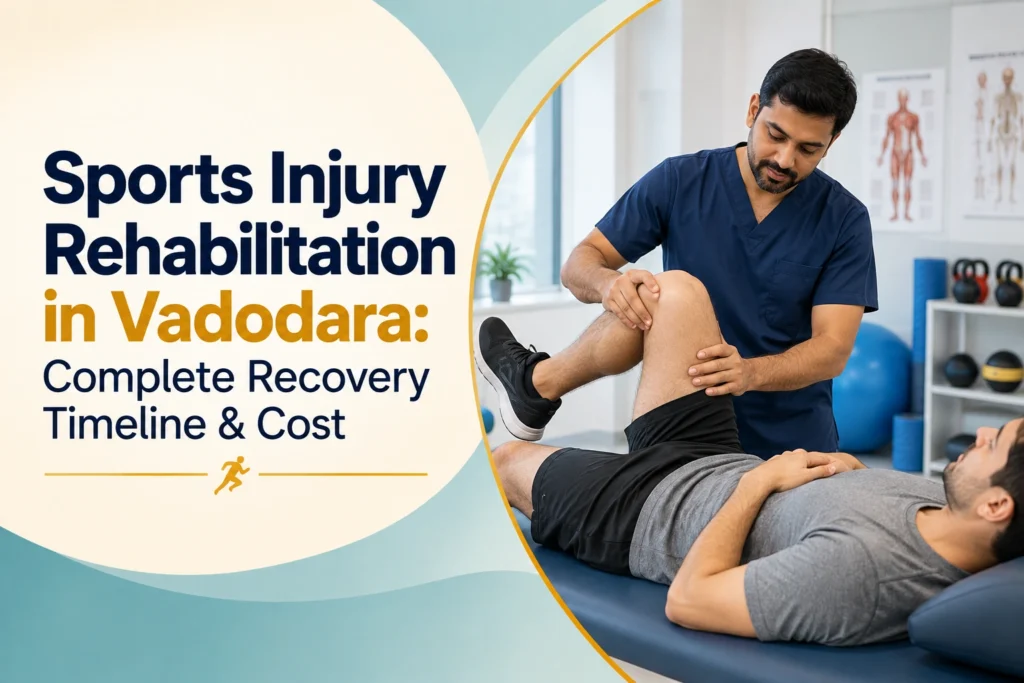
Sports injury rehabilitation is a structured, science-backed process that helps athletes recover from musculoskeletal injuries — from ankle sprains to post-ACL reconstruction. Unlike rest-and-wait, active rehab restores strength, flexibility and confidence so you return to sport stronger. At Ekdantaay Dental & Physio, sports rehabilitation combines manual therapy, exercise prescription, dry needling, taping and movement analysis — the goal is return to performance, not just pain-free movement. Research in the British Journal of Sports Medicine shows structured rehabilitation reduces re-injury risk by up to 50% compared to rest alone.The 5 Stages of Sports Injury Rehabilitation
Every sports injury rehabilitation program at Ekdantaay follows these 5 evidence-based stages. The timeline varies by injury, but the sequence never changes.Stage 1: Pain & Inflammation Control (Days 1–7)
The first 48–72 hours after injury are critical. The body’s inflammatory response is natural, but excessive swelling delays healing. Treatment includes:- PRICE protocol: Protection, Rest, Ice (15–20 min every 2–3 hours), Compression, Elevation
- Pain management: TENS therapy, ultrasound therapy, or dry needling to reduce muscle spasm
- Gentle movement: Pain-free range-of-motion exercises to prevent stiffness
Do not: Apply heat, massage aggressively, or “push through pain” in the first week. This increases bleeding and delays healing by 2–3 weeks.
Stage 2: Restoring Range of Motion (Weeks 1–3)
Once pain subsides, the focus shifts to regaining full joint movement. Tight muscles and scar tissue limit mobility — this stage addresses both:- Passive and active-assisted stretching
- Joint mobilisations (Grade I–III)
- Soft tissue massage and myofascial release
- Gentle yoga-based flows for spine injuries
Stage 3: Building Strength (Weeks 2–6)
Muscle atrophy begins within 48 hours of immobilisation. Stage 3 rebuilds strength progressively:- Isometric exercises (muscle contraction without joint movement) — safe for healing tissues
- Isotonic exercises (with resistance bands, then weights)
- Eccentric strengthening — proven to prevent re-injury in Achilles and patellar tendonitis
- Core stability — essential for all sports, especially cricket and running
Stage 4: Proprioception & Agility (Weeks 4–8)
Proprioception — your body’s sense of joint position — is often damaged in ankle and knee injuries. Without retraining, re-injury risk stays high:- Balance board and wobble cushion drills
- Single-leg stance progressions
- Ladder drills, cone drills, and lateral movements
- Sport-specific movement patterns (cutting, pivoting, landing mechanics)
Key stat: Athletes who complete proprioception training have a 41% lower risk of ankle re-sprain (British Journal of Sports Medicine, 2023).
Stage 5: Return to Sport (Weeks 6–12)
The final stage is not just “feeling better” — it’s passing objective tests:- Strength test: Injured limb ≥90% of uninjured limb (isokinetic testing)
- Hop tests: Single-leg hop, triple hop, crossover hop
- Agility test: T-test or 505 agility test
- Psychological readiness: ACL-RSI scale to assess confidence
Common Sports Injuries We Treat in Vadodara
Vadodara’s active community — from football at GSFC to cricket at Alembic — sees a predictable pattern of sports injuries. Here are the most common conditions treated at Ekdantaay Physio:| Injury | Typical Cause | Recovery Time | Sessions Needed |
|---|---|---|---|
| Ankle sprain | Football, running on uneven surfaces | 2–6 weeks | 6–10 |
| ACL tear | Cricket, kabaddi, sudden pivoting | 6–12 months (post-surgery) | 40–60 |
| Tennis elbow | Badminton, tennis, gym | 4–8 weeks | 8–12 |
| Runner’s knee | Running, cycling, stair climbing | 3–6 weeks | 8–14 |
| Rotator cuff injury | Swimming, cricket bowling, volleyball | 6–12 weeks | 12–20 |
| Lower back strain | Weightlifting, cricket, prolonged sitting | 2–6 weeks | 6–12 |
| Achilles tendonitis | Running, jumping sports | 6–12 weeks | 10–16 |
Physiotherapy Cost in Vadodara (2026)
“Physiotherapy cost in Vadodara” depends on injury complexity, session type and duration. Here’s a transparent 2026 breakdown:| Service | Cost per Session | Typical Package | Sessions |
|---|---|---|---|
| Basic physiotherapy (exercise + TENS) | ₹500 – ₹800 | ₹4,000 – ₹6,400 | 8 |
| Sports physiotherapy (manual therapy + dry needling) | ₹800 – ₹1,200 | ₹8,000 – ₹12,000 | 10 |
| Post-surgical rehab (ACL, rotator cuff) | ₹1,000 – ₹1,500 | ₹20,000 – ₹45,000 | 20–30 |
| Home visit physiotherapy | ₹1,200 – ₹1,800 | ₹12,000 – ₹18,000 | 10 |
At Ekdantaay: Initial assessment (45 min) is ₹600 including movement analysis and personalised plan. Most sports injury patients complete rehab in 8–12 sessions costing ₹6,000–₹12,000 total. We provide itemised bills for insurance claims.
Vadodara offers the same quality at 40–50% lower cost than Mumbai or Ahmedabad — patients travel from Padra, Dabhoi and Bharuch to Ekdantaay.
Sports Physiotherapy vs General Physiotherapy — What’s the Difference?
Many patients ask: “Can’t I just go to any physiotherapist?” The answer is yes — for basic aches. But sports physiotherapy is a specialised skill set:| General Physiotherapy | Sports Physiotherapy | |
|---|---|---|
| Focus | Pain relief, basic mobility | Return to sport, performance |
| Techniques | TENS, ultrasound, basic exercises | Manual therapy, dry needling, taping, movement analysis |
| Equipment | Basic | Isokinetic testing, force plates, agility ladders |
| Outcome | Pain-free daily activities | Return to pre-injury performance level |
| Best for | Back pain, neck pain, arthritis | Sprains, tears, post-surgical athletes |
How to Choose the Right Physiotherapist in Vadodara
With 50+ physiotherapy clinics in Vadodara, how do you choose? Use these 5 checks:- Qualification: Look for BPT (Bachelor of Physiotherapy) or MPT with sports specialisation. Avoid “certificate course” practitioners for sports injuries.
- Experience with your injury: Ask “How many ACL rehab cases have you handled?” — a good sports physio will have 20+ cases.
- Assessment quality: A proper assessment takes 30–45 minutes and includes movement analysis, strength testing and functional screening — not just “where does it hurt?”
- Home exercise program: Rehab happens at home, not in the clinic. Your physio must give you a clear, progressive home program with videos or diagrams.
- Return-to-play criteria: The best physios use objective tests (hop tests, strength ratios) to clear you — not just “you feel fine, go ahead.”
7 Recovery Tips to Heal Faster
These 7 evidence-based tips speed up recovery:- Sleep 7–9 hours: Growth hormone peaks during deep sleep — this is when your body repairs tissue. Athletes who sleep <7 hours have 1.7× higher injury risk (British Journal of Sports Medicine).
- Protein intake: Aim for 1.6–2.0g protein per kg body weight daily. Vadodara’s vegetarian athletes should combine dal + paneer + whey to meet targets.
- Don’t skip warm-up: 10 minutes of dynamic warm-up reduces injury risk by 30%.
- Ice for acute, heat for chronic: First 72 hours — ice. After that — heat for blood flow and tissue elasticity.
- Stay hydrated: Dehydrated muscles cramp and tear more easily. Vadodara’s heat (35°C+) makes hydration critical for outdoor sports.
- Cross-train: Maintain fitness with non-impact activities — swimming, cycling, upper body ergometer.
- Mental health matters: Athletes who stay mentally engaged in rehab return 20% faster.