
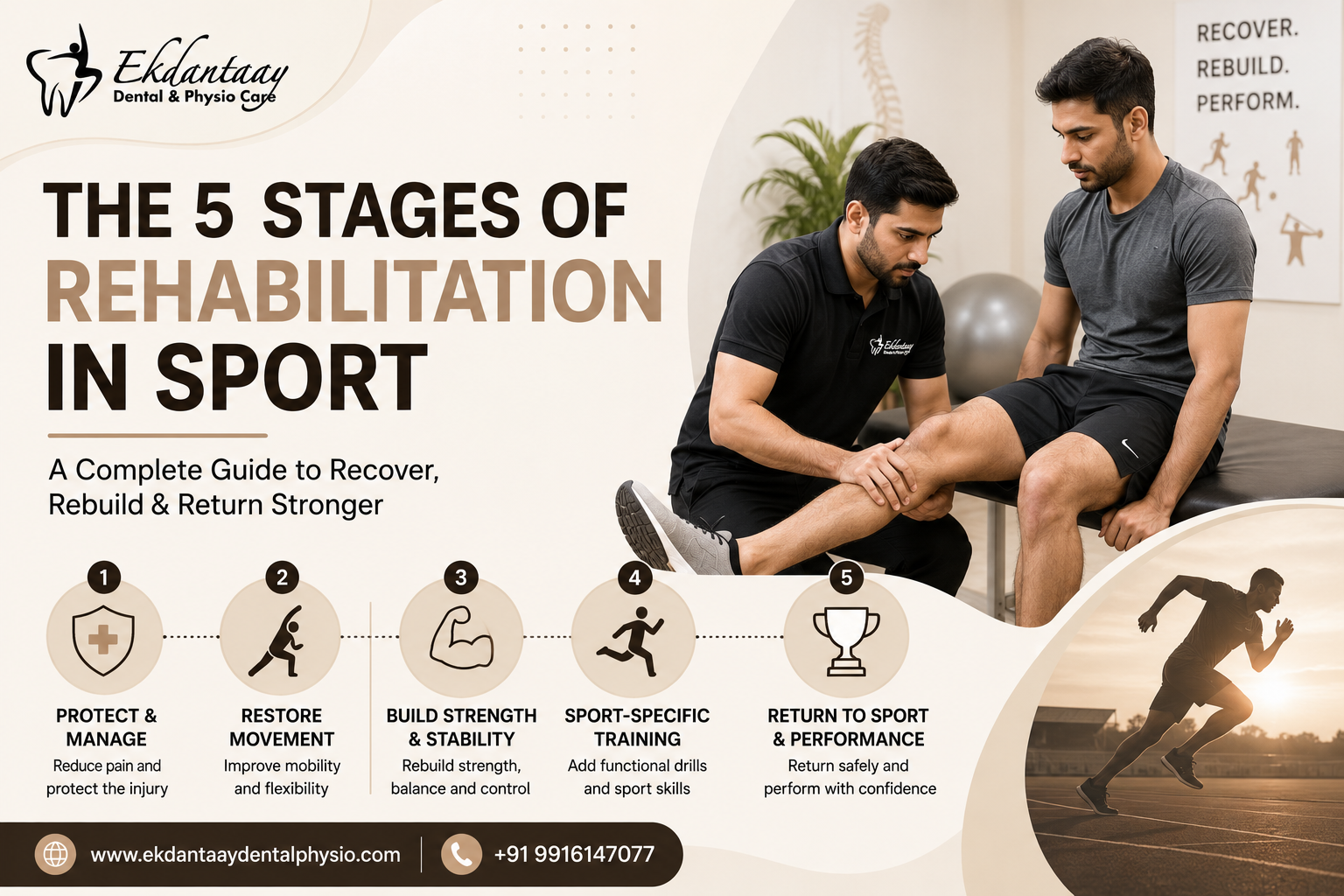
The 5 stages of rehabilitation in sport provide a structured approach to recovering an injury and safely returning to physical activity. They generally progress from protecting the injured area and managing symptoms to restoring movement, rebuilding strength, developing sport-specific ability, and finally returning to full participation and performance. The exact progression depends on injury, individual recovery, and sport.
An injury can be frustrating for an athlete. Whether it happens during a cricket match, football game, gym session, running practice, or another physical activity, the immediate concern is usually the same: When can I get back to my sport?
However, successful recovery is not simply about waiting until pain disappears. An athlete may feel better but still have weaknesses, restricted movement, reduced balance, poor control, or a lack of confidence. Returning to demanding activity before these areas have recovered can place unnecessary stress on the body and may increase the possibility of another injury.
This is why understanding the stages of rehabilitation in sport is important. A structured approach gives athletes a clearer path from injury to normal activity. It allows rehabilitation to progress gradually instead of moving directly from rest to full training.
Modern sports rehabilitation also recognizes that returning to sport is a process rather than a single moment. The widely cited Bern consensus describes return to sport as a continuum involving return to participation, return to sport, and return to performance, with decisions influenced by physical, psychological, sporting, and contextual factors.
In this guide, we explain the 5 stages of sports rehab, what happens during each phase, what athletes should expect, and how a physiotherapist can help guide the recovery process.
5 Stages of Rehabilitation in Sport: Quick Overview
| Stage | Main Focus | Typical Goal |
| Stage 1 | Injury protection and symptom management | Protect the injured area and control symptoms |
| Stage 2 | Movement and flexibility | Restore appropriate movement |
| Stage 3 | Strength and stability | Rebuild physical capacity |
| Stage 4 | Sport-specific function | Prepare for the demands of the sport |
| Stage 5 | Return to sport and performance | Progress toward full participation and performance |
What Are the 5 Stages of Sports Rehab?
The 5 stages of sports rehab can be understood as a gradual progression:
- Injury protection and symptom management
- Restoring movement and flexibility
- Building strength and stability
- Developing sport-specific function
- Returning to sport and performance
These stages should not be treated as rigid time periods. An athlete may move through one stage quickly and spend considerably longer in another depending on the injury and individual response to treatment.
For example, someone with a mild injury may progress relatively quickly, while a person recovering from surgery or a significant ligament injury may require a much longer rehabilitation process. The most important principle is progression based on recovery milestones rather than simply counting days.
Research and expert consensus support a criterion-based approach to return-to-sport decisions. Physical readiness, functional ability, psychological readiness, the demands of the sport, and the circumstances surrounding the athlete all need to be considered.
Stage 1: Injury Protection and Symptom Management
The first of the stages of rehabilitation in sport focuses on protecting the injured area and controlling symptoms while allowing the body to begin its healing process. Immediately after an injury, the body responds naturally with pain, swelling, reduced movement, and sometimes weakness. The appropriate response depends on the nature and severity of the injury.
The first priority is to avoid activities that could worsen the condition. This does not necessarily mean complete inactivity. In many situations, carefully controlled movement can be introduced when appropriate. A physiotherapist can determine what level of activity is suitable based on the injury and the individual’s condition.
What Happens During This Stage?
The initial assessment is an important part of this phase. A physiotherapist looks at how the injury occurred, the location and nature of symptoms, movement limitations, strength, and functional ability. This information helps determine what activities should temporarily be modified and what type of rehabilitation can safely begin.
The athlete may need to reduce training intensity or stop particular movements for a period of time. The objective is to protect healing tissues without unnecessarily reducing overall physical capacity. For example, a runner with a lower-limb injury may temporarily avoid running while continuing appropriately modified activities that do not aggravate the injury.
Stage 2: Restoring Movement and Flexibility
Once the initial symptoms are controlled and the injured area can tolerate movement, rehabilitation progresses toward restoring normal mobility. This is the second important phase among the rehabilitation phases.
Injuries frequently cause restricted movement. A joint may become stiff, muscles may become tight, or an athlete may unconsciously change the way they move to avoid discomfort. If these limitations continue, they can interfere with later stages of rehabilitation.
How Is Movement Restored?
A physiotherapist may introduce carefully selected mobility exercises based on the injured area and the individual’s current ability. The exercises should challenge the body without exceeding its tolerance. Progress may begin with simple controlled movements and gradually become more demanding as mobility improves.
Stretching may also be included when appropriate, but rehabilitation is not simply about making muscles more flexible. The goal is to restore useful movement that supports normal function. For an athlete, that means eventually being able to move through the ranges required by their activity.
Progress Should Be Gradual
A common mistake is trying to regain full movement too quickly. If an exercise repeatedly increases symptoms, the rehabilitation plan may need to be adjusted. Progress should be based on how the body responds rather than an expectation that a particular movement must be achieved by a specific date. This is one reason individualized physiotherapy is valuable during recovery.
Stage 3: Building Strength and Stability
After movement has improved, the focus shifts toward rebuilding strength and stability. This is one of the most important stages of rehabilitation in sport because injuries often result in reduced strength around the affected area. Even when pain has improved, an athlete may not yet have the physical capacity required for training or competition.
Why Is Strength Important After an Injury?
Strength provides the physical foundation needed for sporting activity. Running, jumping, changing direction, landing, throwing, lifting, and other movements require muscles and joints to tolerate repeated loads.
If an athlete returns before adequate strength has been restored, the body may struggle to handle those demands. Rehabilitation therefore progresses from basic strengthening toward more demanding movements.
Strength Training Is Individualized
There is no single strengthening program suitable for every athlete. The exercises depend on the injury, sport, training level, age, previous injuries, and current physical capacity. Someone recovering from a knee injury may require progressive strengthening around the lower limb and trunk. A person recovering from a shoulder injury may require a different approach focusing on the shoulder complex and surrounding muscles.
The goal is not simply to make one muscle stronger. The body works as an interconnected system, so rehabilitation should consider how different areas contribute to movement and stability.
Stability and Control
Strength alone is not enough. An athlete also needs to control movement effectively. For example, an athlete may have sufficient strength to perform a squat but struggle to control the knee during a rapid change of direction. Similarly, someone may regain shoulder strength but still lack adequate control during a throwing movement.
Rehabilitation therefore gradually introduces exercises that challenge stability, coordination, and movement control. This prepares the athlete for more complex activities later in the recovery process.
Stage 4: Developing Sport-Specific Function
The fourth stage is where rehabilitation starts to look increasingly like the athlete’s actual sport. This is an important transition. An athlete may be able to perform normal exercises in a clinic or gym but still not be ready for the unpredictable demands of training and competition.
The sports recovery stages therefore need to include activities that reproduce the physical requirements of the individual’s sport.
What Is Sport Specific Rehabilitation?
Sport-specific rehabilitation involves gradually introducing movements and activities that resemble what an athlete needs to perform during their sport. The exact activities depend on the sport.
A football player may eventually need to perform acceleration, deceleration, changes of direction, and controlled kicking movements.
A badminton player may need repeated lunges, rapid lateral movements, jumping, and changes in direction.
A cricket player may require running between wickets, throwing, bowling, batting, and repeated acceleration.
A runner may need to progress from controlled movement toward higher-speed running and the ability to tolerate longer periods of activity.
The important point is that rehabilitation should eventually prepare the body for the actual demands of the activity.
Why Can’t an Athlete Simply Return Once Strength Is Normal?
Strength testing alone does not completely determine whether someone is ready to return to sport. Sports involve combinations of movements performed repeatedly and often under unpredictable conditions. An athlete may need to react to another player, respond to changing direction, maintain balance, accelerate suddenly, or perform a movement when fatigued.
Research on return-to-sport rehabilitation emphasizes the importance of functional and sport-specific testing rather than relying on a single measure. Factors such as movement, strength, functional ability, cardiovascular readiness, and psychological readiness can all be relevant.
This is why Stage 4 gradually bridges the gap between rehabilitation exercises and actual sports participation.
Stage 5: Returning to Sport and Performance
The fifth stage is the final part of the 5 stages of sports rehab and focuses on returning to the athlete’s desired level of participation and, where appropriate, performance. However, “returning to sport” does not necessarily mean immediately returning to full competition.
A safer approach is usually progressive. An athlete may first participate in modified training, then increase training volume and intensity, then participate in unrestricted practice, and eventually return to competition when appropriate. the Bern consensus describes returning to sport as a continuum rather than a single decision. It distinguishes between returning to participation, returning to sport, and returning to performance.
Return to Participation
At this point, the athlete may begin participating in training or sport at a reduced level. The activity might be modified by reducing duration, intensity, repetition, or certain movements. This gives the body an opportunity to adapt to real sporting demands while rehabilitation continues.
Return to Sport
The athlete progresses toward their normal sporting activity. However, simply participating does not necessarily mean they are performing at their previous level. Training demands may continue to increase gradually while physical and functional responses are monitored.
Return to Performance
The final goal for many competitive athletes is not merely participation but returning to their previous level of performance. This can involve restoring speed, strength, endurance, agility, technical ability, and confidence.
The distinction matters because an athlete can technically return to their sport while still being below their previous performance level. The return-to-sport literature recognizes this difference between participation and full performance.
How Do You Know When You Are Ready to Progress?
One of the most important questions during rehabilitation is whether an athlete is actually ready to move to the next stage. There is no universal test that applies to every injury or sport. Instead, progression should consider the individual’s symptoms, movement, strength, functional ability, and the specific requirements of their activity.
For example, an athlete may need to demonstrate appropriate movement and strength before beginning more demanding training. Later, sport-specific tasks can be assessed to determine whether the body can tolerate the demands of the activity.
Psychological readiness can also matter. An athlete who is physically capable but extremely fearful of repeating the injury may struggle when returning to competition. Evidence-based rehabilitation therefore considers multiple factors rather than using time alone as the deciding factor.
Are the 5 Stages of Rehabilitation Always the Same?
Not necessarily.
The five stages provide a useful framework for understanding the rehabilitation process, but actual treatment should be individualized. An athlete recovering from a minor muscle injury may progress through the stages relatively quickly. Someone recovering from a significant ligament injury or surgery may require substantially more time and more detailed testing before progressing.
Some stages may overlap.
For example, an athlete may continue strength training while beginning sport-specific exercises. Similarly, mobility work may continue throughout later stages if a limitation remains. Therefore, rehabilitation should not be viewed as five isolated boxes that must always be completed one after another.
Instead, the stages represent a progressive framework.
How Does a Physiotherapist Help During the 5 Stages?
A physiotherapist plays an important role in assessing the injury, designing the rehabilitation plan, monitoring progress, and deciding when it is appropriate to increase activity. At the beginning, the physiotherapist identifies the athlete’s current limitations and establishes realistic goals.
As recovery progresses, treatment is adjusted according to the athlete’s response.
The physiotherapist may monitor:
- Movement quality
- Strength
- Flexibility
- Stability
- Functional ability
- Exercise tolerance
- Sport-specific movement
- Confidence during activity
The exact assessment depends on the injury and sport. This individualized process helps prevent two common problems: progressing too quickly and progressing too slowly.
Why Returning Too Early Can Be a Problem
An athlete may feel pressure to return quickly because of an upcoming competition, team responsibilities, or personal goals. However, returning before the body is ready can create problems.
A reduction in pain does not automatically mean that strength, movement control, or functional capacity have returned to the required level. For this reason, return-to-sport decisions should consider more than how the athlete feels on one particular day.
The consensus literature recommends a collaborative, individualized approach that considers the athlete, clinician, sport demands, and risk factors. A carefully managed return may take longer than an athlete initially expects, but the goal is to make that return more sustainable.
What Should Athletes Remember About Rehabilitation?
The most important lesson from the stages of rehabilitation in sport is that recovery is a process. There is rarely a single exercise, treatment, or date that determines when an athlete is ready. Successful rehabilitation gradually develops the physical and functional abilities required by the athlete’s activity.
A good rehabilitation plan should answer three questions:
Where is the athlete now?
This requires an appropriate assessment of the injury and current limitations.
What does the athlete need to achieve?
The answer depends on the sport, activity level, recovery goals, and physical demands.
What evidence shows the athlete is ready to progress?
This may involve movement, strength, functional, sport-specific, and psychological considerations. Thinking about rehabilitation in this way creates a more structured and individualized recovery journey.
This table provides a simplified overview. The actual rehabilitation process should be individualized according to the injury and the athlete’s requirements.
Key Takeaways
The 5 stages of rehabilitation in sport provide a practical framework for understanding how an athlete can progress from injury toward full sporting activity.
The process begins with protecting the injury and managing symptoms. It then progresses toward restoring movement, rebuilding strength and stability, introducing sport-specific activities, and finally returning to sport and performance.
The most important point is that rehabilitation should not be based solely on time. An athlete’s physical condition, functional ability, sport-specific requirements, and psychological readiness can all influence the decision to progress. A gradual, criteria-based approach gives athletes a better opportunity to return safely and confidently.
If you have an injury that is preventing you from training or participating in your preferred activity, professional assessment can help determine where you are in the rehabilitation process and what should happen next.
Ready to Return to Your Sport With Confidence?
An injury does not have to keep you away from the activities you enjoy. With the right assessment and a structured rehabilitation plan, you can work toward restoring movement, strength, confidence, and sport-specific ability.
At Ekdantaay Dental & Physio Care, Dr. Ranakdevi Raj, Physiotherapist, provides personalized physiotherapy care to help athletes and active individuals progress through their recovery safely.
Whether you’re recovering from a recent injury or struggling with an injury that keeps returning, don’t rush your return. Get professional guidance and follow a rehabilitation plan designed around your condition and goals.
Book Your Physiotherapy Consultation in Vadodara
Dr. Ranakdevi Raj
Ekdantaay Dental & Physio Care
📞 Contact: +91 9916147077
Clinic Address:
501, Elite Elegance Gotri Sevasi Main Road, besides Collabera, opposite Hanuman Mandir, Chandramauleshwar Nagar, Gotri, Vadodara, Gujarat 391101
Take the next step toward a safer and stronger return to sport. Call +91 9916147077 to schedule your consultation.