

You lost a molar a couple of years ago. Nobody can see it, so it has not felt urgent. Your dentist abroad has mentioned an implant more than once, and the number attached to it is the reason you are reading this.
Now you have three weeks in Vadodara and you would like it dealt with.
The question is not which option is best in general. It is which option is best for you, given that you fly home on a fixed date. Those are genuinely different questions, and the honest answer sometimes points away from the treatment that fits the trip.
A crown or a bridge normally completes in two appointments about a week apart, so both fit inside a two or three week visit. An implant does not, because the implant needs three to six months to fuse with the bone before the tooth is fitted. If a single visit is the constraint, a bridge is the option that finishes; if the long term is the priority, an implant across two trips usually wins.
What are the three options, in plain terms?
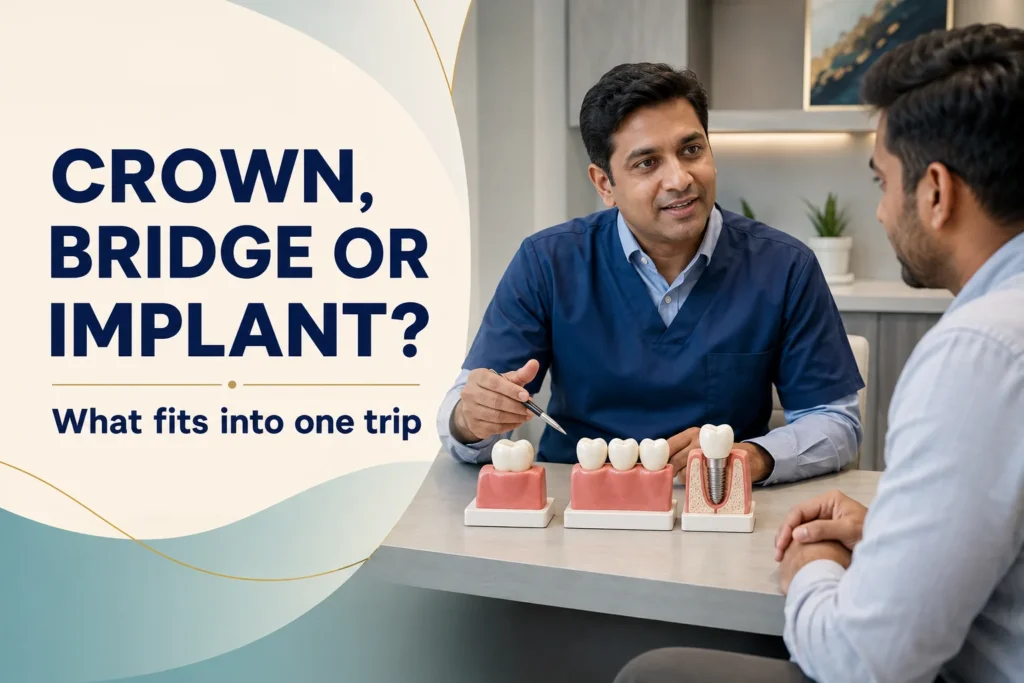
A crown is a cap that covers a tooth you still have, when that tooth is too damaged or heavily filled to survive on its own. It replaces the outside of the tooth, not the tooth itself.
A bridge replaces a missing tooth by anchoring a false tooth to the teeth on either side. Those neighbouring teeth are prepared, meaning reduced in size, and crowned. The unit spans the gap as one piece.
An implant replaces the root of the missing tooth with a titanium post placed into the jawbone. Once the bone has fused to it, a crown is attached on top. Nothing is done to the neighbouring teeth.
The critical difference is not how they look, because all three can look excellent. It is what they do to the teeth around the gap, and how long they take.
Which ones finish inside a single visit?
This is where the choice is usually decided for a visiting patient, so it is worth being precise rather than optimistic.
| Option | Appointments | Time needed | Fits one visit? |
|---|---|---|---|
| Crown | 2, about a week apart | Roughly 7 to 10 days | Yes |
| Bridge | 2, about a week apart | Roughly 7 to 14 days | Yes |
| Implant | 2 stages, months apart | 6 to 12 months overall | No |
| Implant + bone graft | 2 to 3 stages | 4 to 6 months longer again | No |
The implant figures are not a local limitation. According to Guy’s and St Thomas’ NHS Foundation Trust, the implant is left to heal in the bone for three to six months and sometimes longer, impressions and the final crown add a further two to three months, and total treatment runs six to twelve months, with a bone graft adding four to six months again.
That is biology, and no clinic anywhere compresses it safely. What a clinic can do is stage it sensibly across two visits, with the healing happening while you are at home.
What does a bridge actually cost you, beyond money?
Here is the part that tends to get skipped when someone is choosing under time pressure, and it is the reason this article exists.
To fit a conventional bridge, the two healthy teeth on either side of the gap are cut down. Enamel is removed all the way round each of them so that crowns can be fitted. If those teeth were previously untouched, that is permanent, and it cannot be reversed later.
A bridge replaces one missing tooth by permanently altering two healthy ones. That may still be the right decision. It should be a decision you actually made.
What follows from that over time:
- Prepared teeth are more likely to need root canal treatment later, because the nerve has been brought closer to the surface.
- If one supporting tooth fails, the whole bridge usually has to be replaced, not just that section.
- The bone under the gap is not stimulated by a bridge, so it continues to shrink over the years. An implant does load that bone.
- Cleaning under a bridge takes more effort than flossing between separate teeth, and the supporting teeth are more prone to decay at the margins.
None of this makes a bridge a bad treatment. Bridges have been done for decades and they work well. It does mean the comparison is not simply “faster and cheaper versus slower and dearer”.
The case for a bridge is much stronger when the neighbouring teeth are already crowned or heavily filled. If they were going to need crowns anyway, the main objection largely disappears, and a bridge becomes the sensible answer rather than the compromise.
How do they compare side by side?
| Crown | Bridge | Implant | |
|---|---|---|---|
| Replaces | The outside of a damaged tooth | A missing tooth | A missing tooth, root included |
| Needs a tooth present | Yes | Teeth either side | No |
| Affects other teeth | No | Yes, two are cut down | No |
| Preserves jawbone | Not applicable | No | Yes |
| Fits one visit | Yes | Yes | No |
| Cleaning | Normal | Needs threading under the span | Normal, as a natural tooth |
| If it fails | Replace the crown | Usually replace the whole bridge | Usually replace the crown only |
| Best when | The tooth is savable | Neighbours already need crowns | Neighbours are healthy |
How should you choose?
The examination decides it, but the logic is straightforward enough to follow in advance, and it helps to arrive having thought about it.
Choose a crown when the tooth is still there
If the tooth can be saved, saving it is almost always the right answer. Nothing replaces a natural root. A crown after root canal treatment is routine and finishes inside a normal visit.
Consider a bridge when the neighbours already need work
If the teeth either side are already crowned, heavily filled or damaged, a bridge does three jobs at once and the main objection falls away. It also suits someone who cannot commit to a second trip within a year.
Choose an implant when the neighbours are healthy
If the teeth either side are intact, cutting them down to hold a bridge is a significant thing to do to sound teeth. If you visit India regularly, staging an implant across two trips is usually the better long-term decision.
A fourth option worth asking about
For a single missing tooth with healthy neighbours where an implant is not possible, a resin-bonded bridge is sometimes suitable. It is bonded to the back of one adjacent tooth with minimal or no preparation. It is less robust and not right for every position, particularly under heavy chewing load, but it preserves the neighbouring teeth. Ask whether your case suits one.
Which material: zirconia, porcelain-fused-to-metal or e.max?
This question comes up constantly and is usually answered badly, either with “zirconia is the best” or with a shrug. Neither is right, because the correct material depends on where the tooth is.
| Material | Strengths | Trade-offs | Typically used |
|---|---|---|---|
| Zirconia | Very strong, metal-free, no dark line at the gum | Less translucent in its most robust forms, so can look flatter | Back teeth, and front teeth in layered forms |
| Porcelain fused to metal | Long clinical track record, strong, well understood | A dark metal margin can show if the gum recedes over years | Back teeth, longer bridges |
| Lithium disilicate (e.max) | Excellent translucency, closest to natural enamel | Less suited to heavy load or long spans | Front teeth, single units |
The short version: a front tooth is an appearance problem, a back tooth is a load problem, and the material should follow the job. A clinician who asks where the tooth sits and how you chew before recommending a material is doing it properly.
Whichever is chosen, ask which material was actually used and keep the record, for the same reason you would keep implant documentation. A dentist treating you in another country years later benefits from knowing.
What happens after, whichever you choose?
Every one of these options is a long-term commitment rather than a finished event, and the aftercare differs enough to be worth knowing before you decide.
For an implant, Guy’s and St Thomas’ NHS Foundation Trust describes soreness, swelling or bruising in the first week; a review at seven to fourteen days for suture removal and wound assessment; the implant site left unbrushed for the first week with chlorhexidine mouthwash used instead; and regular follow-up checks thereafter, noting that implants last well if they are cared for properly.
The scheduling consequence for a visiting patient: that seven to fourteen day review falls inside most trips if the placement is done early, and outside the trip if it is left late. Another reason to book the first appointment in the first few days.
The three options differ in what they ask of you afterwards:
- Crown. Cleaned like a natural tooth. The margin where the crown meets the tooth is the vulnerable point, so flossing matters there.
- Bridge. Needs cleaning underneath the span, using a floss threader or interdental brush. Ordinary flossing cannot reach it, and neglecting it is the most common reason bridges fail early.
- Implant. Cleaned like a natural tooth, but the surrounding gum and bone can still be lost to the same processes that affect teeth, and an implant gives no early warning through sensitivity because it has no nerve. Regular checks are what catch problems while they are still small.
Ask whoever treats you to show you the cleaning technique for what you have had fitted, before you leave the country. It takes two minutes at the chair and it is considerably harder to work out from a video eight thousand kilometres away.
What about cost?
Cost usually decides this in practice, so it deserves a straight answer even where a specific figure cannot be given.
The general shape holds almost everywhere: a crown costs less than a bridge, which spans three units, and a single implant with its crown usually costs more than a three-unit bridge. That ordering is consistent internationally.
For scale on what people are comparing against, NHS England charges Band 3 at £332.10 as of the March 2025 review, covering crowns, bridges and dentures. That is the subsidised rate, and private treatment abroad for the same work sits substantially above it.
The comparison that actually matters is cost over time, not cost today. A bridge that needs replacing, and takes a supporting tooth with it, can end up costing more across twenty years than the implant that looked expensive at the outset. Ask about expected lifespan, not just price.
We cannot give a figure before an examination, because the answer depends on the material, the number of units, the condition of the supporting teeth and whether anything else needs attention first. What we can tell you before you travel, from an X-ray, is which options are realistic for your case, how many appointments each needs, and which fit the dates you have.
If you are weighing several treatments on the same trip, our guide to what can realistically be finished in one visit covers the sequencing across all treatments, and how to check a dentist and an implant system sets out what to ask before committing. Our dental services page lists the treatments available.
Send your X-ray and your travel dates and we will tell you which of these options is realistic for your case and your trip.