

You have found three clinics. All three have good photographs, confident websites and five-star ratings. One is noticeably cheaper. You are trying to choose between them from four thousand miles away, and you have no way of telling which of them is actually good.
That is a reasonable position to be in. Dentistry is difficult for patients to assess even locally, where you can walk in and form an impression. From abroad you are working entirely from material each clinic wrote about itself.
So stop trying to judge the marketing and start checking the record. Four things are verifiable, and none of them depends on trusting anybody’s description of themselves.
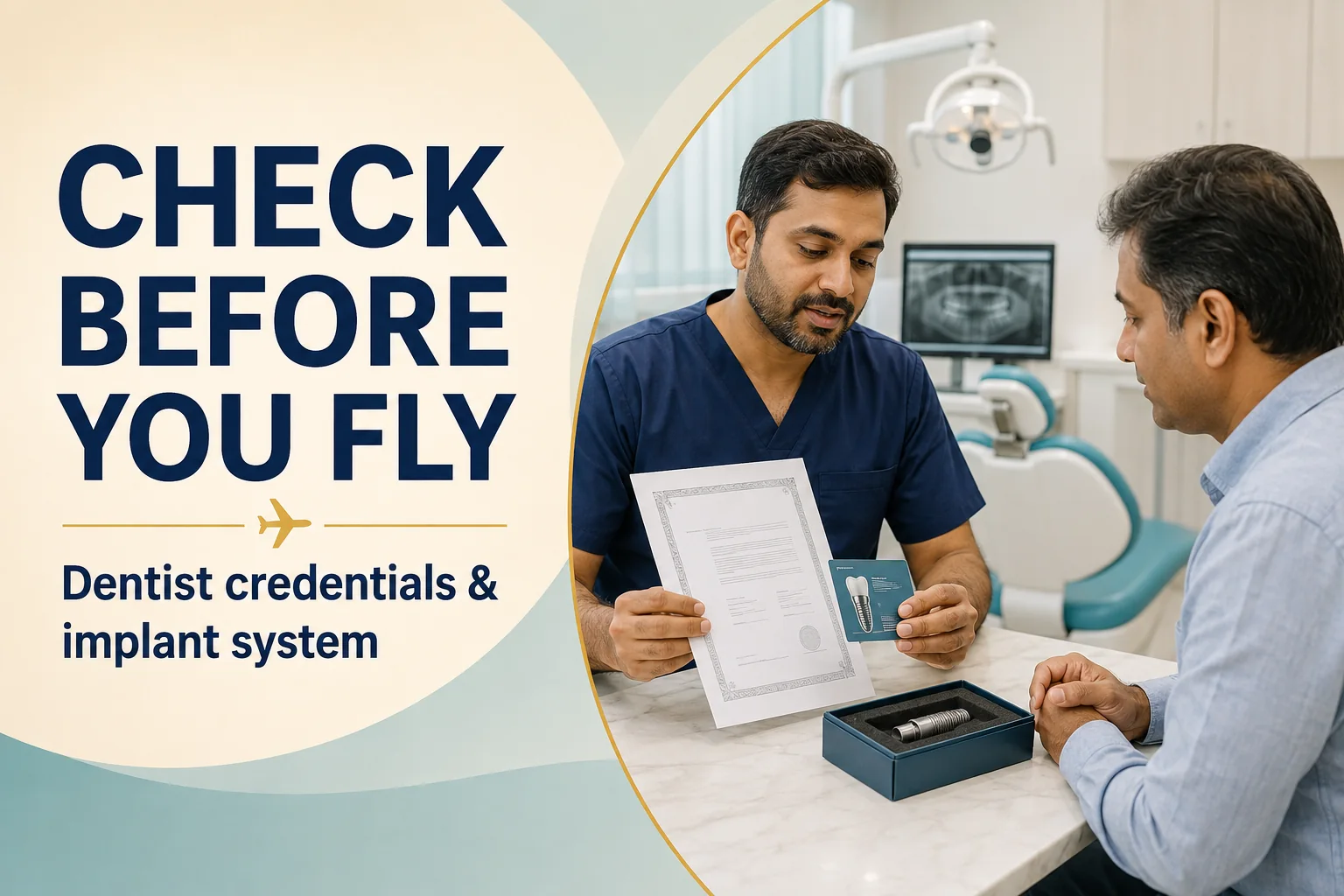
To check a dentist in India before travelling: ask for their State Dental Council registration number and the issuing state, which is a public record; ask which implant system will be used and request the documentation; ask by name who will carry out the treatment; and agree in advance what happens if you need help after you return home.
Why is this so hard to judge from abroad?
Three things work against you at once, and it is worth naming them because each has a different answer.
- Everything you can see was written by the seller. Websites, photographs and before-and-after galleries are marketing material. That is not a criticism, it is what they are for.
- Dental quality is largely invisible to patients. Whether a crown margin fits properly or an implant was placed at the right angle is not something a patient can assess, and often will not surface for years.
- You cannot easily return. Locally, a problem means going back. From abroad, it means a flight or an awkward conversation with a dentist who did not do the work.
The checks below work because none of them relies on your judgement of clinical quality. They rely on public records and on documentation that either exists or does not.
Check 1: Is the dentist registered, and where?
State Dental Council registration is the legal requirement to practise dentistry in India. Registration is held at state level, and the registers are public. It is the Indian equivalent of GDC registration in the UK or state board licensure in the US.
The Dental Council of India maintains the Indian Dentists Register and publishes the list of state dental councils, with the state councils holding the registers and issuing the numbers. So the check is:
- Ask for the treating dentist’s registration number and which state issued it.
- Look it up on that state council’s published register.
- Confirm the name matches the person who will actually treat you.
Also ask what the qualification is, specifically, because the letters carry real meaning:
| Qualification | What it is |
|---|---|
| BDS | Bachelor of Dental Surgery. The primary dental degree, five years including a compulsory rotating internship. A qualified general dentist. |
| MDS | Master of Dental Surgery. A three-year postgraduate specialisation in a named field. Always ask which field. |
| MDS in Orthodontics | Specialist in tooth movement: braces, aligners, bite correction. |
| MDS in Prosthodontics | Specialist in replacing teeth: crowns, bridges, dentures, implant restoration. |
| MDS in Oral and Maxillofacial Surgery | Specialist in surgery: complex extractions, implant placement, jaw surgery. |
| MDS in Periodontics | Specialist in gums and supporting bone. Also places implants. |
The relevant question is not “is this dentist qualified” but “is this dentist qualified in the thing I need”. A skilled orthodontist is not automatically the right person to place a full-arch implant case, and a good practice will tell you that themselves.
Check 2: Which implant system, and can you have the documentation?
If you are having an implant, this is the check that matters most in the long run, and almost nobody asks it.
An implant is not a generic object. It is a specific product from a specific manufacturer, with its own thread design, its own connection geometry and its own matching components. The abutment and crown that attach to it must match that system.
Why this matters years later: if a crown loosens or fractures in eight years and you are living in Melbourne or Manchester, the dentist you see needs to know which system is in your jaw to order the right part. Without that, they are working it out from an X-ray, and sometimes the answer is that the component cannot be sourced at all.
So ask for, and keep:
- The manufacturer and system name.
- The size and batch or lot number of each implant placed.
- The implant passport or certificate, if the manufacturer issues one. Many do.
- A post-placement X-ray, in digital form.
A clinic that places implants routinely will hand this over without being prompted, because it is standard record keeping. Reluctance or vagueness here is worth taking seriously.
You do not need to become an expert on brands. Searching the system name will tell you quickly enough whether it is an established international manufacturer with a long clinical record or something you cannot find much about. Both may be perfectly acceptable, but you should know which you are choosing, and it should be a choice rather than a surprise.
Check 3: Who is actually treating you?
On a single filling this hardly matters. On a multi-stage treatment plan it matters a great deal, and it is where overseas patients most often find a gap between what they expected and what happened.
Larger practices frequently work in teams, which is entirely legitimate and often better: a surgeon places the implant and a prosthodontist restores it, because those are different skills. The problem is not the division of labour. It is not being told about it.
Ask plainly:
- Who performs the surgical stage, and what is their qualification?
- Who does the restoration, and is it the same person?
- If I come back for stage two on my next visit, will I see the same clinician?
- Who do I speak to if I have a question between stages?
The last one matters more than it looks. For a patient who leaves the country between stages, continuity is not a nicety, it is the whole mechanism by which staged treatment works at distance.
Check 4: What happens after you fly home?
This is the question most likely to be skipped and most likely to be regretted, because by the time it becomes relevant you are no longer in a position to ask it comfortably.
Settle these before treatment starts:
| Question | What a good answer sounds like |
|---|---|
| Who do I contact if something feels wrong? | A named person and a direct channel, not a general enquiry form. |
| How will you review something remotely? | Photographs and a video call, with a stated response time. |
| What records will I leave with? | Full treatment record by tooth, all X-rays, implant documentation, materials used, all in digital form. |
| What if an adjustment is needed once I am home? | A clear position, including what a local dentist can do and what needs to wait for your next visit. |
| What is covered if something fails? | Stated plainly, in writing, before you commit. |
Notice that none of these asks for a guarantee. They ask for a process. Any clinic can promise that nothing will go wrong. A clinic that has thought about overseas patients can tell you what happens if it does.
What should make you walk away?
Not everything unusual is a warning sign, and cheap is not automatically bad. These are the ones that genuinely matter.
- A full treatment plan quoted without seeing an X-ray. A preliminary view from images is reasonable. A firm, itemised plan for work inside your mouth, sight unseen, is not.
- An implant promised complete in one short visit. Healing takes months. Same-day temporary teeth are a real technique and are not the same as a finished implant.
- Evasiveness about the implant system. There is no legitimate reason not to tell you.
- Pressure to decide before you travel. Limited-time pricing belongs in retail, not in a treatment decision.
- No willingness to discuss what happens afterwards.
- A treatment plan that grows substantially at the chair without a clear clinical explanation for what changed.
Equally, some things that worry people are not warning signs at all. Being told a tooth can safely be left alone, being advised that something is better done on your next visit, or being quoted more than the cheapest option because a more established implant system is being used, are all signs of a practice thinking about you rather than about the sale.
What does proper follow-up actually look like?
One way to judge a practice before committing is to ask what the follow-up schedule is, and compare the answer against what the treatment actually requires. A clinic that describes real follow-up is describing something it does. A clinic that says “come back if there is a problem” is describing an absence.
Implants are the clearest example, because the schedule is well established. Guy’s and St Thomas’ NHS Foundation Trust sets out implant aftercare: soreness, swelling or bruising in the first week; a review appointment at seven to fourteen days for suture removal and wound assessment; the implant site left unbrushed for the first week; and ongoing regular checks thereafter, because implants last well only if they are maintained.
The question that follows from this: if I am having an implant placed and flying out in five days, what happens about the seven to fourteen day review?
There are several legitimate answers. If you get none of them, that is the finding. If you are having an implant placed and flying out in five days, what happens about the seven-to-fourteen-day review? There are legitimate answers: bring the appointment forward where clinically sensible, use dissolving sutures, review remotely with photographs, or arrange for a local dentist to check the site. There is one illegitimate answer, which is not mentioning that the review exists.
The maintenance point nobody mentions when selling
Implants need ongoing care in the same way natural teeth do. The bone and gum around an implant can be lost to the same processes that affect teeth, and an implant does not warn you with sensitivity the way a tooth does. Whoever places it should tell you what maintenance it needs and how often, and that conversation should happen before treatment rather than after.
Does a large price difference mean lower quality?
This is the anxiety underneath most of the others, so it is worth addressing directly rather than reassuring around.
The difference between Indian and Western dental pricing is structural. Rent, salaries, laboratory work and overheads differ enormously; implant systems, ceramics and instruments are traded on a global market and differ far less. For scale on the other side, NHS England publishes its charges openly, with Band 3 covering crowns, bridges and dentures at £332.10 as of the March 2025 review, and that is the subsidised rate rather than the private one most people abroad are quoted.
The comparison that tells you something is not India versus home. It is one Vadodara clinic against another. The structural costs are identical for both, so a large gap between them has a different explanation, and it is worth asking what it is.
A large gap against a Western price is expected and explains nothing on its own. A large gap between two clinics in the same city is the one worth asking about, because the structural costs are the same for both. The question is not “why is this cheaper than home” but “what is included here that is not included there”.
Ask what changes the price: the implant system, the crown material, whether grafting is included, how many appointments, and what happens if more work is found. Those five answers make two quotes comparable. The headline figure does not.
How much should online reviews count?
They are useful for a narrow set of things and misleading for the rest.
Reviews are reasonable evidence about the experience: whether appointments run on time, whether staff explain things, whether the place is clean, whether people felt rushed. Those are things patients can genuinely assess, and consistent patterns across many reviews mean something.
Reviews are weak evidence about clinical quality. A patient cannot evaluate whether an implant was placed at the correct angle, and the review is almost always written within days, long before the outcome that matters is known. Most dental work fails slowly or not at all, on a timescale no review captures.
Read reviews for the experience. Use the four checks for the clinical side. They answer different questions and one cannot substitute for the other.
If you are planning treatment around a visit, our guide to what can realistically be finished in one trip covers the sequencing, and the timing of a wisdom tooth extraction works through the one procedure most often mistimed against a return flight. Our dental services page sets out the treatments available.
And apply all four checks here. Ask us for the registration number, the qualification, the implant system and the aftercare process before you commit to anything. Ask us directly, and if the answers are not specific, ask again.