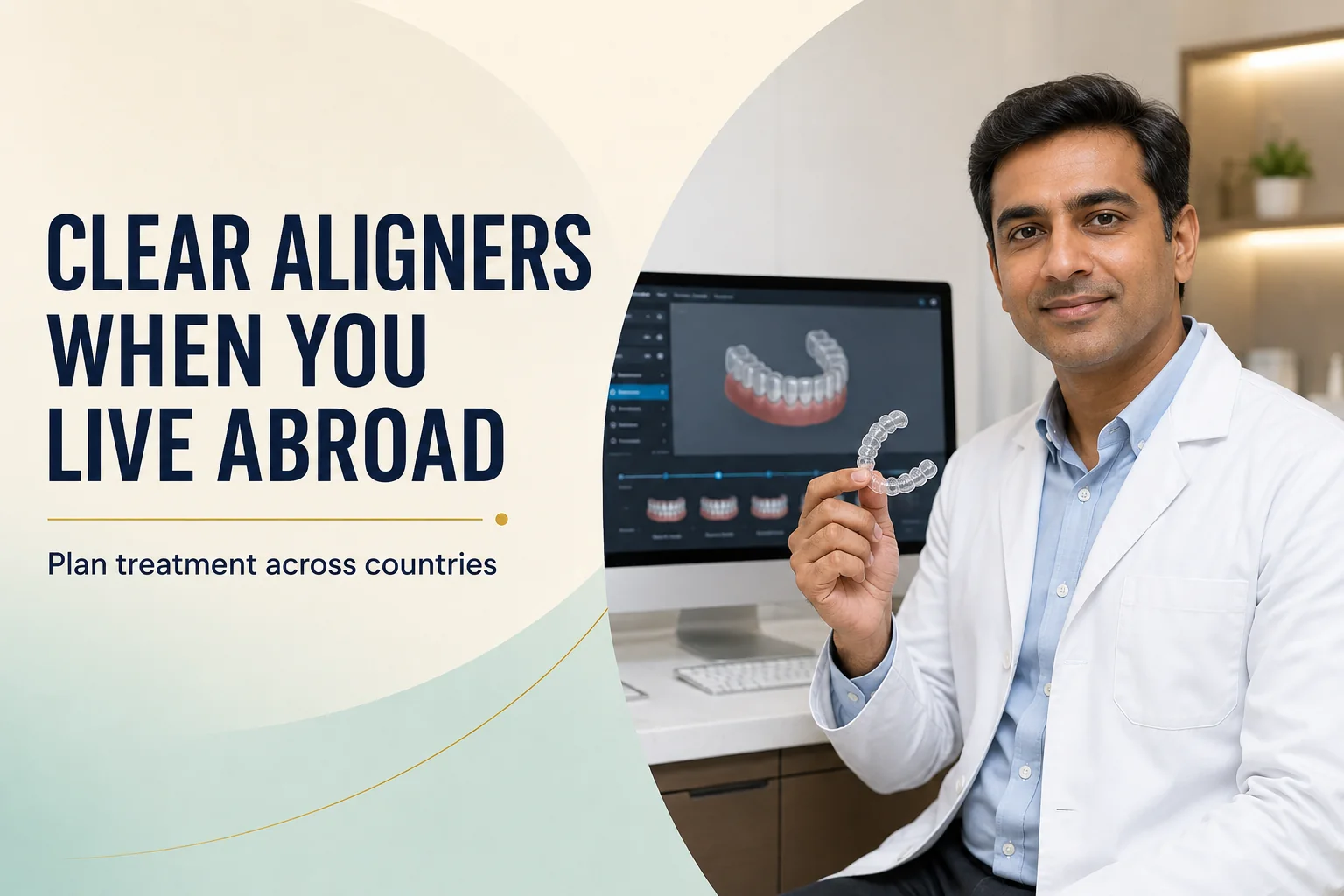
Clear Aligners When You Live Abroad: Can You Start Treatment in India?

Aligner treatment runs for months, and no visit home covers it. The real question is whether it can run across two countries, and for whom that works.

Dental Reading time: 11 minutes

Published: 6 September 2026

You have thought about straightening your teeth for years. You priced it where you live and decided against it. Now you are back in Gujarat every year or so, you have seen what treatment costs here, and the arithmetic suddenly looks different.

Then the obvious problem arrives: you cannot stay for a year.

This is a genuinely different question from every other treatment on this site, and it deserves a more careful answer than yes or no.

Clear aligner treatment cannot be completed during a visit to India, because it typically takes several months to two years. It can, however, be started here and continued abroad: the scan, treatment plan and first aligners on one trip, the series worn at home with remote review, and refinements or the next stage timed to your following visit. It suits people who return predictably, and it suits complex cases poorly.

Why is this different from other dental treatment?

Most dentistry is a repair. A filling, a crown, an extraction: something is done to a tooth, and once it is done it is done.

Orthodontic treatment is not a repair, it is a process. Teeth are moved gradually through bone, which remodels around them as they go. The movement happens continuously over months, and it depends on wearing the appliance consistently rather than on any single appointment.

That changes what “having treatment in India” even means. For a crown, the question is whether the appointments fit your trip. For aligners, the trip is not the treatment. The trip is where the treatment is set up and where it is periodically checked.

Which is precisely why it can work across borders, where a crown cannot be done half in one country and half in another.

How long does aligner treatment actually take?

Long enough that no visit covers it, and it is worth being honest about the range rather than quoting a best case.

For context on orthodontic treatment generally, the NHS notes that fixed braces are typically worn for one to two years, with adjustment appointments every six to eight weeks, and that a retainer is needed afterwards to stop teeth moving back to their original position.

Aligner treatment varies with the case. A mild alignment issue may take a matter of months. A case involving significant crowding or bite correction can run comparably to fixed braces or longer. Anyone quoting you a duration before seeing a scan is guessing, and the honest answer at that stage is a range with the reasons it might sit at either end.

The number that actually matters for you is not the total duration. It is how long you can go between in-person appointments without treatment stalling. That is the question to ask, and it is rarely the one people ask.

How would treatment across two countries work?

The model depends on aligner treatment being planned digitally up front. The whole series is designed from a single scan, which is what makes it portable in a way fixed braces are not.

Visit one, in India: setting up

  1. Clinical examination, X-rays and a digital scan of your teeth.
  2. A treatment plan built from that scan, showing the projected sequence of movements and roughly how many aligners it will take.
  3. Attachments bonded to the teeth where the plan requires them. These are small tooth-coloured shapes that give the aligner something to grip.
  4. The first set of aligners fitted, with instructions and a wear schedule.
  5. You leave with a batch of aligners covering the coming months.

At home: the months in between

  • Aligners are changed on schedule, usually every one to two weeks.
  • Progress is reviewed remotely with photographs at agreed intervals.
  • Additional aligner batches are shipped, or carried by family, or collected on a short visit, depending on what was agreed.

Visit two and beyond: checking and refining

  1. Progress compared against the plan.
  2. A new scan if teeth have not tracked as predicted, which is common and not a failure.
  3. Refinement aligners produced for the remaining movements.
  4. Attachments adjusted, added or removed.

At the end: retention

Attachments removed, final records taken, retainers made and fitted, and a long-term retention plan agreed that works where you actually live.

Who does this suit, and who should not do it?

This is the part that decides whether the idea is sensible for you specifically, and it is where an honest clinician will sometimes talk you out of it.

Who cross-border aligner treatment suits
Works well whenWorks badly when
You visit India predictably, roughly once a year or more Your visits are irregular or years apart
The case is mild to moderate The case involves complex bite correction or significant crowding
You are reliable about wearing them 20 to 22 hours a day You know you would not be consistent
You can be reached and will send photographs on schedule You would rather not think about it between visits
You have a local dentist for routine care You have no dental care at all where you live
You can bring a trip forward if progress needs it Your travel is completely fixed

If your case is complex, have it treated where you live. That is the honest answer even though it is not the one that wins us the patient. Complex orthodontics needs hands-on adjustment on a shorter cycle than international travel allows, and a compromised result is expensive in a way that has nothing to do with money.

What can go wrong, honestly?

Every article about aligners lists the benefits. Fewer list what actually causes problems, and for treatment run at distance the risks are specific.

  • Teeth not tracking to plan. Common, and normally fixed with refinement aligners. At distance the risk is that it is noticed late, which is the entire reason remote reviews are scheduled rather than optional.
  • Attachments coming off. They do sometimes. A local dentist can often re-bond one if they have the details, which is a question worth settling before you leave rather than after.
  • Running out of aligners. Shipping is unreliable in both directions. Agree the supply plan in advance and keep a buffer.
  • Inconsistent wear. The commonest cause of treatment taking longer than planned anywhere in the world. Nobody can supervise this for you.
  • Losing a set. Ask what to do, because the answer is usually to go back a stage rather than skip forward, and skipping forward causes problems.
  • Needing something unplanned. Occasionally treatment reveals a tooth that needs different intervention. Agree how that would be handled.

None of these is a reason not to do it. All of them are reasons to have the plan written down before you start.

What happens at the end, and why retainers matter most

This is the most under-discussed part of orthodontics generally, and it matters more for someone treated abroad.

Teeth move back. It is not a sign that treatment failed; it is what teeth do. The NHS is explicit that a retainer is needed after braces to stop teeth returning to their original position, and that how long it must be worn varies from person to person.

Retention is part of treatment, not an optional extra. Plan how retainers will be checked and replaced across countries before starting aligners in India.

The British Orthodontic Society advises that retainers should be worn for life to hold the result, with wear typically reducing over time rather than stopping: intensive wear in the first months after treatment, then nightly, then a reduced schedule agreed with your orthodontist.

In practice, retention is indefinite for most people, usually as a fixed wire behind the front teeth, a removable retainer worn at night, or both.

That has a specific consequence if you were treated in another country. A lifelong appliance needs a lifelong plan, and “come back to India if it breaks” is not one.

Setting up retention that survives the distance

  • Ask for a spare set of removable retainers at the end of treatment. Replacing a lost retainer is far easier when a second already exists, and far harder when it requires a new scan on another continent.
  • Get your final scan and records in digital form. With those, a replacement can often be produced without you being present.
  • Identify a local dentist who will check the retainer at your routine appointments. This is a small ask and most will agree.
  • Know what a debonded fixed retainer feels like, because a wire that has come away at one end can go unnoticed while teeth quietly move.

For someone living abroad this raises a practical question that should be answered before treatment starts, not after:

  • Who checks the retainer, and how often?
  • If a fixed retainer debonds, who re-bonds it where you live?
  • If a removable retainer is lost or cracks, can a replacement be made from stored records without you flying back?
  • Are your final records kept in a form another clinician can use?

Treatment that finishes beautifully and then relapses over three years because nobody planned retention has not really succeeded. Ask about the last stage before you commit to the first.

Is the cost difference the whole story?

Cost is usually what prompts the question, so it should be answered rather than sidestepped. It is also the place where this particular treatment differs from the others on this site.

For scale on what people compare against, orthodontic treatment for adults is generally not available on the NHS. NHS England places braces in Band 3, charged at £332.10 as of the March 2025 review, but adults over 18 usually have to pay privately, and private orthodontic treatment sits far above that band figure.

The honest caveat specific to aligners: on a treatment requiring several visits over one to two years, the saving has to be weighed against travel. If you were flying to India anyway, the arithmetic is strong. If you would be flying specifically for appointments, it weakens quickly.

This is the one treatment where the cost case can genuinely reverse. For a crown or an extraction, a single visit captures the whole saving. For orthodontics, the saving is spread across a treatment that needs periodic in-person attention, so it depends on travel you were doing anyway.

Work out how many visits your plan needs before comparing prices. Two clinics quoting similar figures can imply very different amounts of flying.

What to ask before starting

  1. Is my case suitable for treatment at this distance? Ask directly, and take a cautious answer seriously.
  2. How long between in-person appointments can I safely go?
  3. How are aligners supplied while I am abroad?
  4. How is progress reviewed remotely, and how often?
  5. What happens if teeth do not track to plan? Are refinements included, and how are they handled from abroad?
  6. What is the retention plan, and does it work where I live?
  7. What are the records I will hold? Scans and the treatment plan, in a form another orthodontist could use.

If you are considering fixed braces instead, our guide to the types of braces available in Vadodara covers the options, and what orthodontic treatment involves explains the process in general. Be aware that fixed braces need adjustment every six to eight weeks, which makes them a poor fit for treatment at distance.

Discuss your visit dates and treatment questions with your dentist. Our dental services page covers the full range.

Tell us how often you visit and send recent photographs of your teeth, and we can tell you honestly whether this is a sensible plan for your case or whether you would be better treated where you live.

Frequently asked questions

Can I get clear aligners in India while living abroad?

Treatment can be started in India and continued abroad. The scan, plan, attachments and first aligners are done on a visit, the series is worn at home with remote review, and refinements are timed to your next trip. It cannot be completed in one visit, because treatment runs for months.

How often would I need to come back?

It depends on the case, but roughly annually suits many treatment plans, with remote reviews in between. Ask specifically how long you can go between in-person appointments before treatment stalls.

Can my dentist abroad supervise the treatment?

Sometimes, for routine checks or re-bonding an attachment, provided they have the records and are willing. Agree it with both sides early rather than assuming it, because many will not take on someone else’s orthodontic case.

What if my teeth do not move as planned?

This is common and normally handled with refinement aligners made from a new scan. The risk when treated at distance is noticing late, which is why scheduled photo reviews matter rather than being a formality.

Are aligners suitable for every case?

No. They work well for mild to moderate alignment issues. Complex bite correction or significant crowding may need fixed braces, and sometimes the right answer is treatment where you live rather than at distance.

How long do I have to wear a retainer?

Indefinitely, for most people. Teeth move back without retention, and that is normal rather than a failure of treatment. How long and what type varies, and your orthodontist will tell you what applies to your case.

Can I get more aligners posted to me?

Usually, and it is one of the details to agree before starting. Shipping is not always reliable, so keep a buffer and have a plan for delays. Some patients have family bring batches over instead.

Is starting aligners in India worth it if I visit rarely?

Probably not. If your trips are irregular or years apart, treatment tends to stall between visits and takes far longer than planned. Predictable visits matter more than frequent ones.
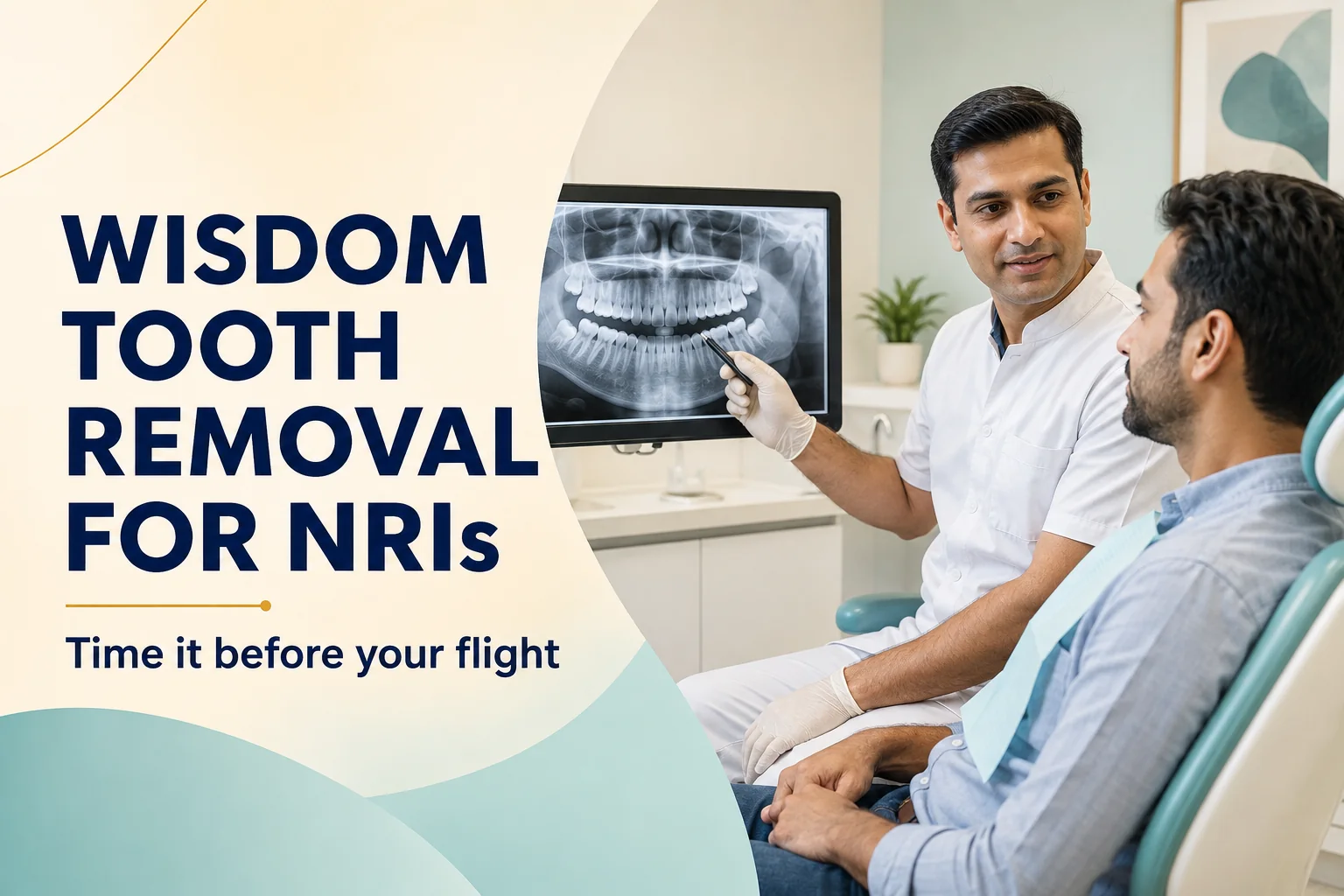
Wisdom Teeth Removal on a Visit Home: Getting the Timing Right

The extraction takes forty minutes. The recovery takes longer than most people plan for, and the riskiest days fall exactly when a visitor is packing to leave.

Dental Reading time: 10 minutes

Published: 6 September 2026

It started as a dull ache behind the back molar about three years ago. Your dentist abroad mentioned it needed to come out, quoted a number that made you blink, and you decided it was manageable. It flares up every few months, you take something for it, and it settles.

Then you book a trip home, and it occurs to you that this is the moment.

It usually is, and this is one of the few treatments that genuinely finishes inside a single visit. The thing worth planning carefully is not the appointment. It is the ten days afterwards.

Wisdom tooth removal can be completed comfortably during a visit to India, because the procedure takes under forty minutes and needs no second stage. The part that needs planning is recovery: schedule the extraction in the first week of your trip, and leave seven to ten days before a long-haul flight, because the most common complication appears three to five days afterwards.

Why do so many NRIs get this done in India?

Wisdom teeth are the classic deferred procedure. They are rarely an emergency, which is precisely why they get postponed for years. Three things tend to line up on a trip home.

  • It is not urgent, so it never gets scheduled. A problem that flares and settles never quite reaches the top of the list abroad.
  • It genuinely completes in one visit. Unlike an implant, there is no healing phase that has to finish before a second stage can start.
  • There is someone to look after you. Soft food, a lift home after the appointment, and nobody expecting you at a desk the next morning.

That last one is underrated. Recovery is considerably easier in a house where somebody else is making the khichdi.

What actually happens during the extraction?

An impacted wisdom tooth is one that does not have room to emerge fully, so it stays partly or completely below the gum. Impacted lower wisdom teeth are the most common reason extraction is recommended, and they are also the most involved to remove.

According to the NHS guidance on wisdom tooth removal, the procedure normally involves local anaesthetic, with sedation available for anxious patients. The dentist cuts the gum, widens the socket, removes the tooth whole or in sections, and places stitches if needed. The whole thing usually takes no more than 40 minutes, and patients go home the same day.

Removing a tooth in pieces sounds alarming and is entirely routine. It is often the gentler option, because it takes out less surrounding bone than lifting a large tooth whole.

How long does recovery really take?

This is where planning matters, and where most published advice is vague. Actual figures, from Guy’s and St Thomas’ NHS Foundation Trust:

What to expect, day by day
WhenWhat is normalWhat to do
Day 0 Numbness for a few hours. Light bleeding in saliva. Do not rinse at all today. Soft food. No hot drinks.
Days 1 to 2 Swelling appears, usually within 48 hours. Pain building. Start warm salt water rinses from day two, four times daily.
Days 2 to 3 Pain typically peaks, then begins to ease. Regular pain relief. Avoid exercise.
Days 3 to 5 ⚠ The dry socket window. Pain that increases rather than decreases, with a bad taste or smell. If pain is rising rather than settling, get seen. Do not wait.
Days 5 to 7 Swelling normally resolves. Jaw stiffness easing. Back to most normal food.
Up to 2 weeks Dissolving stitches disappear on their own. Residual soreness possible. No removal appointment needed for dissolving stitches.

Most people are back to normal activity the next day after a local anaesthetic. The NHS notes that a general anaesthetic typically means two to four days off, and that pain and swelling can persist for up to two weeks in some cases.

How long should you leave before flying home?

This is the question nobody publishing on dental tourism seems to answer, and it is the one that decides whether your trip ends well.

Leave at least seven to ten days between a surgical extraction and a long-haul flight. Not because flying is dangerous after dental surgery, but because the window in which something might need attention falls squarely inside the first week.

Look at the timeline again. Dry socket develops three to five days after the extraction. It is the most common complication, it is more likely with impacted lower wisdom teeth, and it is straightforward to treat: the socket is cleaned and an antiseptic dressing placed. That is a ten minute appointment.

It is a ten minute appointment if you are still in the same city as the dentist who treated you. If you flew home on day four, it becomes finding an emergency appointment in another country, with a dentist who has no records of the procedure, at whatever that costs where you live.

The complication is minor. The logistics of having it in the wrong country are not.

When in your trip should you book it?

Best: days two to five of the visit

Not the day you land, because jet lag and a general sense of chaos make a poor start. From day two onwards you are settled, and everything that follows has room around it. On a three week trip this means the entire recovery, including the risk window, is well behind you before you fly.

Workable: up to about ten days before departure

Still comfortable. Pain will have peaked and passed, swelling resolved, and the dry socket window closed with time to spare.

Avoid: the final week

Particularly the final three to five days, which places your flight directly on top of the window in which a problem is most likely to appear. If your trip is short and this is unavoidable, say so before treatment starts so it can be part of the conversation rather than a surprise.

A short trip is not automatically a no

A straightforward, fully erupted upper wisdom tooth is a much simpler extraction than an impacted lower one, and recovers faster. If your visit is only ten days, it is still worth being examined. The answer may be that one tooth is easily done now and the other is better on your next visit.

Should all four come out at once?

A genuine decision with trade-offs both ways, and worth discussing rather than assuming.

One appointment or two
All four togetherTwo at a time
Recovery periodsOneTwo, spaced apart
Total appointmentsFewerMore
EatingHarder. Both sides sore at onceEasier. One side always usable
Fits a short tripBetterNeeds a longer stay
AnaestheticSedation or general more likelyLocal usually sufficient

For someone on a limited visit, doing all four in one appointment often makes sense despite the tougher few days, simply because there is only one trip. For someone who visits India regularly, splitting them is more comfortable. Neither is the right answer in general; both are right in the right circumstances.

What about the cost?

This is usually the reason the extraction was deferred abroad in the first place, so it deserves a straight answer rather than being skipped.

The honest position: the cost of removing a wisdom tooth depends entirely on what the X-ray shows, and any figure quoted before that is guesswork. A fully erupted upper wisdom tooth and a horizontally impacted lower one sitting against the nerve are different procedures with different times, different techniques and different costs. Two teeth in the same mouth can fall into different categories.

What is worth understanding is how the gap arises in the first place.

Note what that figure is. It is the subsidised NHS rate, and NHS dental appointments are difficult to obtain across much of the UK. Private extraction of an impacted wisdom tooth, which is what most people abroad are actually quoted, sits well above it, and surgical cases higher again.

The gap between that and Indian pricing comes from premises, salaries and overheads. It does not come from the procedure, which takes the same forty minutes and uses the same instruments wherever it is performed.

What we can tell you before you travel, without seeing you, is more useful than a number anyway:

  • Whether the extraction looks straightforward or surgical, from your X-ray.
  • How many appointments it needs, and how much recovery time to allow.
  • Whether it fits your dates at all, and where in the trip to place it.
  • Whether it needs doing now, or could reasonably wait.

Send the X-ray and you get specific answers to all four, and a cost with the examination rather than before it.

How should you prepare before you travel?

Send an X-ray before you fly

If you have had a recent panoramic X-ray abroad, send it ahead. Impaction type and the position of the tooth relative to the nerve are visible on it, and that determines how involved the extraction is and how much recovery time to allow. It also means the answer to “can this be done on my trip” arrives before you have committed to dates.

Tell us your medical history properly

Blood thinners, diabetes, heart conditions and bisphosphonate medication all change how an extraction is planned. So does anything you take regularly. This is not paperwork, it genuinely changes the approach.

Plan the first 48 hours

  • Arrange a lift home from the appointment, particularly with sedation.
  • Have soft food ready: dal, curd, khichdi, soup, ice cream. Nothing hot.
  • Keep the day after clear. Not bed rest, but not a wedding either.
  • Skip the gym for several days. Exercise is specifically discouraged early on.

Know what “normal” looks like before you leave

Most people who panic after an extraction are reacting to something entirely expected. Knowing the difference in advance saves an anxious international phone call, and more importantly it means you act quickly on the one thing that does need attention.

  • Expected: swelling that peaks around day two, light bleeding in saliva for a day or so, jaw stiffness, bruising visible on the outside of the face, and a sore throat from keeping the mouth open.
  • Worth a call: pain that rises after day three instead of easing, a bad taste or smell, or bleeding that does not stop after ten minutes of firm pressure.

Ask what happens if you need help after you leave

Establish a named contact and get your treatment record, including the X-rays, in digital form before you fly. Most post-extraction questions are resolved with a photograph and a conversation, provided you know who to send it to.

If you are weighing up several treatments on the same visit, our guide to what can realistically be finished in one trip sets out which procedures fit a two, three or four week stay and which need to be staged. For anything more involved, our dental services page covers the full range.

The most useful first step is a conversation before you fly. Send your X-rays and travel dates and we can tell you whether this fits your visit and where in it to place the appointment.

Frequently asked questions

Can wisdom teeth be removed in a single visit to India?

Yes. The procedure takes under 40 minutes and needs no second stage, so it is one of the treatments that genuinely completes in one trip. Plan the recovery time rather than the appointment.

How long after wisdom tooth removal can I fly?

Leave seven to ten days where possible. Flying itself is not the concern. The reason is that dry socket, the most common complication, typically appears three to five days afterwards, and treating it is a ten minute appointment only if you are still in the same city.

How painful is it really?

Pain typically peaks around day two or three and then eases, and is usually managed with ordinary painkillers. Swelling appears within about 48 hours and lasts five to seven days. Discomfort can linger up to two weeks in some cases.

What is dry socket and how will I know?

It happens when the blood clot over the socket is lost before healing. The signal is pain that increases rather than settling after day three, often with a bad taste or smell. It is treated by cleaning the area and placing an antiseptic dressing. It is more likely if you smoke.

Should I have all four removed at the same time?

It depends on your trip. One appointment means a single tougher recovery and suits a short visit. Splitting them is more comfortable but needs either a longer stay or a second trip. Both are reasonable.

Do I need a general anaesthetic?

Usually not. Most extractions are done under local anaesthetic. Sedation is available for anxious patients and for more difficult extractions. A general anaesthetic typically means two to four days off normal activity.

Can I have it done if my wisdom tooth is not hurting?

Sometimes it is recommended, sometimes it is not. A wisdom tooth causing no problems is often left alone. An X-ray and examination decide it, and being told it can safely stay is a legitimate outcome.

What should I bring to the appointment?

Any recent X-rays, a list of medicines you take, and details of relevant medical conditions, particularly blood thinners, diabetes or heart conditions.

How much does wisdom tooth removal cost in Vadodara?

It depends on what the X-ray shows, because a fully erupted upper tooth and an impacted lower one are genuinely different procedures. Send your X-ray before you travel and you will get a specific answer along with the treatment plan, rather than a range that may not apply to your case.

Can I eat normally afterwards?

Not for the first couple of days. Soft, cool food from the start: dal, curd, khichdi, soup, ice cream. Avoid hot food and drinks for two days, and hard or crunchy food until the socket has settled. Most people are back to normal food within about a week.

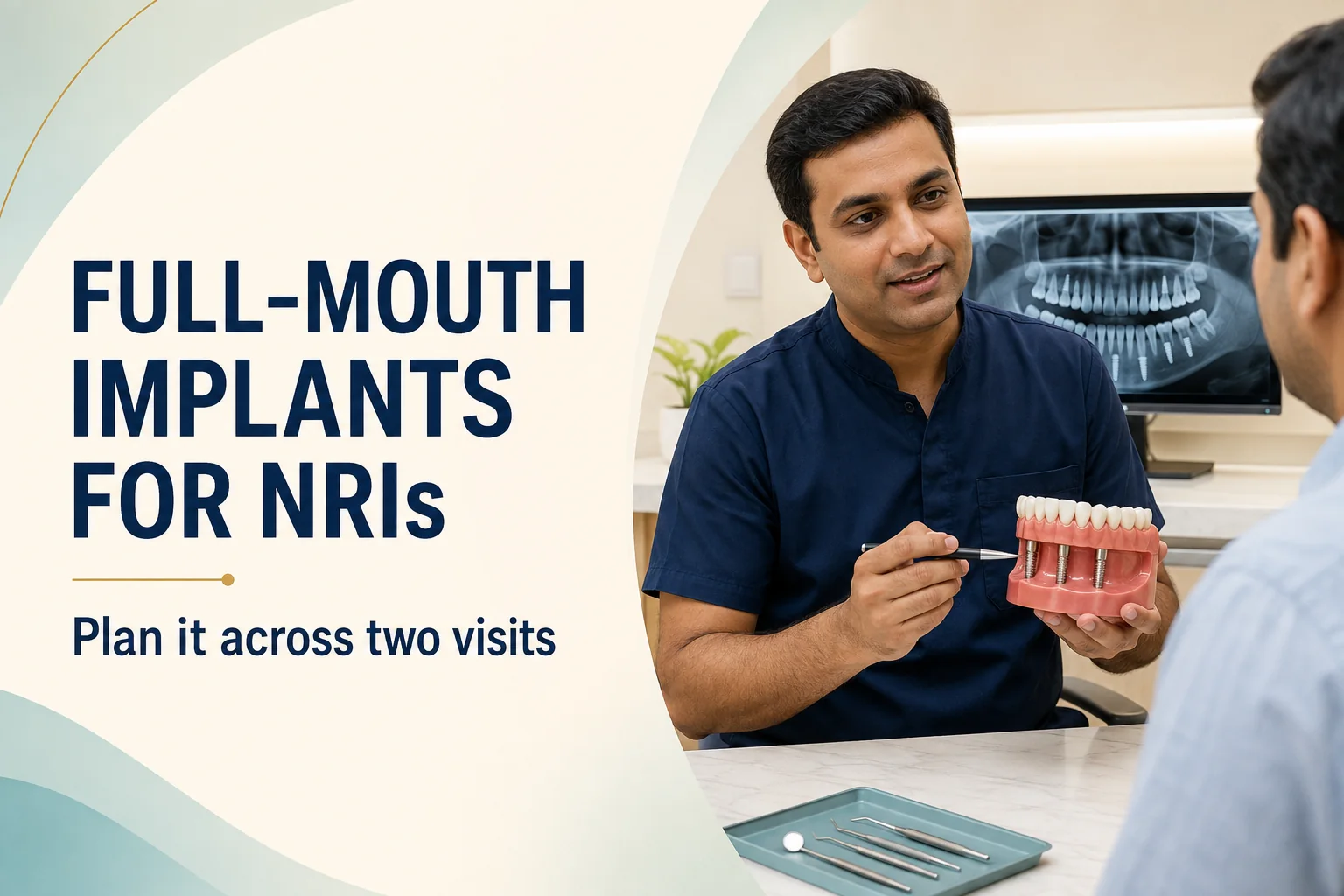
Full-Mouth Implants for NRIs: How the Two-Trip Plan Actually Works

The biggest treatment most people will ever have, planned around a flight schedule. What happens on each visit, what happens in the months between, and why “teeth in a day” does not mean what it sounds like.

Dental Reading time: 13 minutes

Published: 6 September 2026

You have been managing for years. A partial denture that never quite settled, or a run of failing teeth that have each been patched more than once. Someone has mentioned full-mouth implants, you priced it where you live, and the figure was somewhere between a car and a deposit on a flat.

So you are looking at having it done in India, on a visit home.

That is a reasonable plan, and it is the treatment where getting the sequencing right matters most. It is also the treatment most often mis-sold to people with a return flight booked.

Full-arch implant treatment cannot be completed in a single visit to India. Implants need three to six months to fuse with the jawbone before the permanent teeth are attached. The realistic plan is two trips: surgery and a fixed temporary bridge on the first, the final teeth on the second, with the healing happening while you are back home.

What does full-mouth implant treatment actually mean?

A full-arch implant bridge replaces all the teeth in one jaw with a single fixed bridge, supported on a small number of implants placed in the jawbone. It is fixed in place, so it does not come out, unlike a denture.

Two things people often assume, both wrong, and worth clearing up early because they change the whole conversation:

  • You do not get one implant per tooth. A full arch of twelve to fourteen teeth is typically carried on four to six implants. The bridge spans between them.
  • “Full mouth” often means one jaw, not both. Upper and lower are separate treatments with separate costs and different difficulty. Establish which is being quoted, because it is a common source of confusion when comparing prices.

The upper jaw is generally more demanding than the lower. The bone is softer and the sinuses sit above the back teeth, which sometimes limits where implants can be placed. A quote for a lower arch is not a guide to what an upper arch will cost or involve.

What is All-on-4, and is it right for everyone?

All-on-4 is a specific technique in which a full arch is supported on four implants, with the two at the back placed at an angle. Tilting them lets the implant engage more available bone, which often avoids the need for a graft.

It is a genuine advance and it suits a lot of people. It is not a universal answer, and it is worth understanding the trade-offs rather than treating the name as a guarantee of quality.

Common full-arch approaches
ApproachTypical useConsiderations
All-on-4 Full arch on four implants, back two angled Often avoids grafting. Fewer implants means each carries more load, so placement accuracy matters a great deal.
All-on-6 Full arch on six implants Load spread more widely. Often preferred in the upper jaw or with heavy chewing forces. Needs more available bone.
Implant-supported overdenture A removable denture clipped onto two to four implants Removable rather than fixed. Considerably less expensive. Easier to clean. Some people prefer it.
Individual implants and bridges Where several natural teeth are still sound Keeps healthy teeth. Rarely appropriate for a whole failing arch.

The right approach depends on how much bone you have, where it is, how you bite, and what you want. A clinic that recommends the same technique to everyone is selling a product rather than planning a treatment.

Does “teeth in a day” mean I fly home with permanent teeth?

No, and this is the single biggest misunderstanding in this entire subject.

Immediate loading is a real, well-established technique. Implants are placed and a fixed temporary bridge is attached the same day, so you do genuinely leave with fixed teeth rather than a gap or a removable denture.

The bridge you leave with on day one is a temporary. It is designed to look good and function reasonably while the bone heals. It is usually acrylic, deliberately lighter and more forgiving than the final one, and it is not the finished result.

The permanent bridge is made after healing is complete, once the implants are stable and the gum has settled into its final shape. That is when impressions are taken for the definitive prosthesis, typically in zirconia or a metal-reinforced material, built to last.

Why the distinction matters to you specifically: “teeth in a day” is often marketed to overseas patients in a way that implies the whole treatment finishes in one trip. It does not. It means you do not walk around toothless during healing, which is genuinely valuable, and it is a different claim entirely.

How does the two-trip plan work?

Here is the sequence that actually works for someone living abroad.

Before you travel

  • Send existing X-rays, any CBCT scan, and a treatment plan or quote from abroad if you have one.
  • Discuss your medical history properly, particularly diabetes, blood thinners, bisphosphonates and smoking, all of which affect implant healing.
  • Get an indicative plan and an appointment schedule mapped against your dates before you book flights, not after.

Trip one: roughly 10 to 21 days

  1. Examination, imaging and final planning. A CBCT scan is standard for full-arch work and lets the implant positions be planned in three dimensions.
  2. Any remaining failing teeth removed, and implants placed. Usually one surgical session per arch.
  3. A fixed temporary bridge fitted, often the same day or within a few days.
  4. A review appointment at seven to fourteen days, checking healing and the surgical sites.
  5. You fly home with fixed temporary teeth and written aftercare.

Between the trips: three to six months

The implants fuse with the bone. You eat carefully, following the instructions you were given, and stay in contact for remote review.

Trip two: roughly 7 to 14 days

  1. Healing assessed and implant stability confirmed.
  2. Impressions or digital scans taken for the permanent bridge.
  3. Try-in, adjustments to fit, bite and appearance.
  4. Final bridge fitted and the bite refined.
  5. You fly home with the finished result and full documentation.

Those timings come from what the treatment requires rather than from what fits a holiday. Guy’s and St Thomas’ NHS Foundation Trust states that implants are left to heal in the bone for three to six months and sometimes longer, that impressions and fitting the final restoration add a further two to three months, and that total treatment runs six to twelve months, with a bone graft adding four to six months again.

What happens during the months in between?

This is the part of the plan most likely to be glossed over, and the part that decides whether treatment at distance actually works.

You will be living normally, eight thousand kilometres away, wearing a temporary bridge over healing implants. Several things need to be settled before you leave.

  • Eating. A temporary bridge is not built for full chewing force. You will be given specific instructions and they matter, because overloading implants during healing is one of the ways they fail.
  • Cleaning. Full-arch bridges need cleaning underneath, and the technique should be demonstrated at the chair before you fly, not explained over video afterwards.
  • Remote review. Agree how and when. Photographs at set intervals, a video call, and a named contact who answers.
  • If the temporary chips or loosens. This is not unusual over several months. Agree in advance what a local dentist can safely do and what must wait, and leave with the documentation they would need.
  • Smoking. Smoking materially raises the risk of implant failure. If you smoke, this is the conversation to have honestly before surgery rather than after.

On aftercare more generally, Guy’s and St Thomas’ NHS Foundation Trust describes soreness, swelling or bruising in the first week, a review at seven to fourteen days for suture removal and wound assessment, the implant site left unbrushed for the first week with chlorhexidine mouthwash used instead, and regular ongoing checks thereafter, noting that implants last well only when properly maintained.

What if I have been told I need a bone graft?

A bone graft adds bone where there is not enough to hold an implant securely. Bone is lost over time after teeth are removed, so people who have been without teeth for years frequently need it.

Grafting changes the plan significantly, and it is better to know before you book flights.

  • It adds four to six months to overall treatment.
  • It may mean a third visit, or a longer first one, depending on whether the graft and the implant can be done together.
  • Some grafting is done at the same time as implant placement; larger grafts need to heal first.

This is one reason All-on-4 is often proposed. Angling the rear implants can engage existing bone and avoid grafting altogether, which for a patient managing this around international travel can be the difference between two trips and three. Whether it is appropriate depends on your scan, not on preference.

What should you ask before committing?

This is a large, effectively irreversible treatment. These questions are reasonable and the answers should be specific.

  1. Which implant system, and can I have the documentation? Manufacturer, size and batch details. You may need them in another country in fifteen years.
  2. How many implants, and why that number for my case?
  3. Upper, lower, or both? Confirm exactly what the quote covers.
  4. What material is the final bridge? And what is the temporary?
  5. Who places the implants, and who makes the final bridge? Names and qualifications.
  6. What happens if an implant does not integrate? It is uncommon but it happens. There should be a clear, stated position.
  7. What is the plan if I cannot return exactly on schedule? Flights change. This should not be a crisis.

Our separate guide on how to check a dentist and an implant system before you fly goes through the verification steps in detail, including how to look up State Dental Council registration.

What about cost?

Cost is the reason most people consider this in India, so it deserves a direct answer rather than being avoided.

We cannot give a figure before an examination and a scan, and any clinic that does is guessing. Five things move a full-arch total substantially:

  • The number of implants placed.
  • The implant system used.
  • Whether bone grafting is needed.
  • The material of the final bridge.
  • Whether one arch or both are being treated.

What can be said honestly is where the difference comes from. Implant systems, components and materials trade on a global market at broadly comparable prices. Premises, salaries and laboratory costs do not. For scale on the comparison, NHS England publishes Band 3 at £332.10 as of the March 2025 review, covering crowns, bridges and dentures, and note that full-arch implant work is not routinely available on the NHS at all, so the relevant comparison abroad is private pricing.

Compare what is included, not the headline number. Ask whether the quote covers the scan, extractions, the temporary bridge, the final bridge, review appointments and the second trip’s work. Two quotes that look far apart often include different things.

If you are planning several treatments on the same visit, our guide to what can realistically be finished in one trip sets out the sequencing, and crown, bridge or implant covers the single-tooth decision. Our dental services page lists what is available.

Send your scans and your travel dates and we will map a realistic two-trip plan against them before you book anything.

Frequently asked questions

Can full-mouth implants be done in one trip to India?

No. Implants need three to six months to fuse with the jawbone before the permanent bridge is fitted. You can have surgery and a fixed temporary bridge on one trip and the final teeth on the next. Any offer to complete permanent full-arch work inside a few weeks should be questioned closely.

What does “teeth in a day” actually mean?

That implants are placed and a fixed temporary bridge attached the same day, so you are not without teeth during healing. The permanent bridge is made months later, after the bone has fused with the implants.

How long is each trip?

Roughly 10 to 21 days for the first, covering assessment, surgery, the temporary bridge and a review. Roughly 7 to 14 days for the second, covering impressions, try-in and fitting the final bridge.

What is the difference between All-on-4 and All-on-6?

The number of implants supporting the arch. All-on-4 angles the rear implants to use available bone and often avoids grafting. All-on-6 spreads the load across more implants and is often preferred in the upper jaw or with heavy bite forces. Which suits you depends on your scan.

Will I be without teeth at any point?

Usually not. A fixed temporary bridge is normally placed at the time of surgery or within a few days, so you leave with teeth. Confirm this is included in your plan rather than assuming it.

What if an implant fails to integrate?

It is uncommon but it does happen, and it is more likely in smokers and in people with uncontrolled diabetes. Ask before treatment what the clinic’s position is, and get it in writing.

Does the final bridge look natural?

A well-made full-arch bridge can look very natural. Appearance depends on the material, the laboratory work and the try-in stage, which is where shape, shade and tooth position are adjusted before anything is finalised. Do not skip the try-in, and say clearly at that appointment if something is not right.

Can I fly soon after implant surgery?

Allow time for the seven to fourteen day review before flying where possible. Schedule surgery early in the trip so that review falls inside your stay rather than after you have left.

Types of Braces Available in Vadodara: Metal, Ceramic, Lingual and Clear 

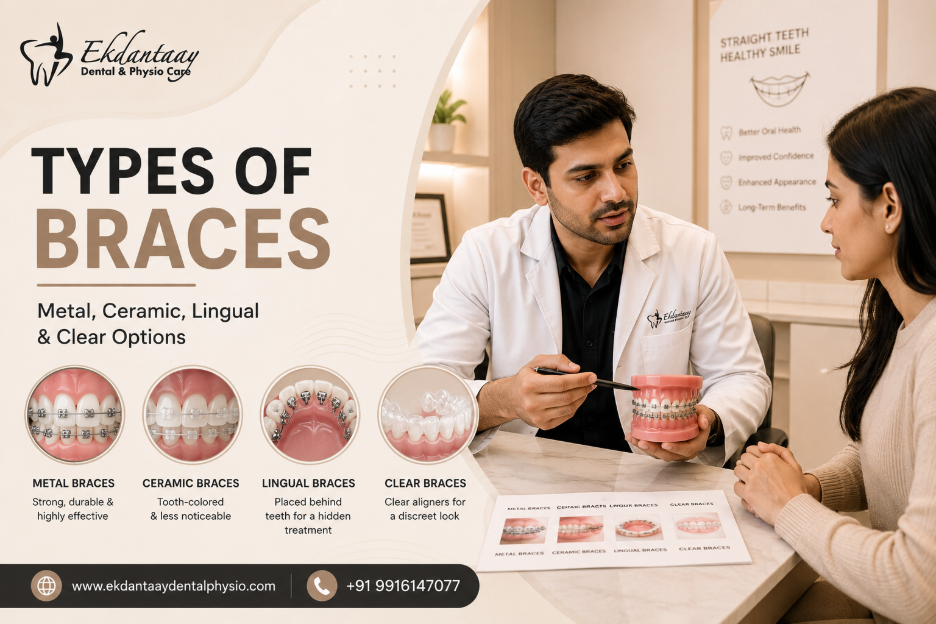
The main types of braces available in Vadodara are metal, ceramic, lingual, and clear braces. Each option differs in appearance, comfort, maintenance, and suitability for specific dental conditions. The right braces depend on factors such as tooth alignment, bite, oral health, lifestyle, and the orthodontist’s recommended treatment plan. 

Introduction  

Choosing braces is an important decision, especially when you are comparing different treatment options for yourself or your child. The types of braces available today offer different levels of visibility, comfort, maintenance, and suitability depending on the individual dental condition. 

The most commonly discussed options include metal braces, ceramic braces, lingual braces, and clear braces. While all these options are designed to improve tooth alignment, they are not interchangeable. The right choice depends on the position of your teeth, the type of correction required, your lifestyle, and your orthodontist’s treatment plan. 

If you are looking for the right braces in Vadodara, understanding how these options differ can help you have a more informed conversation with your orthodontist. 

At Ekdantaay Dental & Physio Care, Dr. Raj Parthdev provides orthodontic treatment based on each patient’s individual dental needs. Rather than recommending one option for everyone, the treatment approach is selected after assessing the teeth, bite, oral health, and expected treatment goals. 

This guide explains the major types of braces, how each option works, their advantages and limitations, and what you should consider before making a decision. 

What Are the Different Types of Braces? 

The main types of braces include metal braces, ceramic braces, lingual braces, and clear braces. They differ mainly in their design, visibility, placement, maintenance requirements, and suitability for different patients. 

Here is a quick comparison: 

Type Visibility Placement Main Advantage Important Consideration 
Metal braces More visible Front of teeth Reliable and versatile More noticeable 
Ceramic braces Less noticeable Front of teeth Tooth-coloured appearance Requires careful maintenance 
Lingual braces Hidden Back of teeth Very discreet May require an adjustment period 
Clear braces Less noticeable Depends on the system Discreet appearance Suitability varies by case 

Although appearance is an important consideration for many patients, it should not be the only factor. Orthodontic treatment is primarily planned around achieving appropriate tooth movement and a healthy bite. 

How Do the Different Types of Braces Work? 

Braces use controlled forces to gradually move teeth toward planned positions. The orthodontic system applies pressure through brackets, wires, or other components, while the surrounding tissues adapt to the gradual movement. 

The basic principle is similar across fixed braces, but the design and position of the appliance can differ. 

For example, conventional braces are attached to the front surface of the teeth, while lingual braces are positioned behind the teeth. Ceramic braces use tooth-coloured components to make the appliance less noticeable. 

This means that choosing between the types of braces is not simply an aesthetic decision. Your orthodontist must determine which system can effectively address your particular dental condition. 

Metal Braces: A Reliable Orthodontic Option 

Metal braces are one of the most established orthodontic treatment options. They use brackets attached to the front surfaces of the teeth and an orthodontic wire that guides tooth movement throughout treatment. 

Modern metal braces are smaller and more refined than many of the older designs patients may remember. They remain widely used because they can be suitable for a broad range of orthodontic problems. 

What Are the Advantages of Metal Braces? 

One of the biggest advantages of metal braces is their versatility. They can be used in many different treatment situations and are commonly considered when significant tooth movement or bite correction is required. 

Other advantages include: 

  • Proven orthodontic design 
  • Durable components 
  • Suitable for many treatment needs 
  • Continuous tooth movement during treatment 
  • No requirement for the patient to remove the appliance 

Because metal braces remain attached to the teeth throughout active treatment, patients do not need to remember to put them back after eating or brushing. 

Ceramic Braces: A More Discreet Fixed Option 

Ceramic braces work on the same basic orthodontic principle as conventional braces, but the brackets are designed to blend more closely with the natural appearance of the teeth. 

They are often considered by patients who want fixed orthodontic treatment while reducing the visibility of their braces. 

Ceramic braces can be particularly appealing to older teenagers and adults who are concerned about the appearance of traditional metal brackets. 

What Are the Advantages of Ceramic Braces? 

The main advantage of ceramic braces is their appearance. 

Depending on the system used, the brackets can be considerably less noticeable than traditional metal brackets. 

Potential advantages include: 

  • More discreet appearance 
  • Fixed treatment approach 
  • Suitable for many orthodontic situations 
  • Can be an option for patients who prioritise aesthetics 

However, ceramic components may require careful handling and cleaning. Your orthodontist will explain whether they are appropriate for your particular treatment. 

Lingual Braces Vadodara: What Makes Them Different? 

Lingual braces Vadodara are designed to be placed on the inner surfaces of the teeth rather than the outer surfaces. 

Because the brackets are positioned behind the teeth, they are much less visible when a person smiles. 

This makes lingual braces an option for patients who want fixed orthodontic treatment while keeping the appliance discreet. 

What Are the Benefits of Lingual Braces? 

The most obvious benefit is their discreet appearance. 

Other considerations include: 

  • Braces are positioned behind the teeth 
  • They are difficult to notice when smiling 
  • They provide a fixed treatment approach 
  • They may appeal to adults concerned about visible braces 

However, because the appliance is positioned behind the teeth, patients may need time to adapt to the sensation. Cleaning can also require additional attention. 

A consultation is therefore important before deciding whether lingual braces are appropriate for your case. 

What Are Clear Braces? 

Clear braces are designed to make orthodontic treatment less noticeable while still providing the benefits of a fixed appliance. The term can refer to braces that use less visible components, depending on the specific system being offered. 

For patients who are concerned about the appearance of traditional braces, clear braces can provide a more discreet alternative while keeping the appliance attached to the teeth throughout treatment. 

However, the appearance of the appliance is only one consideration. Your orthodontist also needs to evaluate whether the treatment system can provide the tooth movement required for your individual case. 

What Are the Advantages of Clear Braces? 

Clear braces may appeal to patients who want a less noticeable treatment option. 

Their potential advantages include: 

  • More discreet appearance 
  • Fixed treatment approach 
  • Suitable for selected orthodontic cases 
  • Less visually prominent than conventional metal braces 
  • No need to remove the appliance during meals 

Like other fixed appliances, clear braces require consistent oral hygiene. Patients should carefully clean around the brackets and follow their orthodontist’s instructions throughout treatment. 

Types of Braces: How Do They Compare? 

The different types of braces offer different combinations of appearance, placement, maintenance, and treatment characteristics. 

Factor Metal Braces Ceramic Braces Lingual Braces Clear Braces 
Appearance More noticeable Less noticeable Highly discreet Less noticeable 
Position Front of teeth Front of teeth Behind teeth Depends on system 
Fixed appliance Yes Yes Yes Yes 
Cleaning Requires regular attention Requires regular attention Can require additional care Requires regular attention 
Visibility Higher Lower Very low Lower 
Patient adaptation Usually straightforward Usually straightforward May require more adaptation Usually straightforward 
Suitability Many orthodontic cases Selected cases Selected cases Selected cases 

This comparison provides a general overview. It should not be used to select treatment without a professional assessment because the most suitable appliance depends on the individual’s dental condition. 

Which Type of Braces Is Best for You? 

There is no single option that is best for every patient. The appropriate types of braces depend on your dental condition, treatment objectives, lifestyle, appearance preferences, and the type of tooth movement required. 

For example, a patient who prioritizes durability and versatility may consider metal braces, while someone who is more concerned about visibility may prefer ceramic, lingual, or clear options when clinically suitable. 

Your orthodontist should make the final recommendation after examining your teeth and bite. 

Metal Braces May Be Considered When: 

  • A reliable fixed appliance is required 
  • The case involves more extensive tooth movement 
  • Appearance is less important than appliance versatility 
  • A patient prefers a straightforward fixed treatment option 

Ceramic Braces May Be Considered When: 

  • A fixed appliance is appropriate 
  • The patient wants a less noticeable appearance 
  • The dental condition is suitable for this type of appliance 

Lingual Braces May Be Considered When: 

  • Discreet fixed treatment is a priority 
  • The patient’s dental condition is suitable 
  • The patient is comfortable adapting to an appliance positioned behind the teeth 

Clear Braces May Be Considered When: 

  • A less noticeable fixed option is preferred 
  • The patient’s dental condition is suitable 
  • Appearance is an important treatment consideration 

These are general considerations rather than treatment recommendations. An orthodontic examination is necessary before selecting an appliance. 

What Should You Consider Before Choosing Braces? 

Choosing between the different types of braces involves more than comparing how they look. 

1. Your Dental Condition 

The first consideration should always be your teeth and bite. Some treatment options may be more appropriate for types of tooth movement than others. 

2. Appearance 

If you are concerned about visible orthodontic appliances, you may want to discuss ceramic, lingual, or clear options with your orthodontist. 

3. Maintenance 

Every fixed appliance requires good oral hygiene. Some designs may require additional attention while brushing and cleaning between teeth. 

4. Comfort and Adaptation 

It is normal to need some time to adapt to braces. The location and design of the appliance can influence how quickly you become comfortable with it. 

5. Treatment Requirements 

Your orthodontist needs to consider the amount and direction of tooth movement required before recommending an appliance. 

6. Your Lifestyle 

Students, working professionals, public-facing professionals, and others may have different preferences regarding the appearance and maintenance of their braces. 

7. Long-Term Results 

The goal should not simply be to choose the least noticeable appliance. The treatment should be planned to achieve appropriate tooth alignment and bite function. 

How Do You Take Care of Braces? 

Regardless of which type of braces you choose, maintaining good oral hygiene is an important part of treatment. 

Brackets and wires can create additional areas where food particles and plaque can be collected. Careful cleaning helps protect the teeth and gums during orthodontic treatment. 

Follow These Basic Care Tips: 

  • Brush carefully around all brackets and wires. 
  • Clean between the teeth regularly. 
  • Follow the cleaning technique recommended by your orthodontist. 
  • Avoid foods that may damage the appliance. 
  • Attend scheduled orthodontic appointments. 
  • Inform your orthodontist if a bracket or wire becomes damaged. 
  • Continue routine dental care during orthodontic treatment. 

Good daily care can make treatment more comfortable and help maintain healthy teeth and gums throughout the process. 

Do Braces Hurt? 

Some patients experience temporary discomfort when braces are first placed or after adjustments. This happens because the teeth are responding to controlled orthodontic forces. 

The sensation is generally temporary and tends to become easier to manage as the patient adapts. 

The amount of discomfort can vary from one person to another. If you experience significant or persistent pain, contact your orthodontist rather than trying to manage the problem yourself. 

How Long Do You Need to Wear Braces? 

Treatment duration varies between patients. The time required depends on factors such as: 

  • The complexity of the dental condition 
  • The amount of tooth movement required 
  • The selected appliance 
  • Patient cooperation 
  • Oral hygiene 
  • Regular attendance at appointments 

Your orthodontist can provide a more meaningful estimate after examining your teeth and preparing your treatment plan. It is important not to compare your treatment duration with someone else’s. Two patients may have similar-looking braces but completely different treatment requirements. 

How Can Dr. Raj Parthdev Help You Choose? 

Selecting the right braces begins with understanding your individual dental needs. 

At Ekdantaay Dental & Physio Care, Dr. Raj Parthdev evaluates the alignment of the teeth, bite relationship, oral health, and treatment objectives before recommending an appropriate orthodontic approach. 

Rather than treating every patient with the same appliance, the treatment plan is personalized according to the patient’s condition and expectations. 

If you are considering braces in Vadodara, a consultation can help you understand: 

  • Which treatment options may be suitable 
  • How different braces compare 
  • What your treatment may involve 
  • How you should care for your braces 
  • What factors may affect your treatment duration 

A professional assessment gives you a clearer basis for making your decision instead of choosing an appliance based only on appearance or someone else’s experience. 

Key Takeaways 

The main types of braces discussed in this guide are metal braces, ceramic braces, lingual braces, and clear braces. Each option has different characteristics, and none is automatically the right choice for every patient. 

  • Metal braces are a well-established fixed option. 
  • Ceramic braces provide a less noticeable appearance. 
  • Lingual braces are positioned behind the teeth. 
  • Clear braces offer a more discreet appearance in suitable cases. 
  • Treatment selection should be based on your individual dental condition. 
  • Appearance, maintenance, comfort, lifestyle, and treatment requirements should all be considered. 
  • A consultation with an orthodontist is the best way to determine the appropriate option. 

Considering Braces in Vadodara? 

If you are unsure which type of braces may be suitable for you or your child, a professional orthodontic assessment is the right place to start. 

At Ekdantaay Dental & Physio Care, Dr. Raj Parthdev provides personalised orthodontic treatment in Vadodara based on patient’s dental needs and treatment goals. 

Clinic Address: 

501, Elite Elegance, Gotri Sevasi Main Road, 

Besides Collabera, Opposite Hanuman Mandir, 

Chandramauleshwar Nagar, Gotri, 

Vadodara, Gujarat 391101 

Book a consultation to discuss your orthodontic concerns and understand which treatment option may be appropriate for your smile. 

Medical Disclaimer 

This article is provided for general educational purposes and should not replace professional dental examination, diagnosis, or treatment. Every patient’s dental condition is different, so the appropriate treatment option should be determined by a qualified dental professional after an individual assessment. 

What Is Orthodontic Treatment? A Complete Guide for Patients in Vadodara 

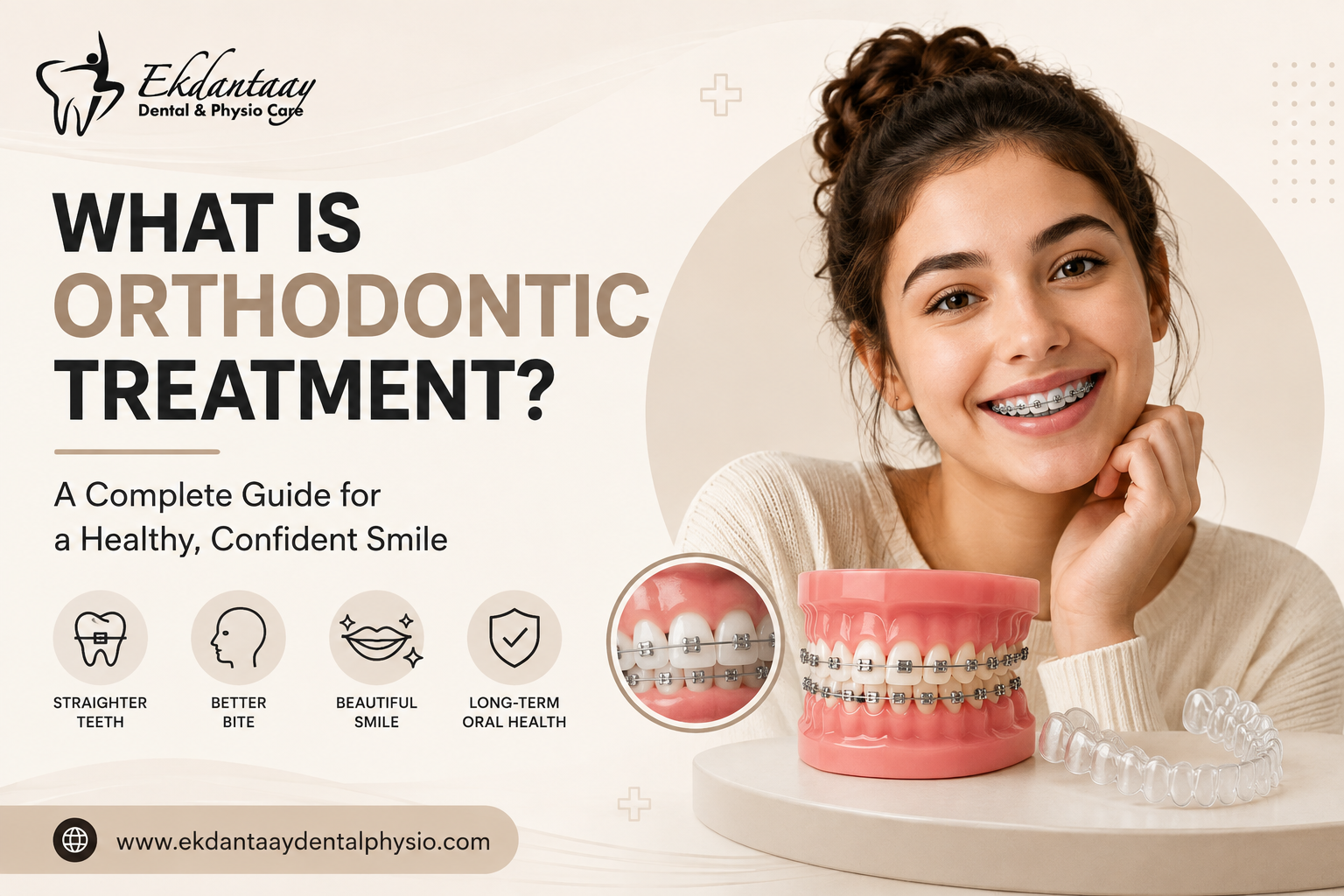
Orthodontic treatment is a specialized branch of dentistry that corrects misaligned teeth, improper bites, and jaw irregularities using braces, clear aligners, or other orthodontic appliances. Proper treatment improves oral health, chewing efficiency, speech, facial aesthetics, and long-term dental function for both children and adults. 

Introduction 

A straight, healthy smile is about much more than appearance. Misaligned teeth can make it difficult to clean your teeth properly, chew comfortably, speak clearly, and maintain good oral hygiene. Over time, these issues may increase the risk of tooth decay, gum disease, abnormal tooth wear, jaw discomfort, and reduced confidence in your smile. 

This is where orthodontic treatment plays an important role. Orthodontics is a specialized area of dentistry focused on correcting crooked teeth, bite problems, and jaw alignment to improve both oral health and smile aesthetics. Modern orthodontic care offers several treatment options, including traditional metal braces, ceramic braces, self-ligating braces, and clear aligners, allowing patients to choose solutions that fit their lifestyle and dental needs. 

Whether you’re a parent wondering if your child needs braces or an adult considering teeth straightening for the first time, understanding orthodontic treatment helps you make an informed decision. 

At Ekdantaay Dental & Physio Care in Vadodara, Dr. Raj Parthdev provides personalized orthodontic treatment plans designed to achieve healthy, functional, and confident smiles. Every treatment begins with a detailed assessment of your teeth, bite, and jaw alignment to recommend the most suitable option for your needs. 

In this comprehensive guide, you’ll learn what orthodontic treatment is, who can benefit from it, the types of braces available, treatment duration, expected costs, common myths, and what to expect throughout your orthodontic journey. 

What Is Orthodontic Treatment? 

Orthodontic treatment is a specialized dental treatment that corrects the position of teeth and jaws to improve oral health, bite function, and smile appearance. It uses braces, clear aligners, retainers, and other orthodontic appliances to gradually move teeth into their ideal positions. 

Orthodontics is one of the recognized specialties in dentistry. Rather than focusing only on repairing damaged teeth, orthodontics addresses the alignment of teeth and jaws. Properly aligned teeth are easier to clean, distribute biting forces more evenly, and can contribute to improved speech and facial harmony. 

Orthodontic treatment is suitable for children, teenagers, and adults. Thanks to advances in dental technology, many modern treatments are more comfortable, discreet, and efficient than ever before. 

Orthodontic treatment can help correct: 

  • Crooked teeth  
  • Crowded teeth  
  • Gaps between teeth  
  • Overbite  
  • Underbite  
  • Crossbite  
  • Open bite  
  • Protruding front teeth  
  • Jaw alignment problems  
  • Uneven bite  

When these conditions are left untreated, they may contribute to difficulties with oral hygiene, uneven tooth wear, gum problems, and jaw discomfort over time. 

Definition 

Orthodontic treatment is the branch of dentistry that diagnoses, prevents, and corrects improperly positioned teeth and jaw relationships using specialized appliances such as braces and clear aligners. 

Why Is Orthodontic Treatment Important? 

Many people think braces are only for cosmetic reasons, but orthodontic treatment provides significant functional and long-term health benefits. 

A properly aligned bite can improve chewing efficiency, reduce excessive pressure on certain teeth, make brushing and flossing easier, and lower the risk of future dental complications. 

Orthodontic treatment improves: 

  • Oral hygiene  
  • Chewing ability  
  • Speech clarity  
  • Bite function  
  • Jaw comfort  
  • Facial balance  
  • Smile confidence  
  • Long-term dental health  

Health Benefits of Orthodontic Treatment 

Benefit How It Helps 
Easier Cleaning Straight teeth are easier to brush and floss effectively. 
Lower Risk of Tooth Decay Better cleaning reduces plaque buildup and cavities. 
Healthier Gums Properly aligned teeth are less likely to trap food and bacteria. 
Better Bite Improves chewing efficiency and reduces uneven tooth wear. 
Reduced Jaw Stress Correcting bite issues may decrease strain on the jaw joints. 
Improved Speech Certain alignment issues can affect pronunciation; correction may improve clarity. 
Enhanced Confidence A straighter smile often contributes to greater self-esteem and comfort in social situations. 

Beyond these clinical benefits, orthodontic treatment often has a positive impact on quality of life. Many patients report feeling more confident during conversations, smiling more freely in photographs, and finding it easier to maintain their oral hygiene routine after treatment. 

At Ekdantaay Dental & Physio Care, treatment planning goes beyond simply straightening teeth. Dr. Raj Parthdev evaluates your bite, jaw relationship, facial profile, and oral health to create a personalized orthodontic plan aimed at achieving both functional stability and an attractive smile. 

How Does Orthodontic Treatment Work? 

Orthodontic treatment works by applying gentle, continuous pressure to move teeth into their correct positions over time. Depending on your dental condition, this is achieved using braces, clear aligners, or other orthodontic appliances. The movement happens gradually, allowing the surrounding bone and tissues to adapt safely while creating a healthier bite and a well-aligned smile. 

Teeth are supported by the jawbone and surrounded by a ligament called the periodontal ligament. When a controlled force is applied, the bone around the tooth naturally remodels. Bone on one side of the tooth is gradually resorbed, while new bone forms on the opposite side, allowing the tooth to move into its planned position. 

Since every patient’s teeth and bite are unique, orthodontic treatment begins with a detailed clinical examination. Your orthodontist evaluates your teeth, jaw alignment, bite relationship, and overall oral health before creating a personalised treatment plan. 

At Ekdantaay Dental & Physio Care, Dr. Raj Parthdev carefully plans each stage of treatment to ensure teeth move safely, efficiently, and predictably while maintaining long-term oral health. 

The Orthodontic Treatment Process 

Step What Happens 
Initial Consultation Examination of teeth, bite, and jaw alignment to understand the orthodontic problem. 
Diagnostic Records Digital scans, photographs, and dental X-rays help create an accurate treatment plan. 
Personalized Treatment Plan The most suitable orthodontic treatment option is selected based on your needs. 
Appliance Placement Braces or clear aligners are provided according to the treatment plan. 
Regular Follow-Up Visits Periodic appointments monitor progress and make necessary adjustments. 
Retention Phase Retainers help maintain the new tooth position after active treatment is completed. 

Each stage is important for achieving stable, long-lasting results. Skipping appointments or not following your orthodontist’s instructions may delay treatment progress. 

Who Needs Orthodontic Treatment? 

Orthodontic treatment is recommended for children, teenagers, and adults who have crooked teeth, bite problems, or spacing issues that affect oral health, function, or appearance. Early evaluation can help identify developing problems, while adults can also benefit from orthodontic treatment at any age. 

Many people believe orthodontic treatment is only for teenagers, but this is a common misconception. Advances in orthodontic technology have made treatment suitable for patients of all age groups. Whether the goal is improving bite function, correcting crowded teeth, or achieving a straighter smile, orthodontic treatment can be planned according to the individual’s dental condition. 

You May Need Orthodontic Treatment If You Have: 

  • Crooked teeth  
  • Crowded teeth  
  • Gaps between teeth  
  • Difficulty biting or chewing food  
  • Teeth that protrude significantly  
  • Upper and lower teeth that do not meet properly  
  • Frequent cheek biting  
  • Speech difficulties related to tooth alignment  
  • Jaw discomfort caused by bite problems  
  • Difficulty maintaining proper oral hygiene because of overlapping teeth  

If any of these concerns sound familiar, an orthodontic consultation can help determine whether treatment is appropriate. 

Orthodontic Treatment for Children 

The Indian Orthodontic Society and many dental professionals recommend that children have an orthodontic evaluation by around seven years of age. This does not necessarily mean treatment will begin immediately. Instead, early assessment helps identify developing bite or jaw problems before they become more complex. 

Early orthodontic monitoring may help guide jaw growth, manage space for permanent teeth, and reduce the likelihood of more extensive treatment later. 

Parents should consider an orthodontic evaluation if they notice: 

  • Early or delayed loss of baby teeth  
  • Crowded permanent teeth  
  • Difficulty chewing food  
  • Mouth breathing  
  • Thumb sucking beyond the appropriate age  
  • Noticeable jaw shifting  
  • Teeth that appear significantly misaligned  

Orthodontic Treatment for Teenagers 

Teenage years are often considered an ideal time for orthodontic treatment because most permanent teeth have erupted, while the jaw is still developing. 

During this stage, orthodontic treatment can effectively correct: 

  • Crowding  
  • Spacing  
  • Bite problems  
  • Jaw alignment concerns  
  • Protruding front teeth  

Many teenagers choose from different orthodontic treatment options based on their clinical needs and lifestyle preferences. 

Orthodontic Treatment for Adults 

Orthodontic treatment is not limited by age. Adults increasingly seek treatment to improve oral health, smile aesthetics, and bite function. 

Adult orthodontic treatment can help: 

  • Correct long-standing bite problems  
  • Improve oral hygiene by aligning crowded teeth  
  • Prepare teeth for restorative dental procedures  
  • Enhance smile confidence  
  • Reduce abnormal tooth wear caused by improper bite alignment  

Although adult treatment may take slightly longer than treatment for younger patients, predictable outcomes can still be achieved with proper planning and patient cooperation. 

Common Orthodontic Problems 

Orthodontic treatment addresses a wide range of dental alignment and bite issues. Identifying these problems early allows treatment to begin before they lead to additional complications. 

Crowded Teeth 

Crowded teeth occur when there is not enough space in the jaw for all teeth to align properly. Overlapping teeth can make brushing and flossing more difficult, increasing the risk of plaque buildup and gum disease. 

Spacing Between Teeth 

Noticeable gaps between teeth may occur because of missing teeth, differences in tooth size, or natural jaw development. While some spacing is purely cosmetic, larger gaps may also affect bite function. 

Overbite 

An overbite occurs when the upper front teeth overlap the lower front teeth excessively. Severe overbites may contribute to tooth wear, gum irritation, or difficulties with biting. 

Underbite 

An underbite develops when the lower teeth extend in front of the upper teeth. This bite relationship may affect chewing, speech, and overall jaw function. 

Crossbite 

A crossbite occurs when one or more upper teeth bite inside the lower teeth instead of outside them. If left untreated, it may contribute to uneven tooth wear and jaw asymmetry. 

Open Bite 

In an open bite, the upper and lower teeth do not touch when the mouth is closed. This may interfere with biting food effectively and can sometimes affect speech. 

Protruding Teeth 

Protruding front teeth extend further forward than normal and are more vulnerable to accidental injury. Orthodontic treatment can improve their position while enhancing bite function and smile appearance. 

When Should You Visit an Orthodontist? 

You should consider scheduling an orthodontic consultation if you notice: 

  • Crooked or crowded teeth  
  • Gaps between teeth  
  • Difficulty chewing food  
  • Bite problems  
  • Jaw discomfort  
  • Teeth that appear uneven  
  • Concerns about smile alignment  
  • A child showing signs of developing bite irregularities  

Early assessment allows orthodontic problems to be diagnosed and managed before they become more complex. 

Expert Tip from Dr. Raj Parthdev 

Not every patient who visits an orthodontist requires immediate braces or aligners. A thorough evaluation helps determine the right time to begin treatment, the most suitable treatment option, and the expected duration based on your individual dental condition. Beginning treatment at the appropriate stage can improve both efficiency and long-term stability. 

Types of Orthodontic Treatment 

Orthodontic treatment is available in different forms to suit various dental conditions, lifestyles, and treatment goals. The most suitable option depends on factors such as the severity of tooth misalignment, bite correction requirements, age, oral health, and personal preferences. After a detailed examination, your orthodontist will recommend the treatment that best fits your clinical needs. 

Modern orthodontics offers several treatment options, allowing patients to choose between traditional braces and more discreet alternatives. Each treatment has its own advantages, and the right choice should always be based on a professional assessment rather than appearance alone. 

Metal Braces 

Metal braces are the most commonly used orthodontic treatment. They consist of stainless-steel brackets attached to the teeth and connected by orthodontic wires that gradually move teeth into their correct positions. 

Today’s metal braces are smaller, smoother, and more comfortable than older designs. 

Metal Braces are commonly recommended for: 

  • Moderate to severe teeth misalignment  
  • Crowded teeth  
  • Bite correction  
  • Complex orthodontic cases  
  • Teenagers and adults  

Advantages 

  • Suitable for most orthodontic problems  
  • Highly effective for complex cases  
  • Durable and reliable  
  • Cost-effective compared to some alternatives  

Ceramic Braces 

Ceramic braces function similarly to metal braces but use tooth-coloured or clear brackets, making them less noticeable during treatment. 

They are often preferred by patients who want a more discreet appearance while still benefiting from fixed orthodontic treatment. 

Ceramic Braces may be suitable for: 

  • Adults  
  • College students  
  • Working professionals  
  • Patients concerned about aesthetics  

Advantages 

  • Less visible than metal braces  
  • Effective for many orthodontic conditions  
  • Blend more naturally with teeth  

Clear Aligners 

Clear aligners are removable, transparent trays that gradually move teeth into their desired positions. Each aligner is custom-made and replaced periodically as treatment progresses. 

Clear aligners are popular among adults and professionals because they are nearly invisible and can be removed while eating and brushing. 

Clear Aligners are commonly chosen for: 

  • Mild to moderate teeth alignment problems  
  • Adults seeking a discreet treatment option  
  • Patients who prefer removable appliances  

Advantages 

  • Nearly invisible appearance  
  • Comfortable to wear  
  • Removable while eating  
  • Easier oral hygiene maintenance  
  • No dietary restrictions caused by brackets or wires  

Self-Ligating Braces 

Self-ligating braces use a specialized clip mechanism instead of elastic bands to hold the orthodontic wire. 

These braces are designed to reduce friction during tooth movement and may require fewer adjustments in certain cases. 

Benefits include: 

  • Reduced friction  
  • Easier cleaning  
  • Comfortable adjustments  
  • Efficient tooth movement for suitable cases  

Braces vs Clear Aligners 

Both braces and clear aligners are effective orthodontic treatment options. The right choice depends on the complexity of your dental condition, treatment goals, and lifestyle. Your orthodontist will recommend the option that offers the most predictable and stable results. 

Feature Braces Clear Aligners 
Appearance Visible Nearly Invisible 
Removable No Yes 
Suitable for Complex Cases Yes Selected Cases 
Eating Restrictions Yes No (Removed During Meals) 
Oral Hygiene Requires Extra Care Easier to Maintain 
Comfort Mild Initial Discomfort Generally Comfortable 
Regular Adjustments Yes Scheduled Aligner Changes 

Instead of choosing based only on appearance, patients should consider long-term treatment effectiveness. During your consultation, Dr. Raj Parthdev evaluates your bite, jaw relationship, and alignment before recommending the most appropriate orthodontic treatment. 

Benefits of Orthodontic Treatment 

Orthodontic treatment improves much more than the appearance of your smile. It enhances oral health, chewing efficiency, bite function, speech in some cases, and long-term dental stability while helping patients maintain better oral hygiene. 

Although many people initially seek orthodontic treatment for cosmetic reasons, the functional benefits often have an even greater impact on overall oral health. 

Functional Benefits 

Better Bite Function 

Properly aligned teeth help distribute chewing forces evenly, reducing unnecessary stress on individual teeth and supporting more efficient chewing. 

Easier Oral Hygiene 

Crooked or overlapping teeth can make brushing and flossing difficult. Aligning the teeth improves access, making it easier to maintain daily oral hygiene. 

Lower Risk of Dental Problems 

Proper alignment may help reduce the risk of: 

  • Plaque accumulation  
  • Tooth decay  
  • Gum disease  
  • Uneven tooth wear  
  • Bite-related complications  

Improved Jaw Comfort 

Correcting bite irregularities can reduce excessive pressure on certain areas of the jaw and improve overall bite balance. 

Better Long-Term Oral Health 

Orthodontic treatment helps establish a healthier bite that supports the long-term stability of your teeth and surrounding tissues. 

Cosmetic Benefits 

Many patients also notice significant improvements in smile aesthetics after orthodontic treatment. 

These improvements may include: 

  • Straighter smile  
  • Better facial balance  
  • Improved confidence during conversations  
  • Greater comfort while smiling in photographs  
  • Enhanced overall appearance  

For many patients, these changes contribute positively to both personal and professional interactions. 

What to Expect During Orthodontic Treatment 

Knowing what to expect before beginning treatment helps patients feel more confident throughout the process. 

Although every orthodontic treatment plan is personalized, most patients follow a similar journey. 

Step 1: Consultation 

Your orthodontist performs a comprehensive examination of your teeth, bite, jaw alignment, and oral health. 

This appointment is also an opportunity to discuss your concerns, treatment expectations, and available options. 

Step 2: Diagnostic Records 

Diagnostic records may include: 

  • Digital scans  
  • Dental X-rays  
  • Clinical photographs  
  • Bite assessment  

These records help create an accurate treatment plan. 

Step 3: Personalised Treatment Planning 

After reviewing your records, Dr. Raj Parthdev develops a customised orthodontic treatment plan based on your specific dental condition and treatment goals. 

Step 4: Starting Treatment 

Depending on your treatment plan, braces are placed or clear aligners are provided. 

Your orthodontist also explains: 

  • Oral hygiene instructions  
  • Foods to avoid (if applicable)  
  • Appointment schedule  
  • Home care recommendations  

Step 5: Regular Review Appointments 

Periodic appointments allow your orthodontist to monitor tooth movement and make necessary adjustments throughout treatment. 

Attending scheduled visits is essential for achieving the planned results. 

Step 6: Retention Phase 

Once active treatment is complete, retainers are provided to help maintain the corrected tooth positions. 

Wearing retainers as instructed is an important part of preserving your orthodontic results over the long term. 

Tips for a Successful Orthodontic Treatment 

Following your orthodontist’s instructions can help keep treatment on track and support the best possible outcome. 

Practical Tips 

  • Brush after every meal whenever possible.  
  • Floss regularly using the technique recommended by your orthodontist.  
  • Attend every scheduled appointment.  
  • Wear aligners or retainers exactly as instructed.  
  • Avoid damaging braces by following dietary recommendations.  
  • Report any discomfort or appliance issues promptly.  
  • Maintain regular dental check-ups and professional cleanings.  

Expert Insight 

Successful orthodontic treatment is a partnership between the orthodontist and the patient. Careful treatment planning, consistent follow-up appointments, and good oral hygiene all contribute to achieving healthy, stable, and long-lasting results. 

How Long Does Orthodontic Treatment Take? 

The duration of orthodontic treatment varies from patient to patient. It depends on the complexity of the dental problem, the type of treatment selected, age, oral health, and how well the patient follows the orthodontist’s instructions. While some cases can be completed in a shorter period, more complex bite corrections may require a longer treatment timeline. 

Every smile is unique, which is why there is no one-size-fits-all treatment duration. During your consultation, Dr. Raj Parthdev will assess your teeth and bite to provide an estimated treatment timeline based on your individual condition. 

Factors That Influence Treatment Duration 

  • Severity of teeth misalignment  
  • Type of bite problem  
  • Age of the patient  
  • Type of orthodontic treatment selected  
  • Overall oral health  
  • Patient cooperation  
  • Regular attendance at follow-up appointments  

Patients who maintain excellent oral hygiene, attend scheduled visits, and follow treatment instructions are more likely to complete treatment as planned. 

Cost of Orthodontic Treatment in Vadodara 

The cost of orthodontic treatment depends on several factors, including the complexity of the case, the type of orthodontic appliance used, treatment duration, and the patient’s individual treatment requirements. A detailed examination is essential before providing an accurate estimate. 

Rather than comparing treatment solely on price, patients should also consider factors such as the orthodontist’s expertise, treatment planning, follow-up care, and long-term treatment outcomes. 

Factors That Affect Treatment Cost 

Factor Why It Matters 
Severity of the orthodontic problem More complex cases may require longer treatment and additional planning. 
Type of treatment Different orthodontic appliances involve different treatment approaches. 
Treatment duration Longer treatment generally involves more review appointments. 
Diagnostic records Digital scans and X-rays help create an accurate treatment plan. 
Retention phase Retainers are an important part of maintaining treatment results. 

For an accurate treatment estimate, a consultation with an orthodontist is recommended. 

Why Choose Ekdantaay Dental & Physio Care for Orthodontic Treatment in Vadodara? 

Choosing the right clinic is an important part of achieving successful orthodontic treatment. At Ekdantaay Dental & Physio Care, every treatment plan is tailored to the patient’s individual dental condition, treatment goals, and long-term oral health. 

Under the care of Dr. Raj Parthdev, patients receive a comprehensive evaluation before treatment begins, ensuring that recommendations are based on clinical findings rather than a one-size-fits-all approach. 

Why Patients Choose Ekdantaay Dental & Physio Care 

  • Personalised orthodontic treatment plans  
  • Comprehensive examination before starting treatment  
  • Modern diagnostic approach  
  • Treatment options based on individual clinical needs  
  • Focus on both smile aesthetics and bite function  
  • Patient education throughout the treatment journey  
  • Comfortable and patient-friendly environment  
  • Conveniently located in Gotri, Vadodara  

Whether you are considering orthodontic treatment for yourself or your child, a professional consultation can help you understand the available treatment options and choose the most appropriate approach. 

Key Takeaways 

  • Orthodontic treatment helps correct crooked teeth, bite problems, and jaw alignment issues.  
  • Treatment is suitable for children, teenagers, and adults.  
  • Different treatment options are available depending on the patient’s dental condition.  
  • A personalised treatment plan is essential for achieving healthy, stable, and long-lasting results.  
  • Early consultation allows orthodontic problems to be identified and managed before they become more complex.  
  • Choosing an experienced orthodontist and following treatment instructions play an important role in successful outcomes.  

Ready to Improve Your Smile? 

If you are experiencing crooked teeth, bite problems, or spacing issues, an orthodontic consultation can help you understand your treatment options and determine the most suitable plan for your smile. 

At Ekdantaay Dental & Physio Care, Dr. Raj Parthdev provides personalised orthodontic treatment with a focus on healthy function, long-term stability, and confident smiles. 

Ekdantaay Dental & Physio Care 
501, Elite Elegance, Gotri Sevasi Main Road, 
Besides Collabera, Opposite Hanuman Mandir, 
Chandramauleshwar Nagar, Gotri, Vadodara – 391101

Phone No: +91 9916147077 

Book your consultation today and take the first step toward a healthier, straighter smile. 

Medical Disclaimer 

This article is intended for educational purposes only and should not be considered a substitute for professional dental advice, diagnosis, or treatment. Every patient’s dental condition is unique. Consult a qualified dental professional for an accurate diagnosis and a personalised treatment plan. 

Expert Consultation

Make an Appointment

At Ekdantaay Dental & Physio Care, we make scheduling your appointment easy and convenient. Whether you’re looking for a dental check-up, orthodontic consultation, or physiotherapy session, our team is here to help. Simply fill out the form or contact us directly, and we’ll find a time that works best for you.


Our clinic is dedicated to providing exceptional care in a welcoming environment. We look forward to serving you and ensuring you receive the highest level of care.

Contact Us

    Services
    DentalPhysio