

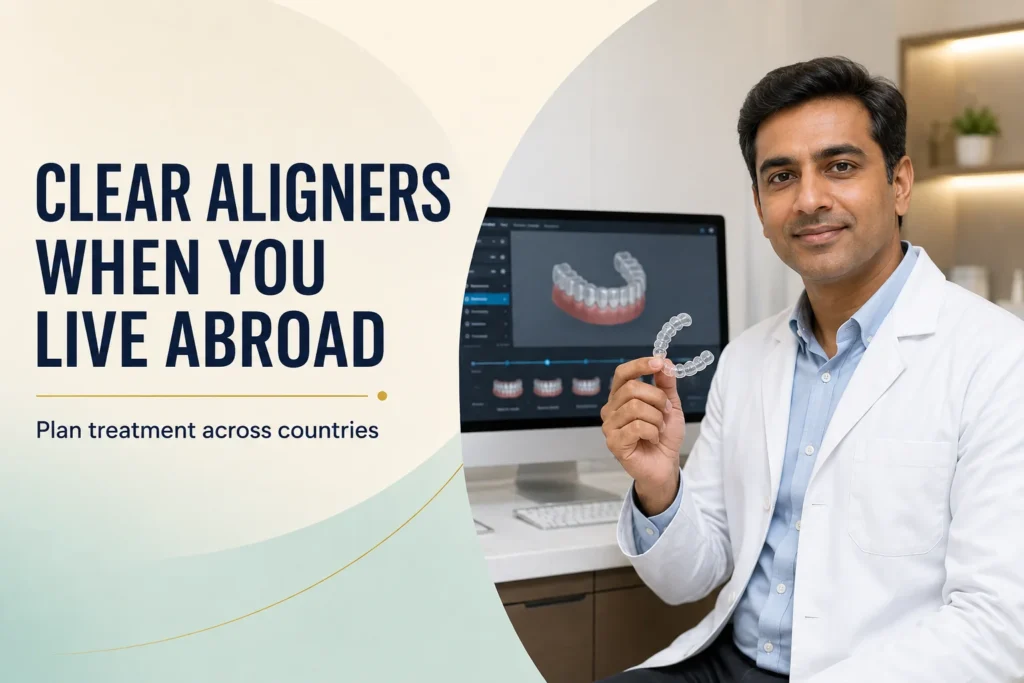
You have thought about straightening your teeth for years. You priced it where you live and decided against it. Now you are back in Gujarat every year or so, you have seen what treatment costs here, and the arithmetic suddenly looks different.
Then the obvious problem arrives: you cannot stay for a year.
This is a genuinely different question from every other treatment on this site, and it deserves a more careful answer than yes or no.
Clear aligner treatment cannot be completed during a visit to India, because it typically takes several months to two years. It can, however, be started here and continued abroad: the scan, treatment plan and first aligners on one trip, the series worn at home with remote review, and refinements or the next stage timed to your following visit. It suits people who return predictably, and it suits complex cases poorly.
Why is this different from other dental treatment?
Most dentistry is a repair. A filling, a crown, an extraction: something is done to a tooth, and once it is done it is done.
Orthodontic treatment is not a repair, it is a process. Teeth are moved gradually through bone, which remodels around them as they go. The movement happens continuously over months, and it depends on wearing the appliance consistently rather than on any single appointment.
That changes what “having treatment in India” even means. For a crown, the question is whether the appointments fit your trip. For aligners, the trip is not the treatment. The trip is where the treatment is set up and where it is periodically checked.
Which is precisely why it can work across borders, where a crown cannot be done half in one country and half in another.
How long does aligner treatment actually take?
Long enough that no visit covers it, and it is worth being honest about the range rather than quoting a best case.
For context on orthodontic treatment generally, the NHS notes that fixed braces are typically worn for one to two years, with adjustment appointments every six to eight weeks, and that a retainer is needed afterwards to stop teeth moving back to their original position.
Aligner treatment varies with the case. A mild alignment issue may take a matter of months. A case involving significant crowding or bite correction can run comparably to fixed braces or longer. Anyone quoting you a duration before seeing a scan is guessing, and the honest answer at that stage is a range with the reasons it might sit at either end.
The number that actually matters for you is not the total duration. It is how long you can go between in-person appointments without treatment stalling. That is the question to ask, and it is rarely the one people ask.
How would treatment across two countries work?
The model depends on aligner treatment being planned digitally up front. The whole series is designed from a single scan, which is what makes it portable in a way fixed braces are not.
Visit one, in India: setting up
- Clinical examination, X-rays and a digital scan of your teeth.
- A treatment plan built from that scan, showing the projected sequence of movements and roughly how many aligners it will take.
- Attachments bonded to the teeth where the plan requires them. These are small tooth-coloured shapes that give the aligner something to grip.
- The first set of aligners fitted, with instructions and a wear schedule.
- You leave with a batch of aligners covering the coming months.
At home: the months in between
- Aligners are changed on schedule, usually every one to two weeks.
- Progress is reviewed remotely with photographs at agreed intervals.
- Additional aligner batches are shipped, or carried by family, or collected on a short visit, depending on what was agreed.
Visit two and beyond: checking and refining
- Progress compared against the plan.
- A new scan if teeth have not tracked as predicted, which is common and not a failure.
- Refinement aligners produced for the remaining movements.
- Attachments adjusted, added or removed.
At the end: retention
Attachments removed, final records taken, retainers made and fitted, and a long-term retention plan agreed that works where you actually live.
Who does this suit, and who should not do it?
This is the part that decides whether the idea is sensible for you specifically, and it is where an honest clinician will sometimes talk you out of it.
| Works well when | Works badly when |
|---|---|
| You visit India predictably, roughly once a year or more | Your visits are irregular or years apart |
| The case is mild to moderate | The case involves complex bite correction or significant crowding |
| You are reliable about wearing them 20 to 22 hours a day | You know you would not be consistent |
| You can be reached and will send photographs on schedule | You would rather not think about it between visits |
| You have a local dentist for routine care | You have no dental care at all where you live |
| You can bring a trip forward if progress needs it | Your travel is completely fixed |
If your case is complex, have it treated where you live. That is the honest answer even though it is not the one that wins us the patient. Complex orthodontics needs hands-on adjustment on a shorter cycle than international travel allows, and a compromised result is expensive in a way that has nothing to do with money.
What can go wrong, honestly?
Every article about aligners lists the benefits. Fewer list what actually causes problems, and for treatment run at distance the risks are specific.
- Teeth not tracking to plan. Common, and normally fixed with refinement aligners. At distance the risk is that it is noticed late, which is the entire reason remote reviews are scheduled rather than optional.
- Attachments coming off. They do sometimes. A local dentist can often re-bond one if they have the details, which is a question worth settling before you leave rather than after.
- Running out of aligners. Shipping is unreliable in both directions. Agree the supply plan in advance and keep a buffer.
- Inconsistent wear. The commonest cause of treatment taking longer than planned anywhere in the world. Nobody can supervise this for you.
- Losing a set. Ask what to do, because the answer is usually to go back a stage rather than skip forward, and skipping forward causes problems.
- Needing something unplanned. Occasionally treatment reveals a tooth that needs different intervention. Agree how that would be handled.
None of these is a reason not to do it. All of them are reasons to have the plan written down before you start.
What happens at the end, and why retainers matter most
This is the most under-discussed part of orthodontics generally, and it matters more for someone treated abroad.
Teeth move back. It is not a sign that treatment failed; it is what teeth do. The NHS is explicit that a retainer is needed after braces to stop teeth returning to their original position, and that how long it must be worn varies from person to person.
Retention is part of treatment, not an optional extra. Plan how retainers will be checked and replaced across countries before starting aligners in India.
The British Orthodontic Society advises that retainers should be worn for life to hold the result, with wear typically reducing over time rather than stopping: intensive wear in the first months after treatment, then nightly, then a reduced schedule agreed with your orthodontist.
In practice, retention is indefinite for most people, usually as a fixed wire behind the front teeth, a removable retainer worn at night, or both.
That has a specific consequence if you were treated in another country. A lifelong appliance needs a lifelong plan, and “come back to India if it breaks” is not one.
Setting up retention that survives the distance
- Ask for a spare set of removable retainers at the end of treatment. Replacing a lost retainer is far easier when a second already exists, and far harder when it requires a new scan on another continent.
- Get your final scan and records in digital form. With those, a replacement can often be produced without you being present.
- Identify a local dentist who will check the retainer at your routine appointments. This is a small ask and most will agree.
- Know what a debonded fixed retainer feels like, because a wire that has come away at one end can go unnoticed while teeth quietly move.
For someone living abroad this raises a practical question that should be answered before treatment starts, not after:
- Who checks the retainer, and how often?
- If a fixed retainer debonds, who re-bonds it where you live?
- If a removable retainer is lost or cracks, can a replacement be made from stored records without you flying back?
- Are your final records kept in a form another clinician can use?
Treatment that finishes beautifully and then relapses over three years because nobody planned retention has not really succeeded. Ask about the last stage before you commit to the first.
Is the cost difference the whole story?
Cost is usually what prompts the question, so it should be answered rather than sidestepped. It is also the place where this particular treatment differs from the others on this site.
For scale on what people compare against, orthodontic treatment for adults is generally not available on the NHS. NHS England places braces in Band 3, charged at £332.10 as of the March 2025 review, but adults over 18 usually have to pay privately, and private orthodontic treatment sits far above that band figure.
The honest caveat specific to aligners: on a treatment requiring several visits over one to two years, the saving has to be weighed against travel. If you were flying to India anyway, the arithmetic is strong. If you would be flying specifically for appointments, it weakens quickly.
This is the one treatment where the cost case can genuinely reverse. For a crown or an extraction, a single visit captures the whole saving. For orthodontics, the saving is spread across a treatment that needs periodic in-person attention, so it depends on travel you were doing anyway.
Work out how many visits your plan needs before comparing prices. Two clinics quoting similar figures can imply very different amounts of flying.
What to ask before starting
- Is my case suitable for treatment at this distance? Ask directly, and take a cautious answer seriously.
- How long between in-person appointments can I safely go?
- How are aligners supplied while I am abroad?
- How is progress reviewed remotely, and how often?
- What happens if teeth do not track to plan? Are refinements included, and how are they handled from abroad?
- What is the retention plan, and does it work where I live?
- What are the records I will hold? Scans and the treatment plan, in a form another orthodontist could use.
If you are considering fixed braces instead, our guide to the types of braces available in Vadodara covers the options, and what orthodontic treatment involves explains the process in general. Be aware that fixed braces need adjustment every six to eight weeks, which makes them a poor fit for treatment at distance.
For treatments that do complete inside a single visit, see what can realistically be finished in one trip. Our dental services page covers the full range.
Tell us how often you visit and send recent photographs of your teeth, and we can tell you honestly whether this is a sensible plan for your case or whether you would be better treated where you live.