

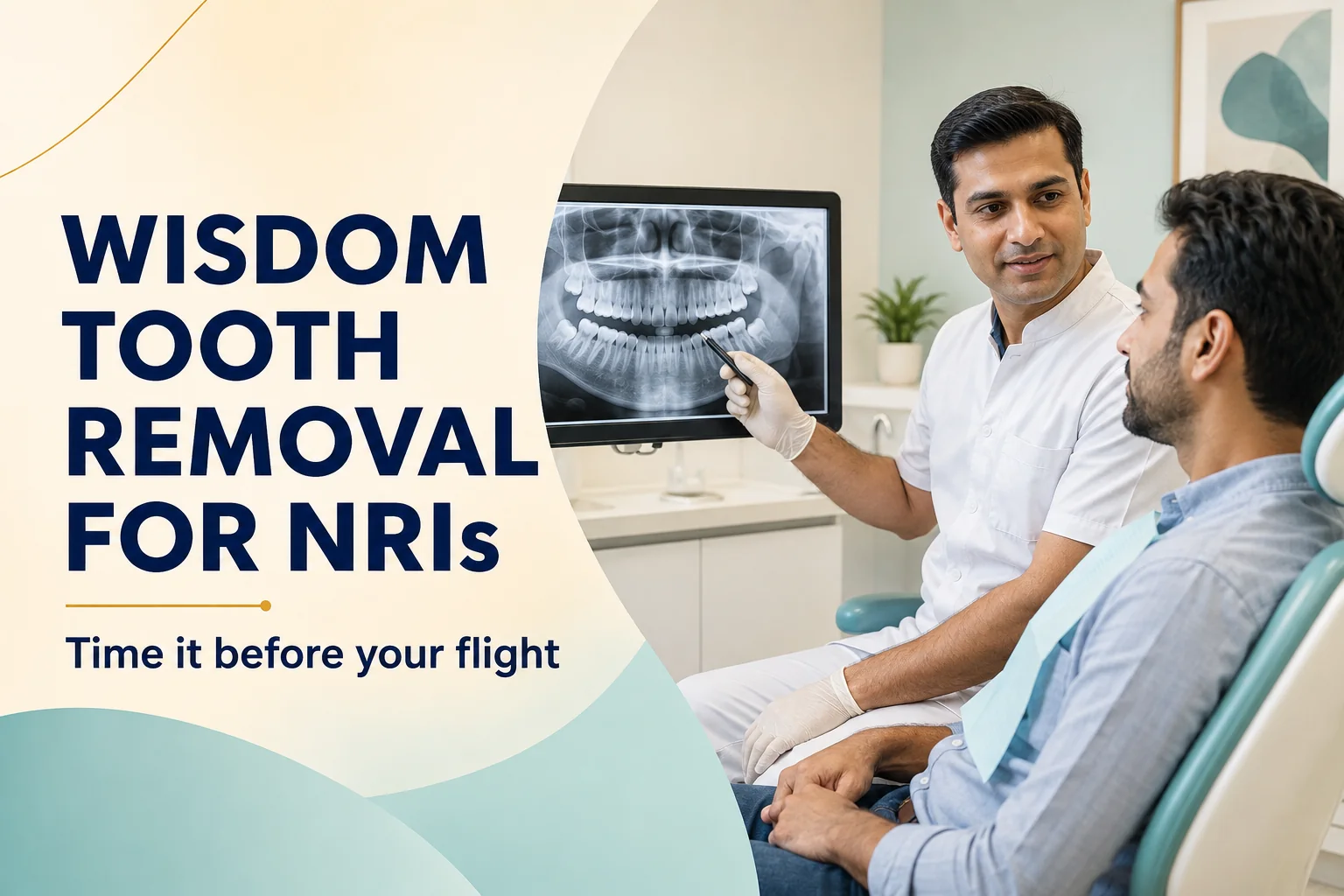
It started as a dull ache behind the back molar about three years ago. Your dentist abroad mentioned it needed to come out, quoted a number that made you blink, and you decided it was manageable. It flares up every few months, you take something for it, and it settles.
Then you book a trip home, and it occurs to you that this is the moment.
It usually is, and this is one of the few treatments that genuinely finishes inside a single visit. The thing worth planning carefully is not the appointment. It is the ten days afterwards.
Wisdom tooth removal can be completed comfortably during a visit to India, because the procedure takes under forty minutes and needs no second stage. The part that needs planning is recovery: schedule the extraction in the first week of your trip, and leave seven to ten days before a long-haul flight, because the most common complication appears three to five days afterwards.
Why do so many NRIs get this done in India?
Wisdom teeth are the classic deferred procedure. They are rarely an emergency, which is precisely why they get postponed for years. Three things tend to line up on a trip home.
- It is not urgent, so it never gets scheduled. A problem that flares and settles never quite reaches the top of the list abroad.
- It genuinely completes in one visit. Unlike an implant, there is no healing phase that has to finish before a second stage can start.
- There is someone to look after you. Soft food, a lift home after the appointment, and nobody expecting you at a desk the next morning.
That last one is underrated. Recovery is considerably easier in a house where somebody else is making the khichdi.
What actually happens during the extraction?
An impacted wisdom tooth is one that does not have room to emerge fully, so it stays partly or completely below the gum. Impacted lower wisdom teeth are the most common reason extraction is recommended, and they are also the most involved to remove.
According to the NHS guidance on wisdom tooth removal, the procedure normally involves local anaesthetic, with sedation available for anxious patients. The dentist cuts the gum, widens the socket, removes the tooth whole or in sections, and places stitches if needed. The whole thing usually takes no more than 40 minutes, and patients go home the same day.
Removing a tooth in pieces sounds alarming and is entirely routine. It is often the gentler option, because it takes out less surrounding bone than lifting a large tooth whole.
How long does recovery really take?
This is where planning matters, and where most published advice is vague. Actual figures, from Guy’s and St Thomas’ NHS Foundation Trust:
| When | What is normal | What to do |
|---|---|---|
| Day 0 | Numbness for a few hours. Light bleeding in saliva. | Do not rinse at all today. Soft food. No hot drinks. |
| Days 1 to 2 | Swelling appears, usually within 48 hours. Pain building. | Start warm salt water rinses from day two, four times daily. |
| Days 2 to 3 | Pain typically peaks, then begins to ease. | Regular pain relief. Avoid exercise. |
| Days 3 to 5 | ⚠ The dry socket window. Pain that increases rather than decreases, with a bad taste or smell. | If pain is rising rather than settling, get seen. Do not wait. |
| Days 5 to 7 | Swelling normally resolves. Jaw stiffness easing. | Back to most normal food. |
| Up to 2 weeks | Dissolving stitches disappear on their own. Residual soreness possible. | No removal appointment needed for dissolving stitches. |
Most people are back to normal activity the next day after a local anaesthetic. The NHS notes that a general anaesthetic typically means two to four days off, and that pain and swelling can persist for up to two weeks in some cases.
How long should you leave before flying home?
This is the question nobody publishing on dental tourism seems to answer, and it is the one that decides whether your trip ends well.
Leave at least seven to ten days between a surgical extraction and a long-haul flight. Not because flying is dangerous after dental surgery, but because the window in which something might need attention falls squarely inside the first week.
Look at the timeline again. Dry socket develops three to five days after the extraction. It is the most common complication, it is more likely with impacted lower wisdom teeth, and it is straightforward to treat: the socket is cleaned and an antiseptic dressing placed. That is a ten minute appointment.
It is a ten minute appointment if you are still in the same city as the dentist who treated you. If you flew home on day four, it becomes finding an emergency appointment in another country, with a dentist who has no records of the procedure, at whatever that costs where you live.
The complication is minor. The logistics of having it in the wrong country are not.
When in your trip should you book it?
Best: days two to five of the visit
Not the day you land, because jet lag and a general sense of chaos make a poor start. From day two onwards you are settled, and everything that follows has room around it. On a three week trip this means the entire recovery, including the risk window, is well behind you before you fly.
Workable: up to about ten days before departure
Still comfortable. Pain will have peaked and passed, swelling resolved, and the dry socket window closed with time to spare.
Avoid: the final week
Particularly the final three to five days, which places your flight directly on top of the window in which a problem is most likely to appear. If your trip is short and this is unavoidable, say so before treatment starts so it can be part of the conversation rather than a surprise.
A short trip is not automatically a no
A straightforward, fully erupted upper wisdom tooth is a much simpler extraction than an impacted lower one, and recovers faster. If your visit is only ten days, it is still worth being examined. The answer may be that one tooth is easily done now and the other is better on your next visit.
Should all four come out at once?
A genuine decision with trade-offs both ways, and worth discussing rather than assuming.
| All four together | Two at a time | |
|---|---|---|
| Recovery periods | One | Two, spaced apart |
| Total appointments | Fewer | More |
| Eating | Harder. Both sides sore at once | Easier. One side always usable |
| Fits a short trip | Better | Needs a longer stay |
| Anaesthetic | Sedation or general more likely | Local usually sufficient |
For someone on a limited visit, doing all four in one appointment often makes sense despite the tougher few days, simply because there is only one trip. For someone who visits India regularly, splitting them is more comfortable. Neither is the right answer in general; both are right in the right circumstances.
What about the cost?
This is usually the reason the extraction was deferred abroad in the first place, so it deserves a straight answer rather than being skipped.
The honest position: the cost of removing a wisdom tooth depends entirely on what the X-ray shows, and any figure quoted before that is guesswork. A fully erupted upper wisdom tooth and a horizontally impacted lower one sitting against the nerve are different procedures with different times, different techniques and different costs. Two teeth in the same mouth can fall into different categories.
What is worth understanding is how the gap arises in the first place.
Note what that figure is. It is the subsidised NHS rate, and NHS dental appointments are difficult to obtain across much of the UK. Private extraction of an impacted wisdom tooth, which is what most people abroad are actually quoted, sits well above it, and surgical cases higher again.
The gap between that and Indian pricing comes from premises, salaries and overheads. It does not come from the procedure, which takes the same forty minutes and uses the same instruments wherever it is performed.
What we can tell you before you travel, without seeing you, is more useful than a number anyway:
- Whether the extraction looks straightforward or surgical, from your X-ray.
- How many appointments it needs, and how much recovery time to allow.
- Whether it fits your dates at all, and where in the trip to place it.
- Whether it needs doing now, or could reasonably wait.
Send the X-ray and you get specific answers to all four, and a cost with the examination rather than before it.
How should you prepare before you travel?
Send an X-ray before you fly
If you have had a recent panoramic X-ray abroad, send it ahead. Impaction type and the position of the tooth relative to the nerve are visible on it, and that determines how involved the extraction is and how much recovery time to allow. It also means the answer to “can this be done on my trip” arrives before you have committed to dates.
Tell us your medical history properly
Blood thinners, diabetes, heart conditions and bisphosphonate medication all change how an extraction is planned. So does anything you take regularly. This is not paperwork, it genuinely changes the approach.
Plan the first 48 hours
- Arrange a lift home from the appointment, particularly with sedation.
- Have soft food ready: dal, curd, khichdi, soup, ice cream. Nothing hot.
- Keep the day after clear. Not bed rest, but not a wedding either.
- Skip the gym for several days. Exercise is specifically discouraged early on.
Know what “normal” looks like before you leave
Most people who panic after an extraction are reacting to something entirely expected. Knowing the difference in advance saves an anxious international phone call, and more importantly it means you act quickly on the one thing that does need attention.
- Expected: swelling that peaks around day two, light bleeding in saliva for a day or so, jaw stiffness, bruising visible on the outside of the face, and a sore throat from keeping the mouth open.
- Worth a call: pain that rises after day three instead of easing, a bad taste or smell, or bleeding that does not stop after ten minutes of firm pressure.
Ask what happens if you need help after you leave
Establish a named contact and get your treatment record, including the X-rays, in digital form before you fly. Most post-extraction questions are resolved with a photograph and a conversation, provided you know who to send it to.
If you are weighing up several treatments on the same visit, our guide to what can realistically be finished in one trip sets out which procedures fit a two, three or four week stay and which need to be staged. For anything more involved, our dental services page covers the full range.
The most useful first step is a conversation before you fly. Send your X-rays and travel dates and we can tell you whether this fits your visit and where in it to place the appointment.